


Burnt Sienna
Burnt sienna is a warm, transparent red-brown made by roasting a natural iron earth. It is the most useful brown in watercolor and the other half of the classic gray.
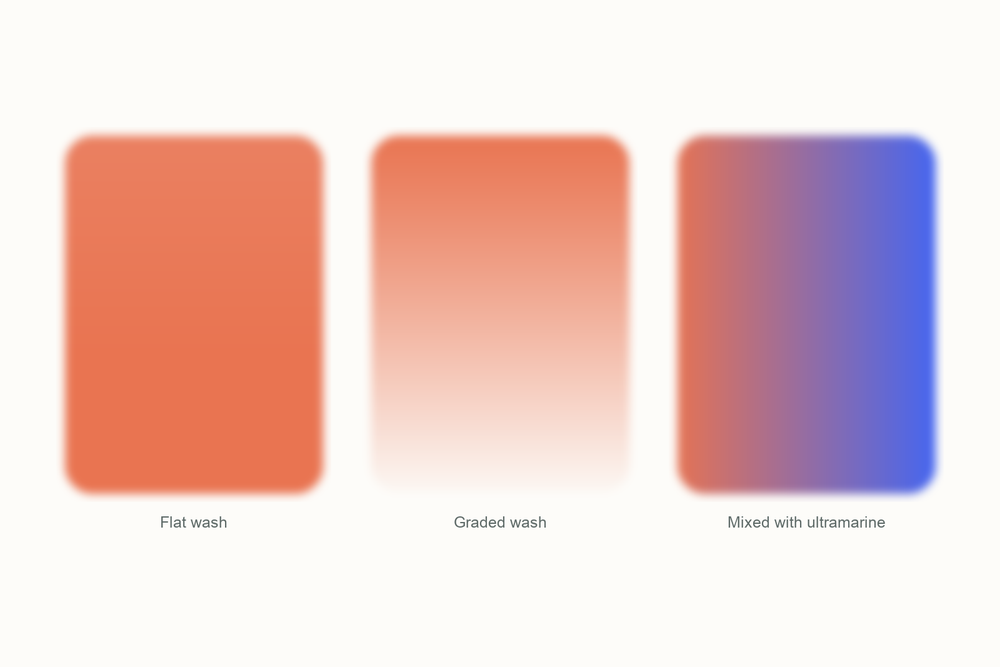
What color is burnt sienna?
| Hex | #E97451 |
| RGB | 233, 116, 81 |
| CMYK | 0, 50, 65, 9 |
| Warm or cool | Warm. Distinctly red-orange, with none of the green undertone you get in the umbers. |
| On the wheel | A red-orange pulled toward brown. It sits between orange and red-brown on the warm side, directly opposite the blues, which is why it mixes such good grays with them. |
The story of burnt sienna
Burnt sienna is dirt from a hillside in Tuscany, cooked.
The raw material is an iron-rich clay dug around Siena for centuries, yellow-brown in the ground. Roast it at a couple of hundred degrees and the iron changes state, the yellow goes out of it, and it turns the deep red-orange we know. Painters of the Sienese school were using local earths in the 1300s, and Renaissance workshops burned their own sienna in the studio, which is roughly as sophisticated as toasting bread.

The names raw sienna and burnt sienna only settled in during the 1700s, when the Siena quarries began supplying the paint trade properly. For two hundred years after that, sienna meant that specific Tuscan earth. Then the deposits ran low. By the early 20th century they were mostly exhausted, and today the pigment sold as burnt sienna comes from Sardinia, Sicily, Cyprus, the United States, or a factory. A lot of modern tubes are synthetic red iron oxide (PR101) with the old name on the label. It is a fine pigment. It is just not from Siena.
None of that changes why painters keep buying it. Burnt sienna is transparent, it is permanent, and it is warm without being garish. Mix it with almost any blue and you get a gray that looks like weather. That one trick has kept it on every palette since the Renaissance, and it is why the kit carries a red earth of its own, Venetian Red, which is its brighter cousin.
Pigment facts
| Colour Index | PBr7, a natural iron oxide made by calcining raw sienna. Some brands use PR101, a synthetic red iron oxide, which is more opaque and a little brighter. Check the tube. |
| Transparency | Transparent. Natural PBr7 is one of the most transparent earth colors, which is why it glazes so well. |
| Lightfastness | Excellent. Iron oxides do not fade. |
| Granulation | Light to moderate. Natural burnt sienna granulates gently in a wash; synthetic PR101 versions stay smoother. |
| Staining | Low to moderate. It lifts easily while damp. |
| Toxicity | Non-toxic. It is roasted earth. |
These describe the pigment in general. Every brand's tube behaves a little differently, so test yours on scrap paper.
How to mix burnt sienna
You can mix a burnt sienna from a red, a yellow and a touch of blue, but honestly it is one of the few colors worth owning rather than mixing, because the transparent version is hard to fake. What matters more is what you mix it into.
Ultramarine and burnt sienna is the most useful pairing in watercolor. Lean blue and you get a cool gray for shadows and skies. Lean brown and you get a warm gray for stone, wood and wet pavement. Equal parts gives a neutral that looks like nothing and makes everything around it look better.
| Mix | Recipe | Best for |
|---|---|---|
| Burnt sienna from scratch | Sunset Orange with a touch of Venetian Red, then a speck of Forest Green to dull it | When you have run out and need it now |
| Cool gray | 2 parts ultramarine, 1 part burnt sienna | Shadows, storm skies, distant hills |
| Warm gray | 1 part ultramarine, 2 parts burnt sienna | Rocks, tree bark, wet streets, old walls |
| Rich dark | Burnt sienna with Twilight Indigo, heavy on the indigo | Deep shadows with warmth in them, instead of black |
| Skin warmth | Burnt sienna with a lot of water and a touch of Lemon Yellow | Cheeks, noses, sunlit skin, terracotta pots |
Closest mix from the Tobio's kit
Venetian Red and Sunset Orange, roughly one to one, then the smallest speck of Forest Green to knock the brightness down. Venetian Red on its own is too red and Sunset Orange too clean; together with a hint of green they land right on burnt sienna. Keep it wet, because this mix goes muddy if you overwork it.
The 12-color kit does not include a tube of burnt sienna, so this is how I get there with what is in the palette. Running low on a color? The 12 paint refills drop straight into the wells.
Using burnt sienna in watercolor
Burnt sienna is the color I reach for when I do not know what color something is. Bricks, tree trunks, hair, rust, autumn leaves, dry grass, a dog: start with burnt sienna and adjust. It is warm enough to feel alive and brown enough to stay out of the way.
Because it is transparent, it glazes beautifully. A thin wash of burnt sienna over a dried blue sky turns it into evening. Over a green, it turns summer into September. Over a gray, it makes stone look sun-warmed.
Wet-on-wet, drop it into a wet ultramarine wash and watch the two separate into granulating clouds. That is the entire technique behind half the stormy-sky paintings you have ever admired.
Two habits worth keeping. Check whether your tube is PBr7 or PR101, because the synthetic one is more opaque and will cover where you wanted a glaze. And keep it away from your yellows on the palette; a little burnt sienna turns a bright yellow into mustard faster than you would believe.
Everything I use on this page is the Tobio's Watercolor Kit: twelve colors chosen to mix, a walnut palette, cotton paper, and a water brush. Want to see how any two of the colors blend before you commit? Try the interactive color mixing chart.
Get the kitBurnt sienna vs burnt umber (and raw sienna)
Burnt umber is the one people confuse it with, and they are not close. Umber contains manganese as well as iron, which makes it darker, cooler and slightly green. Burnt sienna is pure iron, so it stays red-orange and bright. Side by side, umber looks like chocolate and sienna looks like a terracotta pot. Use umber when you want a shadow to recede and sienna when you want a surface to glow.
Raw sienna is the same earth before roasting: yellower, more golden, softer. It makes lovely warm skies and sand. Burnt sienna is what happens when you heat it, and the extra red is why it mixes such clean grays with blue, while raw sienna tends to drift toward green.
Terracotta, which people also ask about, is not a pigment at all. It is a color name for fired clay, and burnt sienna is the closest single tube to it.
Questions people ask
What color is burnt sienna?
What colors make burnt sienna?
What is the difference between burnt sienna and burnt umber?
Is burnt sienna warm or cool?
Is burnt sienna transparent?
What do burnt sienna and ultramarine make?
Sources
More color stories
