


Vermilion
Vermilion is a warm, orange-leaning scarlet made for most of history from cinnabar, the ore of mercury. Genuine vermilion is mercury sulfide, PR106; the tube sold under the name today is usually a mercury-free imitation.
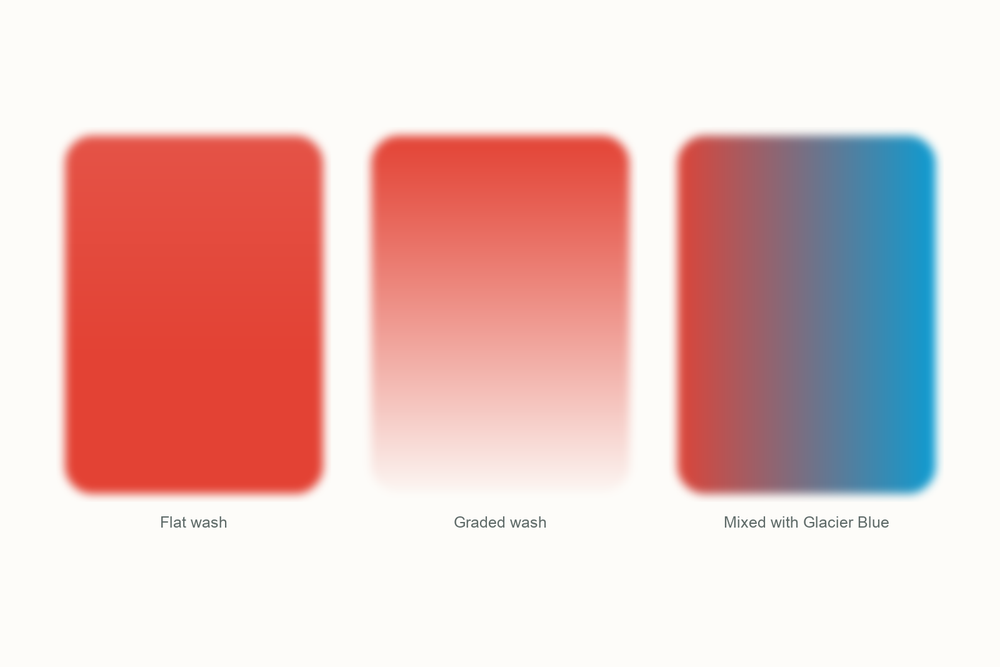
What color is vermilion?
| Hex | #E34234 |
| RGB | 227, 66, 52 |
| CMYK | 0, 71, 77, 11 |
| Warm or cool | Warm. It leans orange rather than blue, which is why it makes clean oranges and dull purples. |
| On the wheel | A red pulled toward orange. It sits between true red and orange on the warm side of the wheel, opposite the blue-greens. |
The story of vermilion
Vermilion is mercury ore ground into powder, and for two thousand years painters decided the color was worth the risk.
The ore is cinnabar, mercury sulfide. Even the name is borrowed, from vermiculus, little worm, the Latin for the kermes insect that gave a red dye. Rome's main supply was Almaden in Spain, a mine worked from Roman times into the 2000s, where a term was regarded as close to a death sentence. Pliny says some ten thousand Roman pounds a year went to Rome under seal, the price fixed by law at seventy sesterces a pound. It went onto the walls at Pompeii, and Pliny grumbled that painters stole it by washing their brushes too often and keeping the water. I have washed a great many brushes and never once thought of it as a business plan.

Han dynasty craftsmen were coloring lacquer with powdered cinnabar by about the third century BC. Lacquer is the sap of a tree related to poison ivy, so this was a poison in a poison. Around the 8th century Chinese chemists learned to make vermilion from mercury and sulfur, it got cheaper, and lacquerware took off: coats of red lacquer, each left to harden before the next, sometimes a few hundred of them, then carved. Europe saw the exports in the 1600s and 1700s and called the color Chinese red. It is also the red of the seal paste stamped on Chinese paintings.

Making it by hand is old alchemy. The Persian alchemist Jabir ibn Hayyan wrote the process down in the early 800s: mix mercury with sulfur, heat the black mess in a flask, break the flask, grind. It comes out almost black and turns red as you grind. Cennino Cennini, writing his handbook for painters in the 1390s, said that ground every day for twenty years it would keep getting better. He also told his readers not to bother: buy it from the apothecary, in solid lumps, because the powder was usually cut with red lead or crushed brick. Sounds familiar.
Titian used it for the robes in his Assumption of the Virgin (1516 to 1518) and for Ariadne's sash in Bacchus and Ariadne. It has one famous flaw: it can darken to a purplish gray or to black. Cennini already knew: on a wall, standing in the air, it turns black. The bridle on a horse in Uccello's Battle of San Romano has gone from red to dark brown, and newer work points to light and chlorine breaking the pigment down into finely divided mercury, which is black.
Cost and mercury finished it off. Cadmium red arrived in the 20th century, similar in color and opacity and more lightfast, and vermilion was almost entirely replaced. The genuine article, PR106, is still sold, mostly made in China, and is still a mercury compound. Most tubes called vermilion today are hues, a modern red with no mercury in it. I do not own the real thing and I do not miss it. What I want from vermilion is the temperature, a scarlet leaning toward orange, and a good hue gives me that without going black on me.
Pigment facts
| Colour Index | PR106, mercuric sulfide (HgS), the same compound as the mineral cinnabar. Most tubes labeled vermilion today are mercury-free hues; if the label does not say PR106, it is not genuine. |
| Transparency | Opaque. Genuine vermilion is dense and covers well, with more hiding power than cadmium red. Hue versions are mostly semi-opaque. |
| Lightfastness | Good on its own, but genuine vermilion can darken to purplish gray or black with time, especially on walls in open air. Mercury-free hues do not do this. |
| Granulation | Genuine vermilion is heavy, about eight times the weight of water, so it drops out of a wash fast and settles into the paper. Hue versions are smooth. |
| Staining | Low for genuine vermilion, which sits on the surface and lifts. Hue versions depend on the pigment inside; modern organic reds tend to stain. |
| Toxicity | Genuine vermilion is a mercury compound and toxic: do not eat it, breathe the dry pigment or sand a painted surface. Mercury-free hues are as safe as any modern watercolor; PR108 on the label means cadmium, another toxic metal, so no eating, dust or spraying. |
These describe the pigment in general. Every brand's tube behaves a little differently, so test yours on scrap paper.
How to mix vermilion
You cannot mix a true vermilion, because mixtures are always duller than the pigment, but you can get close. Start with a warm red and push it toward orange with a little yellow until it stops looking like a tomato and starts looking like a poppy. If it drifts pink, your red is too cool.
One pairing matters more than the rest: vermilion and a blue-green. They sit opposite each other on the wheel, so a touch of one knocks the other back, and vermilion with a little blue-green gives you brick, then rust, then the warm gray of a terracotta pot in shade, the territory where burnt sienna lives.
| Mix | Recipe | Best for |
|---|---|---|
| Vermilion from scratch | A warm red with a little orange, about three to one | When the palette has no scarlet |
| Roman wall red | Vermilion knocked back with a touch of burnt sienna | Terracotta, brick, roof tiles |
| Shadow side of red | Vermilion with a little blue-green, about four to one | A poppy's dark side, a red door in shade |
| Sunset orange | Vermilion and a warm yellow, half and half | Sunsets, marigolds, autumn leaves |
| Warm gray | Vermilion and blue-green in equal parts, then plenty of water | Weathered wood, warm stone |
Closest mix from the Tobio's kit
Sunset Orange and Poppy Bloom, about two to one. Poppy Bloom is a cool red, so the orange does most of the work. Too much like a traffic cone, add Poppy Bloom; going pink, add orange. For the shadow side, a speck of Glacier Blue takes it straight to brick. Test on scrap first; it dries a step lighter than it looks wet.
The 12-color kit does not include a tube of vermilion, so this is how I get there with what is in the palette. Running low on a color? The 12 paint refills drop straight into the wells.
Using vermilion in watercolor
Use vermilion where you want heat rather than depth: a red door, a poppy field, a fishing boat. It reads as sunlight hitting something red, where a crimson reads as the same object in shade.
My favorite way to put it down is dry brush over a dry wash: drag a nearly dry brush sideways across rough paper and you get broken scarlet like old paint on a wooden boat. Wet-on-wet it spreads fast and fades to coral at the edges.
Greens are its friends. Vermilion next to a mid green, Green Gold in the kit, makes both look more like themselves. Next to purple it goes flat, and mixed into purple it makes mud.
Here is the thing I learned the hard way: a little goes a very long way. One dab tints a whole puddle, and once it is in a mix you cannot get it out. Add it last, in small amounts, and never rinse a vermilion brush in your sky water. Pliny's painters kept their wash water. You should not.
Everything I use on this page is the Tobio's Watercolor Kit: twelve colors chosen to mix, a walnut palette, cotton paper, and a water brush. Want to see how any two of the colors blend before you commit? Try the interactive color mixing chart.
Get the kitVermilion vs cadmium red (and crimson)
Cadmium red is the color that put vermilion out of work, and the light version is a close match: warm, opaque, scarlet. Cadmium red does not darken and is more lightfast; genuine vermilion covers a little better and has a glow in a wet wash the cadmium never quite gets.
Crimson is the other direction entirely. It is a cool red with blue in it, and it makes purples. Vermilion is a hot red with orange in it, and it makes oranges. On paper the vermilion jumps forward and the crimson sinks back: vermilion for the lit side of a red thing, crimson for the shade.
If vermilion is a poppy at noon, crimson is the same poppy at dusk, and cadmium red is a very good photograph of it.
Questions people ask
What color is vermilion?
Is vermilion warm or cool?
What colors make vermilion?
Is vermilion toxic?
What is the difference between vermilion and cinnabar?
Why does vermilion turn black?
Sources
More color stories
