


Yellow Ochre
Yellow ochre is a soft, earthy yellow made from iron-stained clay, one of the oldest pigments humans have used. It is opaque, permanent and dull in the best way, and it belongs on every palette.
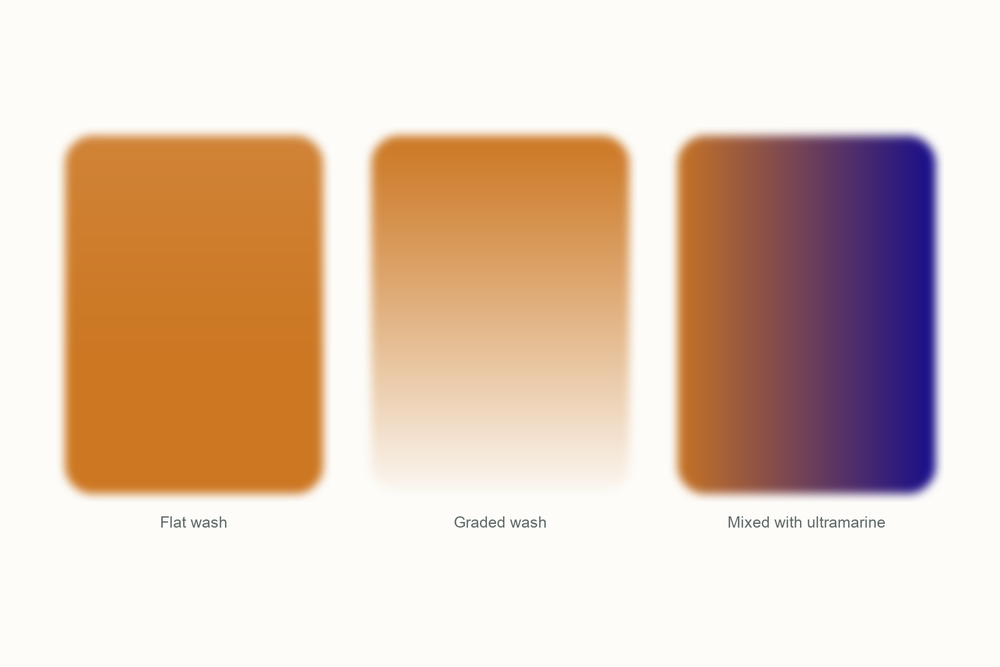
What color is yellow ochre?
| Hex | #CC7722 |
| RGB | 204, 119, 34 |
| CMYK | 0, 42, 83, 20 |
| Warm or cool | Warm. It leans orange rather than green, which is why it flatters skin and makes such quiet greens with blue. |
| On the wheel | A yellow pulled toward orange, then dulled most of the way to brown. It sits on the warm side of the wheel, well in from the rim where the clean yellows live. |
The story of yellow ochre
Yellow ochre is dirt, and dirt is the oldest paint there is.
Dirt, in this case, means clay stained by iron. When the iron is a hydrated oxide, the mineral goethite, the clay is yellow; when it is hematite, the clay is red. Heat the yellow and it loses its water and turns red, which is how much of the world's red ochre got made. The name comes from the Greek okhros, meaning pale. Pale is generous.
People were grinding it long before anyone painted a picture. At Blombos Cave on the South African coast, archaeologists found a paint-making kit roughly 100,000 years old: ochre, grindstones, hammerstones, and two abalone shells used to mix and store a liquid pigment. Nobody knows what the paint was for. The horse at Lascaux is colored with yellow ochre and is about 17,000 years old; the bison at Altamira were done in ochre and charcoal in the same broad era. Lascaux was found by a teenager and his dog in 1940 and closed again in 1963, when the breath of twelve hundred visitors a day started damaging what seventeen thousand years had not.
Egypt made it a rule. In tomb paintings men were shown with brown faces and women with yellow ones, and yellow stood for gold, which the Egyptians considered imperishable. The Romans used it the same way, for gold and for skin, and it is all over the walls of Pompeii. Any old painting with a believable face in it probably has an ochre in there somewhere.

Industry came late. Roussillon, in the Vaucluse in southern France, sits on cliffs of yellow and red clay, and in the 1780s a local man named Jean-Etienne Astier worked out how to turn them into a product: dig clay that is ten to twenty percent ochre, wash the ochre free of the sand, settle it in basins, drain, dry, cut into bricks, crush, sift, sort by color. Vaucluse ochre went all over the world and thousands of people worked the quarries and factories, until the Russian Revolution and the Spanish Civil War took away two of its biggest markets. The Roussillon quarries had already shut by 1930; you can walk the old workings today on the Sentier des Ocres.

What you buy today is mostly a factory version. Synthetic yellow iron oxide, sold as Mars yellow, has been made since the early 1920s, and by 2002 not one supplier of natural iron oxide pigment was registered with the Colour Index. Here is what has not changed. Yellow ochre is the dull yellow that makes clean yellows look clean. Put a lemon yellow next to it and the lemon sings; use it alone and it looks like a highlighter pen. Every palette has an ochre for the same reason every kitchen has salt.
Pigment facts
| Colour Index | PY43, natural hydrated iron oxide, mostly the mineral goethite, in clay. Its factory-made twin is PY42, Mars yellow; as natural deposits run down, some tubes sold as yellow ochre are PY42. |
| Transparency | Opaque to semi-opaque. It has real hiding power, so it covers rather than glows: a body color, not a glaze. |
| Lightfastness | Excellent. The yellow horse at Lascaux has held its color for about 17,000 years. |
| Granulation | Light. Natural PY43 settles into a faint grain on rough paper in my washes; synthetic PY42 dries flat and even. |
| Staining | Low. It lifts easily while damp and reasonably well once dry, a forgiving color to make mistakes with. |
| Toxicity | Non-toxic. It is clay and rust. The only sensible caution is dry pigment powder, which you should not breathe. |
These describe the pigment in general. Every brand's tube behaves a little differently, so test yours on scrap paper.
How to mix yellow ochre
You can get close by dirtying a bright yellow with a touch of red and a speck of black; the recipe below does exactly that. What you cannot fake is the body. Real ochre is opaque and a little gritty, and a mixed version is cleaner and more transparent: fine for a wash, wrong for a stone wall.
Ultramarine is the partner that matters. Together they make the green of actual landscapes, olive and gray-green, a hedge in August rather than a cartoon hedge. Lean yellow for sunlit grass, lean blue for shadow, and add a little burnt sienna when the ground needs to look like ground.
| Mix | Recipe | Best for |
|---|---|---|
| Yellow ochre from scratch | Lemon Yellow with a little Venetian Red, four to one, and a pinhead of Ivory Black | When you have run out mid-wall |
| Landscape green | Yellow ochre and ultramarine, two to one | Grass, hedges, distant trees that have to look real |
| Shadow green | Yellow ochre and ultramarine, one to two | The dark side of a bush, moss, water in shade |
| Warm skin | Yellow ochre with a touch of a red earth, then plenty of water | Faces, hands, sunlit skin; lean red for cheeks |
| Sand and stone | Yellow ochre with a touch of Payne's gray | Beaches, dry walls, paths, plaster |
Closest mix from the Tobio's kit
Lemon Yellow with a little Venetian Red, roughly four to one, then a pinhead of Ivory Black to take the shine off. Lemon Yellow alone is too clean and too bright; the red warms it and the black dulls it into something that looks dug up rather than bottled. Go easy on the black, because a second pinhead makes olive. Add water until it is the color of a manila envelope. Test on scrap first.
The 12-color kit does not include a tube of yellow ochre, so this is how I get there with what is in the palette. Running low on a color? The 12 paint refills drop straight into the wells.
Using yellow ochre in watercolor
Use it for anything the sun has been at: dry grass, sand, plaster, a path, the lit side of a stone wall, the warm side of a face. It is the color of most of the ground in most of the world, which is why landscape painters go through so much of it.
It is the best first wash I know. Wet the paper, float a thin yellow ochre over the whole sheet and let it dry before you start. Everything you put on top looks warmer and more settled, and the white paper stops shouting.
Pair it with ultramarine for greens and grays, with burnt sienna for autumn and brick, and with a cool red for skin. Keep the mixes loose; scrub it and it goes chalky and sits on the paper like dust.
One thing I learned the hard way: yellow ochre goes underneath, never on top. A wash of it over a delicate transparent color buries that color under a chalky film. Lay the ochre first and let the transparent colors go over it.
Everything I use on this page is the Tobio's Watercolor Kit: twelve colors chosen to mix, a walnut palette, cotton paper, and a water brush. Want to see how any two of the colors blend before you commit? Try the interactive color mixing chart.
Get the kitYellow ochre vs raw sienna (and Mars yellow)
Raw sienna is the one people muddle it with; they are cousins rather than twins. Both are iron earths, but the sienna carries about five percent manganese oxide, which makes it darker and browner, and in a wash it lets the paper through where the ochre covers. Ochre is the covering yellow; raw sienna is the glowing one.
Mars yellow is the synthetic version of the same chemistry, PY42 instead of PY43, made in factories since the 1920s. It is cleaner, smoother and a touch brighter, and plenty of tubes labeled yellow ochre are Mars yellow inside. Not worse. Just tidier.
If you can only have one, take yellow ochre: it does the covering jobs and mixes the greens. Add raw sienna when you start caring about skies and skin. If yellow ochre is a plaster wall, raw sienna is a window with afternoon light in it.
Questions people ask
What color is yellow ochre?
Is yellow ochre warm or cool?
What colors make yellow ochre?
Is yellow ochre toxic?
Yellow ochre vs raw sienna, what is the difference?
Why is yellow ochre on every palette?
Sources
- Ochre, Wikipedia (chemistry, prehistory, the Vaucluse industry)
- Blombos Cave, Wikipedia (the 100,000-year-old ochre workshop)
- Roussillon, Vaucluse, Wikipedia (the quarries, 1780s to 1930)
- Queen Nefertari Playing Senet, Nina de Garis Davies, The Metropolitan Museum of Art
- Village on a River, Jan Jansz den Uyl, The Cleveland Museum of Art
More color stories
