


Umber
Umber is a natural brown earth colored by iron oxide and darkened by manganese. Raw umber is a cool, greenish brown; burnt umber is the same earth roasted until it turns a deep, warm red-brown.
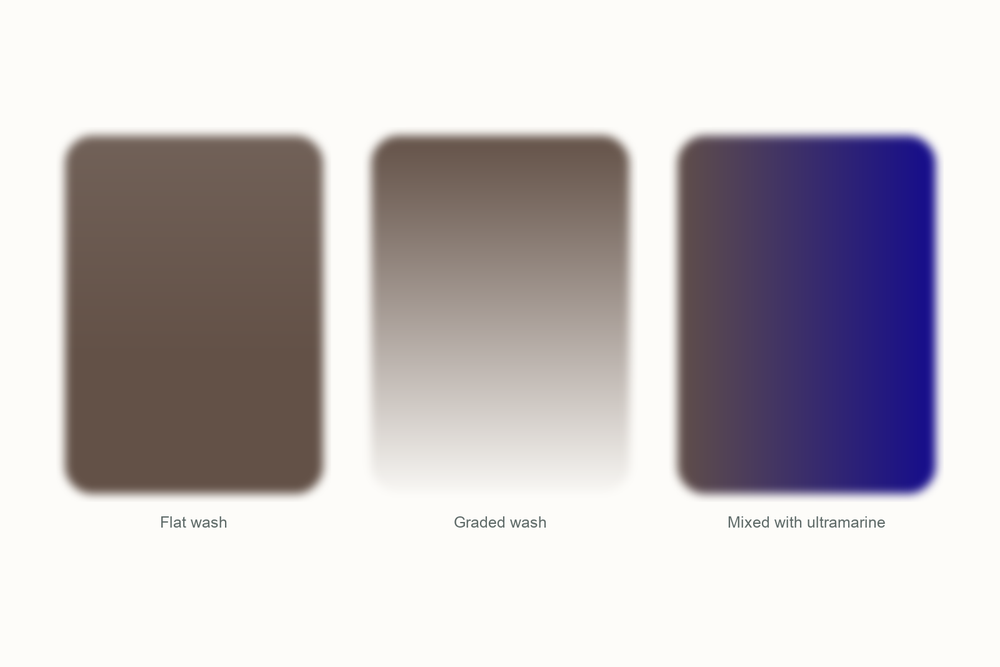
What color is umber?
| Hex | #635147 |
| RGB | 99, 81, 71 |
| CMYK | 0, 18, 28, 61 |
| Warm or cool | Raw umber is the coolest brown on most palettes, with a faint green cast from its manganese. Burnt umber is warm. Same pit, same mineral; roasting is the only difference. |
| On the wheel | A very dark, very dull orange, like every brown. Raw umber leans toward yellow-green, burnt umber toward red. Both sit opposite the blues, which is why they make such clean grays together. |
The story of umber
Umber is one of the oldest pigments on earth, and nobody can agree on what its name means.
Some say it is named for Umbria, the region in central Italy. Others say it comes from the Latin umbra, shadow, by way of the Italian terra d'ombra, shadow earth. I want the second one to be true, because shadow is exactly what the color does. Chemically it is a clay stained with iron oxide, like ochre and sienna, plus one thing they have far less of: manganese, 5 to 20 percent of it against about 5 percent in raw sienna. That pushes it from tan to a proper brown and gives raw umber its faint green cast. The biggest deposits are on Cyprus, which is still the main source.

Painters in Europe took to it in the late 1400s, and by the 1600s it was doing the heavy lifting on the dark side of the palette. Caravaggio and Rembrandt both kept it alongside sienna and yellow ochre, and in one of Rembrandt's late portraits in London the priming itself turned out to be lead white tinted with umber. Vermeer used it in the wall behind the sleeping woman in the Met's A Maid Asleep. It was cheap, and in oil it dries fast, because manganese is a drier, the same metal that goes into the drying agents sold for house paint.

Not everyone was a fan. Edward Norgate, an English painter of the 1600s, called it "a foul and greasy color." Antonio Palomino in Spain called it "very false," and the Belgian Jan Blockx said it "should not appear on the palette of the conscientious painter." The Impressionists dropped it too, mixing their browns from the new synthetic colors. Umber outlasted all of them. It is still in nearly every paint range, usually twice.
Raw umber is the earth as dug, washed and ground: cool, greenish, a little dusty, like dried mud in shade. Burnt umber is the same powder roasted. The heat drives water out of the iron oxides and turns part of them into hematite, the red iron oxide, so the color warms, reddens and darkens until it is nearly black in the pan. The name was first recorded in English in 1650. Most of what you buy is still the natural earth, though some makers now use synthetic oxides.
Here is the part that matters if you paint in watercolor. Umber is the best dark I know for shadows: transparent enough to glaze over a finished passage without killing it, and it lifts if you go too far. Burnt umber with ultramarine makes a black that looks like a shadow instead of a hole. I reach for it far more often than black.
Pigment facts
| Colour Index | PBr7, natural iron oxide, the same code as sienna. The difference is manganese: 5 to 20 percent manganese oxides in umber against about 5 percent in raw sienna. Burnt umber is the raw earth calcined. |
| Transparency | Semi-transparent to semi-opaque, depending on the deposit. Raw umber is usually the more transparent; burnt umber covers more. |
| Lightfastness | Excellent. Umber is about as permanent as a pigment gets; only poor grades with plant matter in them ever faded. |
| Granulation | Moderate. Natural umbers settle into the grain of the paper in a wet wash, burnt more visibly than raw; synthetic versions dry smoother. |
| Staining | Low. Both umbers lift well from most papers, which makes them forgiving colors to learn on. |
| Toxicity | Non-toxic. Iron and manganese oxides, insoluble in water. Avoid breathing the dry powder if you grind your own. |
These describe the pigment in general. Every brand's tube behaves a little differently, so test yours on scrap paper.
How to mix umber
You can get close to both umbers without buying them. Burnt sienna with a little ultramarine, about four to one, lands on burnt umber; the blue knocks the orange out of the sienna. For raw umber, start with yellow ochre and gray it down with a touch of black until it looks like dried mud.
The pairing that matters is burnt umber and ultramarine. Equal parts give a soft black with life in it; tip it toward the blue for a cool shadow, toward the brown for a warm one. That one pair covers most of the darks in a landscape, and it is the same idea as Payne's gray, done by hand.
| Mix | Recipe | Best for |
|---|---|---|
| Burnt umber from scratch | Burnt sienna with a little ultramarine, about four to one | When the palette has no umber |
| Raw umber from scratch | Yellow ochre grayed with a touch of black, about three to one | Cool shadows on white walls, dried mud |
| Living black | Burnt umber and ultramarine, half and half | Doorways, silhouettes, the pupil of an eye |
| Warm stone gray | Raw umber with a speck of ultramarine and plenty of water | Stone, pavement, overcast skies |
| Bark and branches | Both umbers together, a touch of ultramarine on the shadow side | Trunks that read as wood, not chocolate |
| Sepia | Burnt umber with a little black, about four to one | Tonal studies, line and wash |
Closest mix from the Tobio's kit
For burnt umber, start with Venetian Red and add Forest Green a speck at a time until the red gives up and turns brown; a touch of Ivory Black takes it darker. For raw umber, mix Lemon Yellow into Ivory Black until you have a dull olive, then warm it with a little Venetian Red until it reads as brown. Test on scrap first; the green and the black both work faster than you expect.
The 12-color kit does not include a tube of umber, so this is how I get there with what is in the palette. Running low on a color? The 12 paint refills drop straight into the wells.
Using umber in watercolor
Use umber for anything brown in real life and for most things in shadow: tree trunks, soil, old wood, the inside of a barn door. Raw umber is the one for shadows on pale things, because its green cast keeps them from turning muddy orange. Burnt umber is for anything warm.
Glazing is where it earns its place. Let a wash dry completely, then float a thin, watery burnt umber over the part that should sit back. The first layer shows through, the value drops, and the color stays alive. I still do this when a painting looks flat and I cannot tell why.
It pairs with almost everything. With ultramarine it makes every gray and black you need; with yellow ochre, every autumn field.
One thing I learned the hard way: burnt umber at full strength granulates, so on rough paper a flat wash will not be flat. It dries speckled, like sand at the bottom of a glass. Lovely on a tree trunk, a disaster on a smooth tabletop. Thin it down when you need a wash without texture.
Everything I use on this page is the Tobio's Watercolor Kit: twelve colors chosen to mix, a walnut palette, cotton paper, and a water brush. Want to see how any two of the colors blend before you commit? Try the interactive color mixing chart.
Get the kitUmber vs burnt sienna (and Van Dyke brown)
Burnt sienna is the color people mix up with burnt umber most, fairly enough: both are roasted iron earths sold under the same Colour Index code. The difference is manganese. Sienna has a little and umber has a lot, so burnt sienna dries to a bright orange-brown and burnt umber to the color of strong coffee. Sienna is also the more transparent, better for glazing warm light and worse for deep shadow.
Van Dyke brown is the other one. The original was Cassel earth, dug from peat and soil around Kassel and Cologne, and it fades; modern versions are mixtures of a black and an iron oxide. It runs cooler and more transparent than burnt umber, with a slight purple cast in thin washes. A beautiful glaze and a poor foundation.
If burnt sienna is a brick wall in the afternoon sun, burnt umber is the same wall after the sun has gone, and raw umber is the puddle at the bottom of it.
Questions people ask
What color is umber?
Is umber warm or cool?
What colors make umber?
Is umber toxic?
What is the difference between raw umber and burnt umber?
Burnt umber vs burnt sienna, what is the difference?
Sources
More color stories
