


Walvis aquarel schilderij: stap-voor-stap tutorial


What You'll Need
- Aquarelpapier
- Penselen
- Potlood
- Verf
- Twee bekers water
- Papier
Color Palette
If you’ve ever felt intimidated by "perfect" botanical illustrations or hyper-realistic seascapes, welcome to your new favorite headspace. This whale watercolor painting tutorial is all about the "sketchbook aesthetic", think loose edges, visible brushstrokes, and a watery, atmospheric feel.
We aren’t aiming for a textbook diagram here. We’re capturing the soul of a whale in a 15-minute expressive study. It’s fast, it’s beginner-friendly, and it celebrates the beautiful "mistakes" that make watercolor so magical. Put away the masking tape and the tracing lightboxes; we’re going to embrace the flow.
Stap-voor-stap walvis aquarelverf schilderij
Welkom bij deze beginnersvriendelijke gids ontworpen om je te helpen een prachtig, los en expressief walvis aquarelschilderij te maken. Als je ooit de majestueuze, vloeiende natuur van een walvis in je schetsboek wilde vastleggen maar je geïntimideerd voelde door complexe technieken, dan ben je hier op de juiste plek.
Deze tutorial richt zich op een snelle, toegankelijke "schetsboekesthetiek" die de inherente magie van aquarelverf viert — de onvoorspelbare uitvloeiingen, zichtbare penseelstreken en luchtige transparantie. We streven niet naar starre perfectie. In plaats daarvan is dit een 15-minuten studie bedoeld om je te helpen de stroom van pigment te omarmen en de essentie van een walvis vast te leggen in slechts enkele beslissende bewegingen.
We doorlopen een beperkt palet, vereenvoudigen de vorm tot basisvormen en gebruiken fundamentele technieken zoals nat-in-nat mengen en zachte kleurovergangen om moeiteloos diepte op te bouwen. Aan het einde van deze studie heb je een charmant, afgewerkt stuk en een dieper begrip van hoe je de verf het werk laat doen.
Klaar om erin te duiken en je reis van expressief walvis aquarelschilderen te beginnen? Als je op zoek bent naar samengestelde kits om het starten nog makkelijker te maken, ontdek dan de aquarelbenodigdheden bij Tobios Kits voor alles wat je nodig hebt om te beginnen.

Het losse "bonen"-gebaar
- Vergeet complexe anatomie. Schets in je schetsboek licht een "boon"-vorm met je potlood. Maak het hoofd stomp en afgerond, taps toelopend naar een smalle staart. Geef het een eenvoudige "W" voor de staartvin en een kleine bladvorm voor de borstvin. Houd je lijnen vaag – in een losse studie willen we dat de verf het zware werk doet, niet het grafiet.

De expressieve eerste wash
Laad je penseel met een waterig mengsel van Indigo en Ultramarijn. Begin bovenaan het hoofd en veeg de kleur over de rug.
- De truc: Laat een paar "witte gaten" of droog-papier-schitteringen langs de bovenkant van de rug achter om licht op de huid na te bootsen.
- Terwijl de verf nog nat is, trek het pigment naar beneden richting de buik met een iets droger penseel en laat de kleur natuurlijk vervagen naar een bleek, waterig blauw.

Nat-op-nat karakter
- Terwijl je basislaag nog vochtig is (glanzend, niet plasserig), druppel een geconcentreerd mengsel van Paynes grijs langs de "ondercurve" van het hoofd en de basis van de vin. Kijk hoe het pigment bloeit! Dit creëert direct diepte zonder dat je schaduwen hoeft te "schilderen". Dit spontane mengen is het kenmerk van een geweldig walvisaquarel.

Details en versieringen definiëren
Once the paper is about 90% dry, use the tip of your brush with a thick, "creamy" consistency of Payne’s Gray.
- The Eye: One tiny, deliberate dot.
- The Mouth: A single, soft sweeping line that follows the curve of the head.
- The Fin: Add a few darker strokes at the base of the fin to pop it forward from the body.
- Notice the subtle "cauliflower" blooms and hard edges in the reference? Those are our friends! If you have a bit of excess water, let it dry into a "bloom" to create skin-like texture. If you're feeling extra expressive, add a few tiny splatters of Indigo around the tail to suggest a gentle splash.
Variations: Blue Whale, Galaxy Whale, and Tail Silhouette
Same skills, different vibes. Try one of these when you want a second painting without reinventing the wheel.
1) Blue whale version (more realistic color)
To lean into a blue whale watercolor painting look:
- Make your base mix more Ultramarine-heavy for a deeper, natural blue.
- Use Payne’s Gray sparingly for the underside shadows.
- Keep the belly lighter and cleaner for contrast.
2) Galaxy whale
- Wet the whale shape and drop in Ultramarine and Phthalo.
- Add deeper Indigo at the edges.
- While damp, flick clean water for soft “stars,” then add a little splatter once dry.
3) Whale tail silhouette
- Draw only the tail flukes (big “W” shape) coming out of the water.
- Paint the tail as a dark silhouette (wet-on-dry).
- Add wet-on-wet ocean around it, then splatter for spray.
Conclusion
A strong whale watercolor painting comes down to three things: a simple outline, one smooth base wash, and a darker back gradient with soft shadows. Add a tiny eye, a gentle mouth line, and maybe some bubble splatter, and you’ve got a piece that looks finished without feeling fussy.
If you want more guided, low-stress projects like this, head to Tobio’s Kits for inspiration and supplies, then keep the momentum going with the watercolor tutorials. Paint the whale, let it dry, and try not to “fix” it to death. That’s the real pro move.
Mel, Founder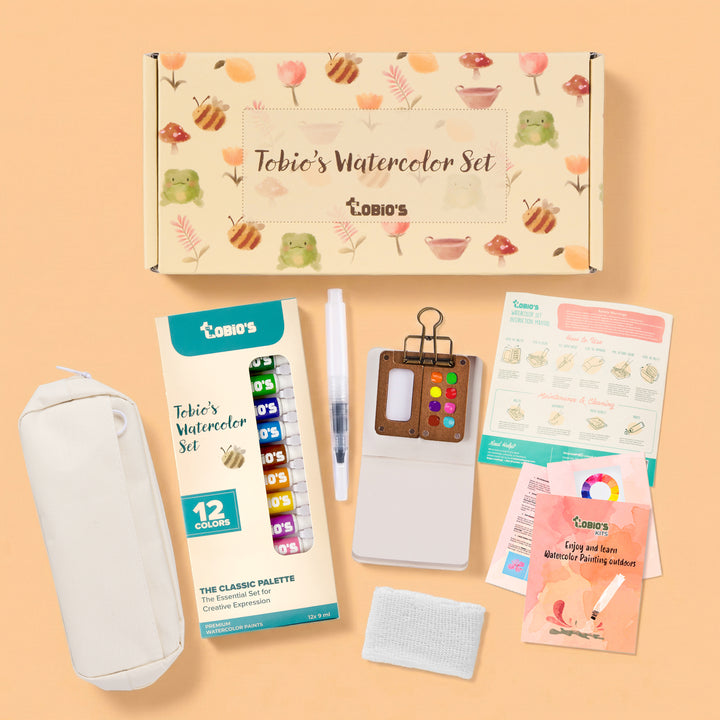
Klaar om te Schilderen?
Deze tutorial is ontworpen voor gebruik met onze aquarelset.
Link naar de link


