


Best Watercolor Workbooks for Beginners and Adults: What to Buy and Why


When you open your browser and search for “watercolor workbooks”, you get two very different products. One is a book you can actually paint in. The other one is more of an instruction manual. One lets you get started straight away. For the other one you need to do another little shopping round to also get the supplies. The best one for you depends on your needs and preferences.
But here’s the real difference. A real watercolor workbook has the designs on the watercolor paper. You can just open the book and add the color. Many of these books come with a mix of motifs, from fruits and flowers to plants and landscapes.
The other kind of workbook is a textbook. Yep, like the ones you used to have in school. It comes with step-by-step instructions so you learn techniques from scratch. But the examples are already finished, so you need to paint on separate paper. This means you need to buy everything you need before you can even put the brush to the paper.
Full disclosure: I do love both and I’ve learned with both options. It’s not that one is better than the other, but it’s a totally different vibe, so you need to know what works best for you.
Who am I? I’m Mel, a founder of Tobio’s. I got a little bit tired of having to buy a set of supplies after already having purchased the teaching book. It felt like I could never get started as soon as I opened the box. So I wanted to create another solution. But this article is for those who don’t know what a workbook is, where to get started and what is the best option. Because what’s right for me, might not be your thing at all. So let’s find out together!
What a Watercolor Workbook Actually Is (and Isn’t)
We’ve touched upon this, but I want to make it even clearer, because this was super confusing when I got started with watercolors.
A watercolor workbook is made of watercolor paper with the designs directly printed on the page. It’s made to tolerate all kinds of watercolor paints and wet washes. With this book, you paint directly on the page. No need to be good at drawing or figure out what you want to do. This means you get a little help when you get started, and it’s less intimidating because you won’t be staring at a blank page, wondering what happens next (we’ve all been there and it takes away a bit of the fun). You also won’t need to buy the paper separately since it’s already the book itself. So it’s one less thing to spend money on.
The other kind of book is all about theory. You learn the techniques behind painting with watercolors. It’s a typical book, printed on normal paper, and you still have to get the actual watercolor paper separately. This is a book you use to study, not paint. So you’ll have to factor in the extra cost of purchasing the special watercolor paper.
How to Know If It’s a Workbook or Theory Book
There are some special criteria for a beginner workbook. To make it easy, ask yourself these questions:
- Is the paper made for water? Cold-press paper, ideally cotton, or at least heavyweight 300 gsm (140 lb) paper drink up the water instead of buckling. Thin paper pills and warps the second you decide to paint on it. Not ideal.
- Are the designs pre-printed? A real workbook gives you a line drawing to paint over. Blank pages mean you’ve bought a sketchbook or a textbook, not a workbook.
- Is it honestly for beginners? You don’t need super advanced stuff when starting out. Just some simple and pretty shapes that make it easy to add your own color and personal touch.
- Theme range. Botanicals, seasonal sets, enough variety to get you excited every time you open it.
- Do you need to buy anything else? Some workbooks come with everything included (like ours!) and some assume that you already have what you need, such as paint, a brush and paper.
The Best Watercolor Workbooks for Beginners and Adults
Here is how the five stack up before we get into the details. I have painted in all of them, and I will tell you where each one shines and where it does not.
- Tobio's Beginners Workbook ($12.99, or $48.99 with the mini kit): paintable and guided, 30 pre-sketched pages plus 30 blank, on 300 gsm cotton paper. Supplies come with the kit. Best for total beginners who want to start today.
- Emily Lex themed workbooks (around $24 each): paintable and themed, on watercolor paper. Paint and brushes sold separately. Best if you already own supplies and want variety.
- Sarah Simon, Watercolor Workbook (Paige Tate & Co.) ($24.95): 25 botanical projects on 200 gsm cold-press paper, spiral-bound. Paint and brushes sold separately. Best for structured floral projects.
- Dana Fox, Watercolor With Me in the Forest ($24.99): 50 woodland projects grouped by technique. Paint and brushes sold separately. Best if you want to learn wet-on-wet, fur and ink and wash one at a time.
- Willow Wolfe, Cute Critters ($35.95): 9 projects on 350 gsm paper, 6 by 9 inches. Paint and brushes sold separately. Best as a short weekend book.
Tobio’s Beginners Workbook (Our Pick for All-in-One Beginners)
To be transparent, this is the one I’ve founded (and Tobio is the name of my cat). I wanted to create something specifically for beginners. Something I wish I had when getting started. So with a beginner in mind, the Tobio’s Beginners Workbook has 30 pages with beautiful yet simple motifs, and the other half is left blank to give you some space to experiment and try your own thing.
When I got started, the blank pages used to make me nervous. I didn’t know what to paint and it all felt a little… overwhelming. I had bought one of those books on techniques, but I didn’t have the material and I didn’t know which paper or brushes to buy, not to mention the paint. What a process!
That’s why I designed a guided workbook. So no first-timer would have to sit like I did, questioning their decision to even get started with watercolor in the first place. It’s also made to work with the kit. This means you get the workbook plus everything else you need to get started right away - without needing to purchase anything else. But more about that in a minute.
There are still many advantages to a technique textbook. You get drills, tips and tricks, and learn everything from scratch so that you understand not just what to do but why. There’s real value in that. I love the textbooks I have and they have helped me improve a lot. But for a beginner, the workbook is usually an easier place to start. You don’t need to read ten pages before placing your first brushstroke.
If you want in-depth color theory, wet-on-wet practices and a full curriculum, a teaching book like Jenna Rainey’s Everyday Watercolor will serve you really well. I’d rather tell you that now than have you expect a textbook and get line drawings.
Tobio’s is more about the daily little wins and removing the barriers that stop you from getting started.
Emily Lex Themed Workbooks
Emily Lex is a well-known name in the watercolor world. She creates themed workbooks that people tend to love, and for good reason. The motifs are gorgeous and she offers a wide range of seasonal and botanical titles in her catalog. They cost around $24 each and that’s great value for what you get. If you want a book that gives you clear instructions and a place to start painting, this workbook is amazing. But what you have to know is that this is not a full kit. You still need to shop for the paint and the brushes etc., which means the cost can get up to $40-$80. Also, it’s not ready when you unpack it. You still need to do the research of what other material to buy, and if you’re a beginner, that’s a bit of a process.
Sarah Simon, Watercolor Workbook
Sarah Simon is another watercolor guru that creates workbooks you might have actually seen in a bookshop. Her watercolor workbook is great for anybody starting. The paper has prints of botanical motifs, often printed on cold-press paper in a spiral-bound book. This is good because it means the paper lays flat as you paint. Very neat and practical, in my opinion.
If you like working project by project, you’ll love this workbook. It’s a solid pick for anybody starting, and you can also continue purchasing her workbooks when you’re ready to level up.
The caveat is the same as Emily Lex. You only get the workbook, and not the full kit, so you will need to source and purchase what you need separately. If you are ready to do that or already have the material at home, this is a good option. But if you prefer to have everything come together, picked out and ready for you, this will not be the best pick.
Dana Fox, Watercolor With Me in the Forest
Dana Fox built this one around 50 forest projects, each printed as a faint outline waiting for paint. What I like is how she organised it: by technique instead of by subject. Four sections cover wet-on-dry, wet-on-wet, painting fur, and ink and wash, so you practise one skill at a time instead of bouncing around. The subjects stay in the woods, a dogwood rose, a sly fox, feathers, that kind of thing. There is a color chart and a supply list at the front, and it costs $24.99 on Amazon.
The honest caveat: a few reviewers say the paper struggles with heavy washes, and that the harder projects skip steps. If wet-on-wet is the technique you most want to learn, test a corner of a page first. Like Emily Lex and Sarah Simon, it is a book only, so you bring your own paint and brush.
Willow Wolfe, Cute Critters
This is the smallest book here: 24 pages, 9 projects, and that is the whole thing. The line drawings are pre-printed, each project has step-by-step instructions and a little color guide on the page, and the 350 gsm paper lays flat while you work. The subjects are bunnies and frogs and friends, and they teach layering, wet-on-wet and blending along the way.
Willow Wolfe lists it at $35.95, and that is the sticking point. For nine projects it is the most expensive book on this list per page, and one Amazon reviewer gave it a single star for being small for the price, with no paint included and customs fees on top. I think of it as a lovely weekend, not a course.
Best Watercolor Workbooks for Adults: Why Pre-Sketched Pages Help So Much
A lot of the emails I get are from adults who have not painted since school and feel a bit silly about starting. If that is you, a workbook with the drawing already on the page removes the two things that stop most grown-ups before they begin. You do not have to choose a subject, and you never have to judge your own sketch before the paint comes out. That second one is bigger than it sounds. Most of us are much harsher on our drawing than on our painting.
Paper decides the rest. Watercolor needs stock heavy enough to drink a wet brush without warping, so a book printed on normal paper will buckle and bleed through no matter how good the instructions are. That is why I would compare these books by paper weight before I compared them by project count. Sarah Simon prints on 200 gsm, Willow Wolfe on 350, ours on 300 gsm cotton.
The other question is what happens when the guided pages run out. A workbook that ends with the last outline leaves you back at a blank page, which is exactly where you started. That is why ours pairs every guided page with a blank one: 30 to follow, 30 to try on your own, with the training wheels still in the same book.
People ask whether the Tobio's workbook is "too simple" for an adult. It is simple on purpose. Across 997 reviews on our site it holds a 4.76 out of 5, and the review that stuck with me was from a man who had taken drafting classes but never painted; he said the printed outlines let him focus on learning technique instead of staring at a blank page. That is the whole idea. It is beginner-friendly for adults and simple enough for kids, which is why families buy one each.
Workbook vs. Teaching Book vs. Coloring Book
Don’t get me started on how often people confuse workbooks with teaching books with coloring books. They are NOT the same thing. It’s an easy assumption to make though, so I don’t blame you if you never knew the difference. Now you do.
Workbook for painting with watercolors. Teaching book for learning how. Coloring book for markers and pencils and not watercolor or anything wet.
This little mix up tends to cost people a lot of money. I know this because I get the occasional DM or email about it (I feel you and I’ve been there). I don’t want you to feel confused about what these things are or to feel like you’re bad at watercoloring when it just happen to be the pick of the wrong paper or the wrong tools.
Paper standards bodies like ASTM International (yes this is a real thing) set the benchmarks for things like weight and lightfastness that separate genuine watercolor paper from craft stock, and that single spec is the difference between a real and fabulous workbook and a nice book but that can’t take a little water.
Do You Need Extra Supplies?
By now you know that our own brand, Tobio’s, does not need any extra supplies. You get a full kit and the workbook is included. For the other two brands I’ve mentioned, this is not the case and you do need to purchase the stuff you need to be able to paint. This is common for a lot of brands out there. This is normal and not a problem if you own these things or don’t mind doing some research on what you need. And of course you need a bit of patience because you won’t be able to start painting straight away.
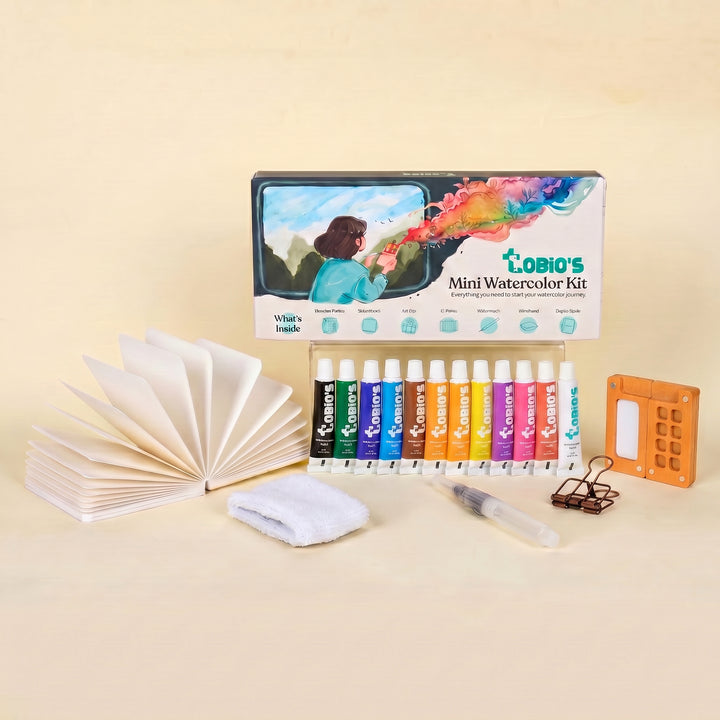
So let me tell you a bit more about Tobio’s kit. You get the workbook which has 30 pre-sketched illustrations in different shapes. There are flowers, fruit, plants, sceneries and more. You also get 30 blank pages because by the time you feel ready, you might want to let your imagination run free. That’s a beautiful feeling too.
The paper we use is super high-quality, 300 GSM cotton paper that tolerates the water really well, and lets the paint shine. The paper is bound in a hardcover book in a mini-size so that it fits in your bag and is ready to bring with you everywhere. You also get a walnut wood mixing palette with place for 8 colors at a time. There are 12 paint tubes, so you can mix and match as you prefer. The colors are rich and vibrant and blend smoothly.
The all-in-one watercolor kit is so special because you get everything you need to get started as soon as you unbox your package. You don’t need to do any more research or shopping. The kit is literally all you need. Our customers constantly tell us how this is so low-stress and perfect for beginners.
If you think you’ll be missing out on the instructions, don’t worry. You get both a physical manual plus an amazing ebook with step-by-step instructions. So you’re still going to learn the basic techniques you want while enjoying the quick set up, the complete kit, and the exceptional portability.
My dream was to create a kit that truly sets you up for success. That’s why Tobio’s exist.
If you’d rather build your own setup piece by piece, you can add an extra sketchbook with the same 300 gsm cotton paper, or a 50-color watercolor paint set to widen your range as you go.
How to Get the Most From Your Workbook
Over the years I’ve picked up a few tricks, and let me tell you they really make a difference. First thing, I always keep a little scrap paper to test a color swatch before it lands on the real page. That way I can check if the color is what I imagined or if I need to mix a bit more.
If you’re doing washes, let them dry fully before applying the next layer. I know I know… It’s tempting to just keep going, but give it a little moment to dry and you’ll get a much better result. This rookie mistake is so common, but don’t mix two wet layers. Trust me on that.
Finally, don’t strive for perfection. Just have fun with it and enjoy the process of learning. Making mistakes is normal, but the important thing is just to keep going. With each page, you’ll get more used to the techniques, and it will feel more natural.
With Tobio’s kit, you get the instructions and guides you need. If you are curious and want to get nerdy about paper weight and such things, Winsor & Newton is a great source of information.
So, Which Workbook Should You Buy?
Here is where you need to listen to yourself and pick by the type that appeals to you the most. For some people it is getting a workbook and then sourcing the rest by themselves. For others, it is getting a kit that is ready to use from the very first moment.
If you like florals and already own paint, Sarah Simon. If you want to learn one technique at a time, Dana Fox. If you want a pretty weekend project and the price does not bother you, Willow Wolfe. If you want variety and seasonal titles, Emily Lex.
If you are starting from zero, Tobio's might be one of the best options for you. It was created for complete beginners and contains everything I wished for when I got started.
You can get Tobio's Beginners Workbook ($12.99) on its own, or bundled with the mini watercolor kit ($48.99) when you want the paint, brush, palette and paper handled in one box. If you already have the supplies and just want fresh designs, you can browse all workbooks and grab a title to keep things interesting.
I'm Mel, founder of Tobio's. I make portable watercolor kits and the guided workbook that goes with them, and I write these guides for the beginner I used to be: someone who wanted to paint without first turning it into this massive project you'll probably get bored of. Read the Tobio's story.
Frequently Asked Questions
What is a watercolor workbook?
A watercolor workbook is made of watercolor paper, and you paint directly in the book. The pages usually have some kind of illustration to help you get started. All you need to do is add the color. No need to be a pro at drawing (or even remotely talented).
Are watercolor workbooks good for beginners?
This is hands down the best way to get started with watercolor. The lines are there to guide you, so all you got to do is mix the paint and add it to the paper. You won’t feel frustrated with paper that buckles, because these workbooks are actually made for watercolor.
Do I need my own paint and paper for a watercolor workbook?
With Tobio’s you don’t, but in many other cases you do. There are tonnes of options out there, but a kit that’s all-in-one is typically the easiest thing for beginners. In this case, you get the workbook plus everything else (such as the paint, brush, palette, wristband and helpful guides).
What’s the difference between a watercolor workbook and a regular watercolor book?
The watercolor workbook is the one you paint in. A regular watercolor book is a book with technical instructions on how to paint, but you don’t paint in this exact book and you still need to buy your own paper (plus everything else).
Are watercolor workbooks good for practice?
Yes, and for adults especially. A workbook gives every session a goal, so you practise one thing per page instead of staring at loose paper wondering what to do. Thirty guided pages is a lot of practice, and if the book has blank pages too (ours does), you keep going after the outlines run out.
How can I teach myself to watercolor?
Start with something structured rather than freeform painting on blank paper. A workbook gives you something to react to and build on, and the mistakes become lessons instead of mysteries. Pair it with a few short video tutorials on water control and you will progress faster than I did on my own.
What is inside Tobio's Beginners Workbook?
Thirty pre-sketched pages plus thirty blank ones, all on 300 gsm cotton paper, in a mini hardcover that fits in a bag. The guided pages walk you through flowers, fruit, plants and little landscapes step by step, so there is no blank page to stare down.
Like these guides? Set Tobio's as a preferred source on Google and our pages will show up first when you search for watercolor questions.
More watercolor reads


Ready to start painting?
Everything you need in one beginner-friendly kit: the guided Beginners Workbook, 12 student-grade paints, water brushes, a walnut palette, and 300gsm cotton paper - all in a pocket-sized box.
Get the Tobio’s Watercolor Kit


