


Best Watercolor Brushes for Beginners: Sizes, Shapes & What to Buy


What You'll Need
- One round, size 6 or 8, synthetic
- One small round, size 1 or 2, for detail
- One half-inch flat for washes (optional in month one)
- A water brush if you paint away from a table
The best watercolor brushes for beginners are synthetic round brushes in sizes 2, 6 and 8, plus one half-inch flat for washes. A round brush is a brush with a pointed tip and a full belly, and it paints a fine line on its tip and a broad stroke on its side, which is why one round does most of the work in watercolor. A synthetic brush is made from nylon or polyester filaments instead of animal hair, holds a little less water than sable, and costs $5 to $15 instead of $40 to $200. Brush size is a number printed on the handle: size 2 is a few millimeters wide for detail, size 8 is about the width of a pencil for shapes and washes. A water brush is a synthetic brush with a hollow handle you fill with water, so you can paint without a cup. Tobio's Artist Brush Set ($21.99) gives you twelve synthetic brushes in those shapes and sizes, and the 4 Extra Water Brushes ($6.99) are the brushes that live in our kit. Below I explain the shapes, the sizes and the five sets I would buy, with what our customers say about ours.
I once walked out of an art store with no brushes at all. Round, flat, mop, dagger, filbert, fan; sable, squirrel, hog, synthetic; sizes from 000 to 24 and three brands I had never heard of. I went home and painted with the one brush I already had, and it was fine. That is the whole lesson of this page, but I will give you the long version too.
Key takeaways
- Start with synthetic. Sable is lovely and you will not notice the difference for a year.
- Three rounds (2, 6, 8) and a half-inch flat cover everything a beginner paints.
- A water brush is the right tool for painting out of the house. A normal brush is better at the table.
- Rinse, reshape, dry flat. Brush care matters more than brush price.
Watercolor brush shapes, and which ones a beginner needs
A beginner needs two brush shapes, round and flat, and can ignore the rest for now. Here is what each shape does, so you know what you are skipping.
Round. A round brush has a pointed tip and a belly that holds water. It paints thin lines on the tip and wide strokes on the side, and it is the only shape you truly need. If you buy one brush, buy a size 6 or 8 round.
Flat. A flat brush has a square edge. It lays a clean, even wash across a sky or a wall, and turned on its edge it draws a straight line. A half-inch flat is the useful size.
Filbert. A flat with rounded corners. It makes soft petal and leaf shapes in one stroke. Nice to have, not necessary.
Angle. A flat cut on a slant, for sharp corners and the edges of buildings. Our set includes one; you will use it once you paint houses.
Mop, dagger, rigger, fan. Specialist shapes for big wet washes, long grasses, fine lines and texture. A size 8 round does a rough version of all of them. Skip for the first year.
What size watercolor brush is best for a beginner?
A size 6 or 8 round is the best first watercolor brush for a beginner, because it is small enough for a flower petal and big enough for a postcard sky. Brush sizes are not standard across brands, so a Princeton 8 and a Cotman 8 differ a little, but the ladder is the same everywhere.
- Size 1 to 2: eyes, stems, lettering, the last five percent of a painting. Buy one.
- Size 4: small leaves and shapes on a sketchbook page. Useful, optional.
- Size 6 to 8: the workhorse. Shapes, medium washes, most of every tutorial on our site.
- Size 10 to 12: large washes on paper bigger than A5. Buy when you move up in paper size.
- Half-inch flat: skies, backgrounds, straight edges. The one flat worth owning.
Our tutorials are painted on a 60-page sketchbook that is roughly postcard size, which is why the water brushes in the kit are small. If you paint bigger, add a size 10 or 12 round.
Synthetic or sable? Synthetic, for now
Synthetic brushes are better for beginners than sable brushes because they cost a tenth as much, hold a little less water, and spring back to a point after every stroke. Sable (kolinsky sable is the finest) holds a huge amount of water and releases it slowly, which is wonderful once you can control water and a problem before that. A single sable round costs $40 to $200. A synthetic round costs $5 to $15. Squirrel mops are softer still and floppier; hog bristle is for oils and acrylics, not watercolor.
The things that matter in a synthetic brush are snap (does the tip return to a point when you flick it), a crimped ferrule (the metal band does not loosen), and a tip that does not split after a week. Those are the three things I had the factory fix in the Artist Brush Set before we sold it.

Tobio's Artist Brush Set: twelve brushes, every shape, $21.99
Tobio's Artist Brush Set is twelve synthetic nylon brushes in a cardboard tube with a drawstring bag: five rounds from size 1 to size 8, flats in sizes 2 to 8, an angled flat (size 10) and a filbert. It is $21.99, which is under $2 a brush, and it was built for the brushes-I-wish-I-had-bought list above: the rounds hold a point, the ferrules are crimped so the heads do not loosen, and the handles are short enough to live in a pencil case.
What customers say
It is a newer product with a 4.7 out of 5 rating from a handful of reviews, so I will quote what there is. "Brushes are excellent and easy to use. I love the variety of sizes and shapes." "A great bunch of brushes, nice storage." One buyer pairs it with the kit: "The size of the brushes keeps in mind the size of your miniature painting." That last one is the point: the set is sized for sketchbook work, not for half-sheet landscapes.
Who it is not for
If you paint large, you will want a size 12 or 14 round and a one-inch flat, and this set does not go that big. If you only paint out of the house, the water brushes below are the better buy, because these need a cup.

Tobio's 4 Extra Water Brushes: the brush that needs no cup, $6.99
The 4 Extra Water Brushes are four synthetic water brushes in different tip sizes and shapes, $6.99 for the set. A water brush stores water in the handle; squeeze and it feeds the tip, so you paint on a train, in a cafe or on a park bench with nothing to spill. One comes in every Tobio's Watercolor Kit; this set adds sizes.
With 320 reviews at 4.84 out of 5 it is one of our best-rated products. "The water brushes are easy to use, even for a first-timer. I fit the whole set of supplies into a pencil case." "The 4 extra brushes have different size and shape brushes to create all kinds of details, techniques, and touches."
The honest limit
A water brush gives you less control over how much water hits the paper than a normal brush and a cup, so big soft washes are harder. For table painting, use a normal round. The full comparison is in water brush vs normal brush.
Princeton Select Synthetic (Series 3750): the open-stock standard
Princeton's Select Synthetic line is the brush most American art teachers point beginners to, because it is sold open stock (one brush at a time) in every shape and size, and a size 6 round costs under $15. The snap is good, the point is sharp, and when one wears out you replace that one brush, not a set. Buy a 2, a 6 and a half-inch flat and you are done.
The downside is only that it is not a set: three brushes bought separately cost about what our twelve do. Worth it if you want to choose each one.
Winsor & Newton Cotman Series 111: the brush your art teacher has
Cotman Series 111 is Winsor & Newton's synthetic round for students, and it holds a little more water than most synthetics, which makes it feel closer to sable. Sizes run from 000 to 14, open stock, under $15 for a size 6. It pairs naturally with the Cotman paints I recommended in the best paints for beginners.
It is slightly softer than Princeton, so it is a little less precise on fine lines and a little nicer on washes. Pick by feel if you can hold both in a shop.
Silver Black Velvet: the first upgrade
Silver Brush's Black Velvet is a squirrel and synthetic blend, and it is the brush that shows up in nearly every "brushes I actually use" video because it holds water like a natural hair brush and still points like a synthetic. A size 8 round costs more than our whole set. It is not a first brush. It is the brush to buy after thirty paintings, when you can feel what a bigger water load lets you do.
Until then, the difference between this and a $9 synthetic is mostly in your hand, not on the paper.
What our customers say about the brushes
Real reviews from our product pages, quoted as written, with the reviewer's name as it appears on the site.
What people like
- Miriam H., on the kit: "The brushes blend colours really well and the paper is great quality."
- On the water brushes: "The extra brushes make painting extra easy."
- On the Artist Brush Set: "Brushes are excellent and easy to use. I love the variety of sizes and shapes."
One thing to know about water brushes
A water brush feels odd for the first hour. You squeeze too hard, the paper floods, and you decide the brush is wrong. It is not; it is new. Squeeze once, paint until it goes dry, squeeze again. If after a week you still miss the control of a cup and a round, buy the Artist Brush Set or a single Princeton 6 and keep the water brush for the train.
How to make cheap brushes last for years
Rinse in lukewarm water after every session, never hot, because heat loosens the glue in the ferrule. Work a drop of mild soap through the bristles if color has crept up toward the ferrule, rinse until clear, then pinch the tip back into a point while it is wet. Dry flat or handle-down. Never leave a brush standing on its tip in a jar; that is how I bent my first water brush and my first sable. The full routine, including the palette and the water brush, is in how to clean your kit.
So which brushes should you buy?
- You own the kit and paint out of the house: the 4 Extra Water Brushes, $6.99.
- You paint at a table and want every shape without choosing: Tobio's Artist Brush Set, $21.99.
- You want to pick three brushes one at a time: Princeton Select or Cotman 111, sizes 2 and 6 plus a half-inch flat.
- You have painted thirty pieces and want more water in the brush: Silver Black Velvet size 8.
Questions people ask about watercolor brushes
What brushes do you need for watercolor as a beginner?
Three rounds (sizes 2, 6 and 8) and one half-inch flat, all synthetic. If you buy only one, make it a size 6 or 8 round. Budget $20 to $45 for all four, or $21.99 for our twelve-brush set.
What size watercolor brush is best for beginners?
A size 6 or 8 round. It is small enough for detail on a sketchbook page and large enough for a wash across a postcard-sized sky. Add a size 2 for fine lines and a size 12 only if you paint on paper larger than A5.
What is the best watercolor brush brand for beginners?
Princeton (Select Synthetic) and Winsor & Newton (Cotman 111) are the two most recommended student brands, both under $15 a brush and sold one at a time. For a complete set in one order, Tobio's Artist Brush Set covers twelve shapes and sizes for $21.99.
Are water brushes good for beginners?
Yes for painting away from a table, because there is no cup to carry or spill. They give less control over water than a normal brush, so for big soft washes at home a normal round and a jar are better. Most people end up with both.
Synthetic or sable brushes first?
Synthetic. A synthetic round costs $5 to $15, keeps its point and holds a manageable amount of water. Sable costs $40 to $200 a brush and holds so much water that beginners flood the paper. Upgrade after a few months, if at all.
Do I need a flat brush for watercolor?
Not in the first weeks. A half-inch flat makes skies and straight edges easier, so it is the fourth brush to buy, after rounds in sizes 2, 6 and 8.
How many brushes come in Tobio's Artist Brush Set?
Twelve: five rounds from size 1 to 8, flats in sizes 2 to 8, a size 10 angled flat and a filbert, all synthetic nylon, in a tube with a drawstring bag. $21.99.
Three brushes, then go paint
If you remember one thing: a size 6 or 8 synthetic round does ninety percent of beginner watercolor. Add a size 2 for eyes and stems and a half-inch flat for skies, and stop.
The brush that matters most is the one you rinse and reshape after every session. A $9 round looked after will outlast a $40 sable left standing in a jar. I know, because I did that to the sable.
Mel, FounderLike these guides? Set Tobio's as a preferred source on Google and our pages will show up first when you search for watercolor questions.
Keep reading


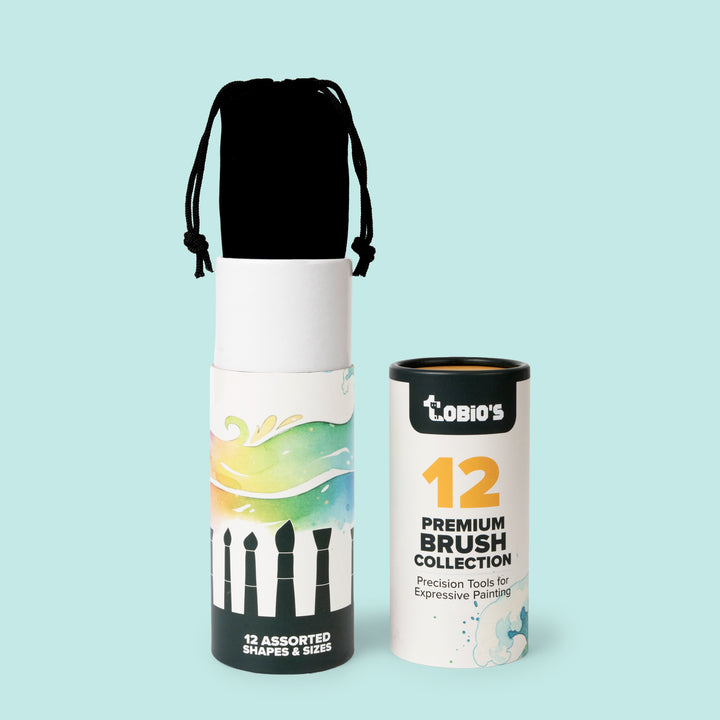
Twelve brushes, every shape a beginner needs
Rounds from size 1 to 8, flats, an angled flat and a filbert, all synthetic nylon with crimped ferrules, in a tube with a drawstring bag. $21.99.
- 5 rounds, sizes 1 to 8
- Flats, an angle and a filbert for washes and edges
- Synthetic nylon that keeps its snap
- Tube and drawstring bag for travel

4.7/5 from customer reviews


