


Sienna
Sienna is a warm earth color named after the Tuscan city of Siena. Raw sienna is the yellow-brown clay as dug, burnt sienna the same clay roasted red. On screen, the sienna color is a deep red-brown, #882D17.
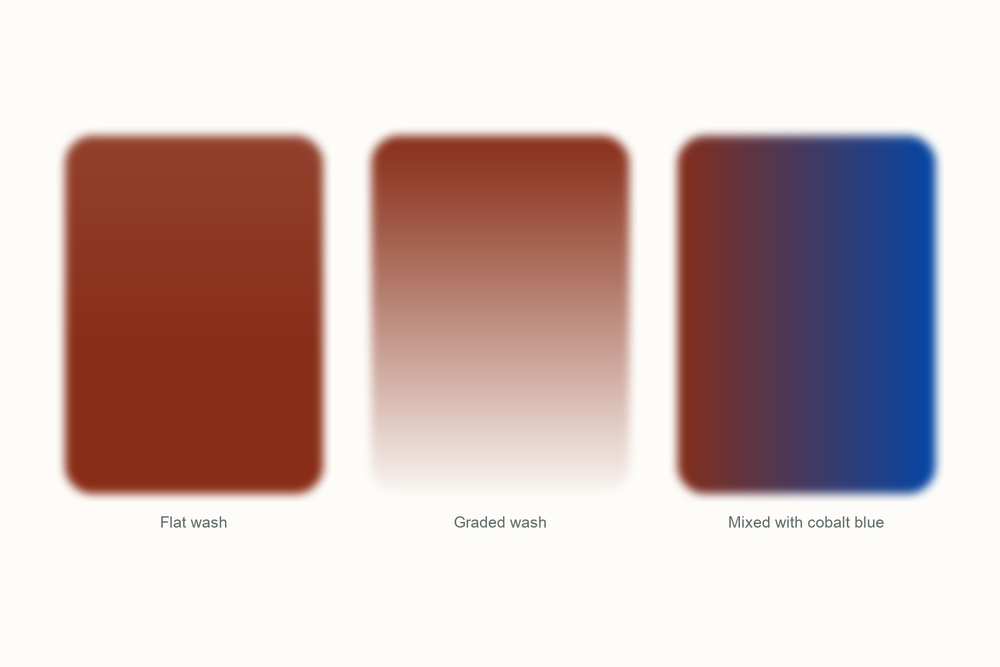
What color is sienna?
| Hex | #882D17 |
| RGB | 136, 45, 23 |
| CMYK | 0, 67, 83, 47 |
| Warm or cool | Warm. Raw sienna is a golden warm, burnt sienna an orange-red warm. Neither has the darker, cooler cast of umber, which carries far more manganese. |
| On the wheel | A red-orange dragged most of the way to brown. Raw sienna sits nearer yellow-orange, the plain swatch and burnt sienna at red-orange, all on the warm side opposite the blues. |
The story of sienna
Sienna is a color named after a city, and the city still looks like the color.
Dig in the hills of southern Tuscany, around Arcidosso on Monte Amiata, and you get a clay stained by iron, like yellow ochre, but with about five percent manganese oxide as well, which makes it darker, browner and more transparent. The locals called it terra rossa, terra gialla or simply terra di Siena, and Duccio and the other painters of the Sienese school were working with earths like this in the late 1200s and early 1300s.

Walk into Siena and you are standing on the swatch. The Piazza del Campo, the city's shell-shaped main square, was paved in red brick in 1349, laid in herringbone and divided into nine wedges for the Nine, the council that ran the place from 1292 to 1355. Brick-making was a city monopoly, and the palaces around the square are brick and stucco in the same warm colors. Twice a year, on July 2 and August 16, they race horses around it. The historic center has been a World Heritage Site since 1995, and it is still the color of the paint.

Names came later than the dirt. Sienna was first recorded as a color name in English in 1760, and burnt sienna not until 1853, because the pair only became trade pigments in the mid-1700s, when quarrying near Siena took off. The burnt version is the raw earth roasted: heat drives the water out of the goethite, part of it turns to hematite, and yellow-brown goes red-brown, deeper the longer you cook it. That story has its own page here, so I will only say the two are the same handful of dirt at different temperatures.
Then Tuscany ran out. By the 1940s the Italian deposits were nearly exhausted, and most sienna is now dug in Sardinia and Sicily, and in the Appalachians. The word escaped the paint box as well. The sienna that color charts give you is a deep red-brown, #882D17; the sienna in your web browser is a lighter brick, #A0522D; and the raw sienna swatch, from a 1919 Italian paint chart, is a tan brown, #965434. Three colors, one word, and none of them is quite the golden thing that comes out of a raw sienna tube.
Here is my opinion. Raw sienna is the underrated one. Burnt sienna gets the fame because it mixes the grays, but raw sienna is the earth I want when the light is low: a sky at six in the evening, sand, thatch, the warm side of a face. It does the golden jobs without the shout of a real yellow, and it lets the paper glow through.
Pigment facts
| Colour Index | PBr7 on most labels, the code for natural brown iron oxide, shared with the umbers. Chemically it is yellow ochre's goethite plus about five percent manganese oxide, so some references file raw sienna under PY43 and burnt under PR102. |
| Transparency | Transparent. Raw sienna is a darker, cleaner and more transparent version of yellow ochre: a glazing earth where ochre covers. That difference is why I own both. |
| Lightfastness | Excellent. Iron oxide does not fade, and cave paintings made with sienna earths are still on the walls. |
| Granulation | Mild. Natural raw sienna settles into a gentle grain in a wet wash, which is why a raw sienna sky looks like weather. |
| Staining | Low. Both siennas lift easily while damp and leave only a faint ghost once dry, forgiving colors for a beginner. |
| Toxicity | Non-toxic in normal use. It is iron earth with a little manganese. As with any pigment, do not breathe the dry powder. |
These describe the pigment in general. Every brand's tube behaves a little differently, so test yours on scrap paper.
How to mix sienna
You can mix a passable raw sienna from yellow ochre with a touch of burnt sienna, or from the kit recipe below, and for a sky wash that is fine. What you lose is the transparency, the whole point of the pigment, so if you glaze with it often, buy the tube.
Blue is the partner that matters. With cobalt blue, raw sienna makes soft, pearly grays that stay clean in a wet sky; with ultramarine it makes a granulating stone gray for walls and paths. The other sienna is always next door: raw for the light, burnt sienna for the shadow, the two together for most of a Tuscan hillside.
| Mix | Recipe | Best for |
|---|---|---|
| Raw sienna from the kit | Lemon Yellow and Venetian Red, two to one, with a speck of Forest Green | First washes, sand, thatch |
| Evening sky | Raw sienna very dilute, cobalt blue dropped in at the top while wet | Low sun, haze, the last hour of light |
| Pearl gray | Raw sienna and cobalt blue, roughly equal | Cloud shadows, distant buildings, wet sand |
| Terracotta | Burnt sienna with a touch of raw sienna, plenty of water | Roof tiles, flowerpots, the walls of Siena |
| Hillside | Raw and burnt sienna side by side, wet-on-wet, ultramarine in the shadows | Fields, bare earth, plowed land |
Closest mix from the Tobio's kit
For raw sienna, Lemon Yellow and Venetian Red, about two to one, then a speck of Forest Green to knock the orange back; it should look like weak tea with honey in it. For the darker red-brown that screens call sienna, Venetian Red straight from the pan is nearly there, warmed with a touch of Sunset Orange if it reads cold. Test on scrap first and keep it thin; these earths go flat when thick.
The 12-color kit does not include a tube of sienna, so this is how I get there with what is in the palette. Running low on a color? The 12 paint refills drop straight into the wells.
Using sienna in watercolor
Raw sienna is a light color. Use it where the sun is low or the ground is pale: sand, straw, thatch, plaster, the lit side of a face. Burnt sienna does the shadows; raw sienna does the glow.
My favorite use is a first wash for a late sky. Wet the paper, lay a thin band of raw sienna along the horizon, drop cobalt blue in from the top, then tilt and leave it. Where they meet you get a soft gray-green that no tube sells.
Any blue gives it grays and greens, burnt sienna gives it anything Tuscan, and a cool red turns it into skin. Because it is transparent it glazes well: a thin layer over a dried gray turns a wall into a sunlit wall.
One thing I learned the hard way: raw sienna in a puddle looks like nothing, and you will want to add yellow. Do not. Paint it on, let it dry, and it warms the whole sheet. Judge it on the paper, never in the pan.
Everything I use on this page is the Tobio's Watercolor Kit: twelve colors chosen to mix, a walnut palette, cotton paper, and a water brush. Want to see how any two of the colors blend before you commit? Try the interactive color mixing chart.
Get the kitSienna vs yellow ochre (and burnt sienna)
Yellow ochre is what people reach for when they mean raw sienna. Both are iron-stained clay, but the sienna carries a few percent of manganese oxide, which makes it darker and browner. The bigger difference is in the wash: ochre covers, raw sienna lets the paper through. Ochre for a wall, sienna for the light on it.
Burnt sienna is the same earth after roasting. The yellow goes out, the red comes in, and it becomes the color that turns any blue into a good gray, where raw sienna and blue drift toward green. Raw for sky and sand, burnt for shade and stone.
Neither of them is the sienna in your browser, a brick red-brown (#A0522D) that sits between the two pigments. If yellow ochre is a field at noon and raw sienna the same field an hour before sunset, burnt sienna is the field once the sun has gone down behind it.
Questions people ask
What color is sienna?
Is sienna warm or cool?
What colors make sienna?
Is sienna toxic?
Raw sienna vs burnt sienna, what is the difference?
Is sienna named after Siena in Italy?
Sources
More color stories
