Bear Watercolor Painting: Step-by-Step Tutorial


What You'll Need
- Paper
- Brushes
- Paint colors
- Palette
- Water cup
- Pencil
Color Palette
Let’s be honest: if you’ve ever attempted a bear watercolor painting and ended up with a muddy, overworked blob that looks more like a fuzzy potato than a majestic grizzly, you are not alone. Fur is intimidating. But today, we are throwing out the masking tape, the professional tracing templates, and the stress of painting thousands of individual hairs.
Instead, we are focusing entirely on a Loose Sketchbook Style. This method is fast, incredibly beginner-friendly, and relies on breaking the bear down into bold, interlocking blocks of color. It’s a fantastic way to practice value and brush control without wrestling your painting into submission.
Your Minimalist Toolkit
Keep your setup simple so you can focus on laying down confident shapes.
- Paper: 140lb / 300gsm cold press watercolor paper (a small sketchbook page is perfect for this).
- Brush: One medium Round brush (Size 6 or 8) with a good point.
- Water & Towel: Two jars of water and a paper towel for dabbing.
- Pencil: An HB pencil for a very light sketch.
The Blocky Color Palette
If you look closely at our reference image, you'll notice there isn't a lot of watery blending. Instead, the bear is built from distinct, graphic patches of color. You only need four pigments to capture this warm, earthy vibe:
- Raw Sienna: A warm, golden-tan for the lightest sunlit fur.
- Burnt Sienna: A rich, reddish-brown for the mid-tone puzzle pieces.
- Burnt Umber: A deep, cool brown for the heavy shadows on the legs and underbelly.
- Payne’s Gray: Just a tiny, concentrated dab for the nose and eyes.
Step-by-Step: Your Expressive Bear Watercolor Painting
Getting ready to tackle a bear watercolor painting doesn't mean you need to spend hours agonizing over every single piece of fur. In fact, we are going to build this majestic woodland creature using a loose, blocky technique that relies on overlapping color shapes rather than tiny, tedious brushstrokes. By working wet-on-dry, you get to keep those crisp, puzzle-piece edges that give this expressive style its modern, illustrative charm. This method is incredibly forgiving, making it the perfect 20-minute exercise to help you stop overthinking and just enjoy the flow of your paint. If you are building out your watercolor practice and want more cozy, nature-inspired projects to try, you can find a wonderful collection of resources over at Tobio's Kits. For right now, simply grab your favorite round brush, mix up those rich earth tones, and get ready to trust the process. Remember that leaving untouched white paper is just as important as the pigment you put down. Let’s jump into these four simple steps and bring this beautiful, blocky bear to life on your page!

The Shy Silhouette
- Skip the complex grid methods.
- Using your HB pencil, lightly map out the basic shape of a walking bear: a large heavy oval for the body, a blocky wedge for the head, and four sturdy pillars for the legs.
- Notice the prominent shoulder hump!
- Keep your pencil lines faint, they are just a gentle guide for your brush.

The Golden Base
- Unlike many watercolor tutorials that start with a soaking wet page, we are painting wet paint onto dry paper to get those crisp, stylized edges.
- Load your brush with a watery wash of Raw Sienna.
- Paint the lighter areas of the bear, mostly along the back, the top of the head, and the front of the chest.
- Leave plenty of dry, white paper showing where the darker shadows will go later.
- Let this layer dry completely.

The Mid-Tone Puzzle Pieces
- Once the first layer is dry to the touch, mix up a puddle of Burnt Sienna.
- Now, treat the bear's fur like a jigsaw puzzle.
- Block in the medium shadows, the side of the face, the middle of the torso, and the upper legs.
- Let these shapes overlap your Raw Sienna base slightly, but keep the edges sharp and graphic.
- Don't try to blend them out! This blocky texture is the signature of this expressive style.

Grounding Shadows & Details
- When the mid-tones are dry, it’s time to carve out the form.
- Use concentrated Burnt Umber to paint the darkest shapes: the back legs, the deep shadow under the belly, and the shadowed underside of the neck.
- Finally, take the very tip of your brush and use a thick drop of Payne’s Gray to dot in the small, dark eye and the triangular nose.
- Leave a tiny sliver of white paper on the nose for a natural highlight.
Bear Watercolor Mistakes (And Easy Fixes)
This is the part where we save your painting before it “mysteriously” ends up in the recycling.
Problem: The bear looks flat
Why: Not enough value difference between light and shadow.
Fix: Glaze targeted shadows: under chin, belly, between legs, inside ears.
Problem: Colors look muddy
Why: Over-scrubbing or mixing too many pigments on paper.
Fix: Mix on your palette, limit to 1 to 2 browns, and let layers dry before glazing.
Problem: Paper buckles or pills
Why: Paper is too thin or you’re using a lot of water.
Fix: Use heavier paper (200 to 300 gsm), tape edges, and work in controlled washes.
Problem: Harsh edges where you wanted soft fur
Why: The area dried before you blended.
Fix: Re-wet the edge lightly and soften with a clean damp brush. Work in smaller sections next time.
Problem: The face looks “wonky”
Why: Features placed too high/low or painted too dark too quickly.
Fix: Lightly map features first, then build up slowly with thin layers.
Frequently Asked Questions
How do I keep my bear watercolor painting from looking muddy?
Muddy colors usually happen when you over-mix your browns on the palette or overwork damp paper. For this loose, expressive style, rely on pure pigments. Paint your lighter shapes first, let them dry completely, and then overlap them with darker shapes. Letting the watercolor paper dry fully between layers keeps your colors crisp and vibrant.
Should I use the wet-on-wet technique for a bear watercolor painting?
While many traditional tutorials use wet-on-wet to create soft, fuzzy fur, this expressive sketchbook style relies almost entirely on the wet-on-dry technique. Applying wet paint onto dry paper gives you those sharp, blocky, puzzle-piece edges that give the bear a modern, illustrative charm without turning the painting into a flat puddle.
What colors do I need to paint a brown bear in watercolor?
You don't need a massive palette to capture beautiful fur! You can build incredible depth with just four earth tones: Raw Sienna for the light, sunlit base; Burnt Sienna for the warm mid-tones; Burnt Umber for the deep, grounding shadows; and a tiny drop of Payne’s Gray for the nose and eyes.
How do I paint a bear face without it looking angry or human-like?
The biggest mistake beginners make is painting the eyes too large. Bears actually have very small eyes relative to their massive heads. Keep the face incredibly simple, use the very tip of your brush to drop in a tiny dot or dash for the eye, and a small triangle for the nose. Leave a tiny sliver of white paper on the nose for a natural highlight, and let the viewer's brain do the rest.
Conclusion
You’ve got two solid ways to paint a bear: the cute version for quick confidence, and the realistic version for texture and form. Either way, the formula is the same: soft base wash, dry fully, glaze your shadows, then add details last.
When you want your next project lined up and ready, head to Tobio’s Kits watercolor tutorials page and keep the momentum going.
Mel, FounderLike these guides? Set Tobio's as a preferred source on Google and our pages will show up first when you search for watercolor questions.
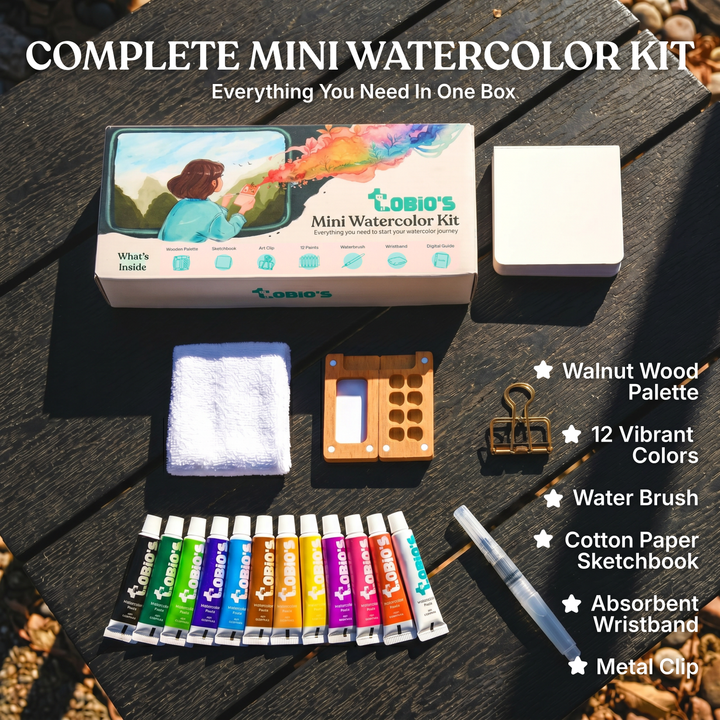
Ready to paint along?
Everything you need to paint anywhere and feel inspired doing it.
- Ultra compact
- Express yourself creatively
- For total beginners