


Birch Tree Watercolor Painting: Step-by-Step Tutorial


What You'll Need
- Watercolor Paper
- Pencil and eraser
- Two water cups
- Watercolors
- Round brush
Color Palette
If you love the look of a birch tree watercolor painting but your past attempts ended up feeling overworked and rigid, you’re in exactly the right place. Today, we are throwing out the masking fluid, skipping the taping, and ignoring the complicated background washes.
Instead, we’re focusing on a "Loose Sketchbook Style." This 15-minute expressive study is fast, incredibly beginner-friendly, and perfect for capturing the fresh, calm essence of nature without overthinking every brushstroke. We are going to let the white of the page do the heavy lifting. Grab your travel palette, and let’s dive in!
If you want more projects like this after you finish, you can browse our full library of step-by-step lessons on Watercolor Tutorials.
The Minimalist Color Palette
To keep things fresh and expressive, we are stripping our palette down to just four essential pigments based directly on the artwork above. Here is all you need:
- Lemon Yellow: For the bright, sunlit dabs of foliage.
- Sap Green: To give the leaves that translucent, earthy spring vibe.
- Raw Sienna: Diluted heavily for the subtle, warm shadow on the trunk.
- Sepia: For the crisp, dark bark markings.
Artist Note: The paper matters more than the paint! Make sure you're using 140lb / 300gsm cold-pressed watercolor paper. It handles loose, wet dabs beautifully without buckling, even without taping the edges down.

The Subtle Trunk Shadow (Protecting the Whites)
Birch trees are mostly white, so we aren't going to paint the bark; we are only painting the shadow!
Load a medium brush with a very watery, pale wash of Raw Sienna.
Gently pull it down the right side of your imaginary trunk, letting the shape naturally split into two or three "Y" shaped branches at the top.
Leave the rest of the trunk as the bare white paper. Think "hint," not "stripe."

The Expressive Canopy
While the trunk shadow is drying, clean your brush. Pick up some Lemon Yellow and Sap Green.
Drop loose, puddle-like dabs of color around the upper branches. Do not try to paint individual leaves, just paint the idea of leaves.
Let the yellow and green bleed into each other slightly on the paper to create organic, natural variations.

Confident Bark Marks (The Fun Part)
Once the trunk is completely dry, switch to a smaller brush with concentrated, mostly-dry Sepia.
Add a few broken horizontal dashes, small "smiles," and dark notches where the branches split.
Keep it irregular and vary your pressure! If you start making the marks perfectly even, it will look like a ladder instead of a tree. Less is more here.
Step Back and Stop
Add maybe one or two final, slightly darker green dabs into the foliage for depth, and then put the brush down.
The absolute fastest way to ruin a loose sketchbook study is to keep "fixing" it. Embrace the white space and the imperfect, watery edges!
Style Variations: Winter Minimalist, Autumn Gold, and Storybook Birch
Want to change the vibe of your birch tree watercolor painting?
Try these quick sketchbook adaptations:
The "Winter Minimalist" (Moody & Stark)
- Cool the palette: Swap your cheerful Lemon Yellow and Sap Green for a moody, diluted Payne’s Gray or soft Indigo in the background.
- Deepen the contrast: Make your Sepia bark marks slightly crisper and darker so they pop against the bare white of the paper.
- Lost edges: Let the bottom of the trunk bleed entirely into a soft, pale blue ground wash to anchor the tree in a deep, wet snowbank.
The "Autumn Gold" (The Warm, Crisp Phase)
- Warm the palette: Swap out the fresh greens for vibrant splashes of Yellow Ochre, Burnt Sienna, and rich oranges.
- Change the foliage: Instead of a full canopy, paint sparse, crunchy leaf clusters and let a few loose dabs "fall" toward the bottom of the page.
- The "Sunlit" Trunk: Use a slightly warmer, heavier wash of Raw Sienna for the trunk shadow to give it that late-afternoon, golden-hour glow.
The "Storybook Birch" (Simplified for Cards & Patterns)
- Exaggerate shapes: Push the shape language into perfectly straight, stylized trunks or whimsical, dramatic bends.
- Bring on the speckles: Lean into the illustrative vibe by flicking a few perfect, deliberate splatters of yellow and green paint over the dry branches for a magical, loose leaf texture.
- Flat color: Skip the soft, watery trunk shadows. Use flat, highly-pigmented dabs for the leaves and bold, graphic dashes for the bark.
Inspiration: Why This Style Works
This loose, expressive sketchbook approach to a birch tree watercolor painting is perfect for:
Travel Journals and Hiking Logs:
Capture the beautiful woodland groves you spotted on a mountain trail without needing hours of free time or a botany degree. You don’t need to paint every single leaf vein or peeling strip of bark; you just need that iconic bright white silhouette and a splash of green to immediately bring the memory back.
Woodland & Cozy Cabin Decor:
Because birch trees naturally provide an airy, calming, and organic vibe, a soft, loose study looks timeless in a home office or cozy reading nook. Frame a trio of these simple trunks (perhaps displaying them alongside a pressed fern or a dried botanical) for instant, nature-inspired wall art that completely avoids that stiff, "store-bought" look.
Frequently Asked Questions
How do I keep trunks white without masking fluid?
In this loose style, just paint the shadow! A pale wash of Raw Sienna down one side of the trunk leaves the rest of the paper bare. That untouched white space instantly reads as bright, sunlit bark.
Why do my bark marks look stiff, like a ladder?
You’re probably making them too evenly spaced! For a natural birch tree watercolor painting, use a mostly-dry brush with Sepia and vary your pressure. Leave irregular gaps and let your marks be a little chaotic. Real bark is never perfect.
Do I really need 140lb watercolor paper for a quick study?
Absolutely. Standard drawing paper will buckle and ruin your loose watercolor blooms. Even for a 15-minute piece, 140lb (300gsm) cold-pressed paper is essential so your Lemon Yellow and Sap Green dabs can blend effortlessly without warping the page.
Conclusion
Birch tree watercolor paintings look sophisticated, but the process is refreshingly simple when you stop trying to “render” everything. Protect your whites, paint the background first, shape the trunks with subtle shadows, and add bark marks with a light hand. That’s the whole game.
If you want more no-drama practice projects, explore our watercolor tutorials, or head back to Tobio’s Kits to keep your creative momentum going.
Mel, FounderLike these guides? Set Tobio's as a preferred source on Google and our pages will show up first when you search for watercolor questions.
Ready to Paint?
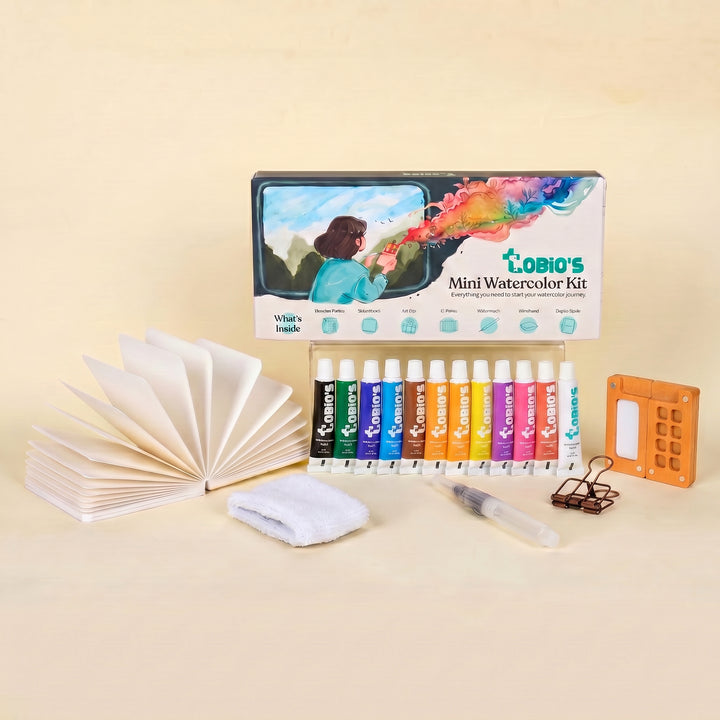
This tutorial was designed for use with our Watercolor Kit.
Link to the link


