


Bluebird Watercolor Painting: Step-by-Step Tutorial


What You'll Need
- Watercolor Paper
- Pencil and eraser
- Two water cups
- Watercolors
- Round brush
Color Palette
If you are looking for a tutorial on a bluebird watercolor painting, you are in the right place, but we are tossing the complicated rules out the window today. We are focusing on a "Loose Sketchbook Style."
This means fast, expressive, and incredibly beginner-friendly.
You want a charming little bird that feels fresh and alive, not a rigid, overworked puddle of blue regret. The beauty of this specific sketchbook study is its simplicity: no masking tape, no tracing paper, and no complicated layering. We are going to let the water do the heavy lifting.
If you want more projects like this after you finish, you can browse our full library of step-by-step lessons on Watercolor Tutorials.
The Minimalist Color Palette
Based exactly on our reference painting, we are skipping the traditional warm/cool rust chests and keeping this purely monochromatic and cool.
You only need three pigments to pull off this expressive little guy.
- Cerulean Blue: The main body wash. It is bright, airy, and perfect for the fluffy belly and head.
- Ultramarine Blue: The darker, richer blue for the wing and tail feather details.
- Payne's Gray: A moody, dark blue-gray used purely for the sharp details: the eye, the beak, and the tiny feet.

The "Jellybean" Sketch
Keep your pencil lines whisper-light. Draw a tilted jellybean for the body and a small circle overlapping the top left for the head. Add a tiny triangle for the beak and a little wedge at the back for the tail. That is it.
If your pencil is dark, gently tap it with an eraser until it is barely visible.

The Soft Body Wash
Load your brush with a watery, light mix of Cerulean Blue. Paint the entire body of the bird, leaving a tiny sliver of dry white paper near the eye area if you can. Let the color pool a bit heavier toward the bottom belly.

Dropping in the Feathers
While the Cerulean Blue body wash is still damp, pick up some slightly thicker Ultramarine Blue. Tap your brush along the back to form the wing, pulling a few distinct, loose strokes downward to suggest feathers. Paint the tail with two or three quick, downward flicks. Because the paper is damp, these darker blue strokes will softly bleed into the lighter body, creating a beautiful, natural fluffiness.

The Crisp Details
Wait for the bird to dry completely. If you paint the eye while the head is wet, it will bloom into a massive raccoon mask. Once dry, take a concentrated, thick dab of Payne's Gray on the very tip of your brush.
- Add a single dot for the eye.
- Fill in the small triangle beak.
- Draw two little sets of feet right at the bottom of the belly, just three quick, tiny lines for each foot. No branch required!
Step back and admire. You just nailed a loose, expressive sketchbook study!
Style Variations: Moody Songbird, Sunlit Fledgling, and Storybook Bluebird
Want to change the vibe of your bluebird watercolor painting?
Try these quick sketchbook adaptations:
The "Moody Songbird" (Dramatic & Heavy)
- Cool the palette: Swap your bright Cerulean for deep, moody blues like Indigo or mix a heavy dose of Payne’s Gray into your Ultramarine wings.
- Deepen the shadows: Paint the underside of the belly and tail much darker, leaving only a tiny sliver of pale rim light on the very top of the head.
- Lost edges: Let the bottom of the bird’s belly bleed entirely into a dark, heavy background wash to anchor it in a stormy sky or a deep, shadowed branch.
The "Sunlit Fledgling" (The Soft, Fluffy Phase)
- Lighten the palette: Stick to highly watered-down Cerulean and perhaps the palest wash of warm yellow or orange near the chest to mimic morning light.
- Change the proportions: Exaggerate the roundness of the belly and tuck the head in further so the bird sits as a perfectly round, fluffy, watercolor cotton ball.
- The "Downy" Texture: Skip the crisp, heavy feather details in step 3. Keep the washes light and let all the edges blur for a fresh, un-ruffled look.
The "Storybook Bluebird" (Simplified for Cards & Patterns)
- Exaggerate shapes: Push the shape language into a perfectly smooth oval body or a distinct, stylized teardrop.
- Bring back the speckles: Lean into the illustrative vibe by flicking a few perfect, deliberate splatters of blue paint over the dry paper around the bird for a whimsical texture.
- Flat color: Skip the messy, organic water blooms. Use flat, highly-pigmented, graphic washes of solid blue for a striking, modern look.
Inspiration: Why This Style Works
This loose, expressive sketchbook approach to a bluebird watercolor painting is perfect for:
- Nature Journals and Birdwatching Logs:
Capture the bright flash of blue you spotted in your backyard or on a trail without needing a telephoto lens or an ornithology degree. You don’t need to paint every single microscopic feather; you just need that charming, round silhouette to bring the memory back. - Airy & Botanical Decor:
Because songbirds are naturally joyful and vibrant, a soft, loose study looks timeless in a sunroom or cozy reading nook. Frame a trio of these (perhaps painting them in slightly different postures or adding a loose botanical leaf to one) for instant, nature-inspired wall art that doesn't feel "store-bought."
Frequently Asked Questions
What if I don't have Cerulean or Ultramarine blue?
No problem! Just swap them for what you have. Use any bright, cool blue (like a watered-down Phthalo) for the light body wash, and a deeper, richer blue (like Cobalt or Prussian Blue) for the darker wing feathers.
How do I fix wet watercolor that bleeds outside my sketch?
Don't panic! While the paint is still wet, dry your brush on a paper towel and use that "thirsty brush" to gently sweep the runaway puddle right back into the bird's body. Or, just leave it, it usually dries looking like a soft, fluffy feather anyway.
How do I paint a simple branch without overworking it?
Keep it to one single, confident swipe. Mix a little brown (like Burnt Sienna), load your brush, and pull one quick line right under the bird's tiny feet. Don't paint bark texture or leaves; let the bluebird remain the star of the page.
Conclusion
A clean, lively bluebird comes down to a simple formula: strong paper, light first washes, patient drying, and a couple confident glazes for depth. Keep your edges soft in a few places, save the crisp lines for the eye and beak, and stop before you “fix” it to death.
If you want to keep the momentum going, head to Tobio’s Kits for more creative projects and an easy way to set up your next painting session.
Mel, FounderLike these guides? Set Tobio's as a preferred source on Google and our pages will show up first when you search for watercolor questions.
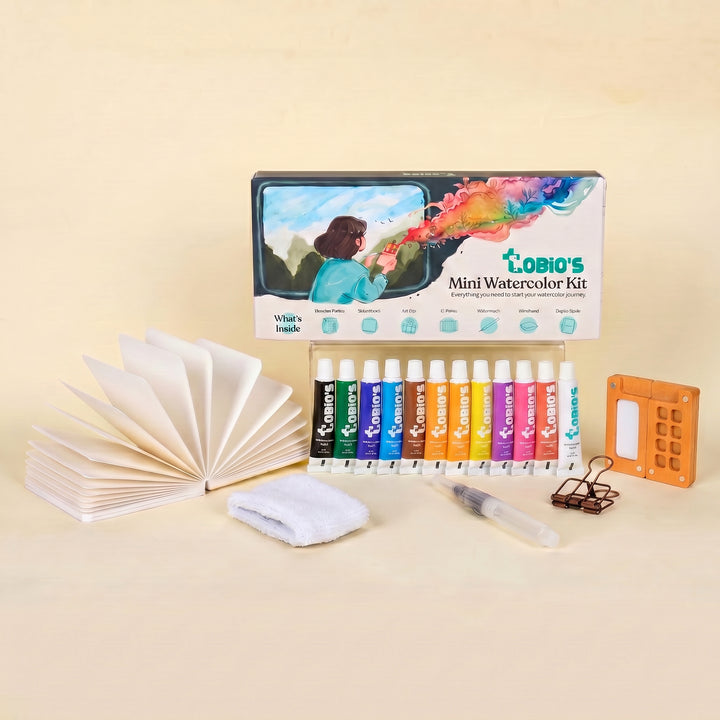
Ready to Paint?
This tutorial was designed for use with our Watercolor Kit.
Link to the link


