


Chinese Watercolor Painting: Step-by-Step Tutorial


What You'll Need
- Paper
- Brushes
- Paint colors
- Palette
- Water cup
- Pencil
Color Palette
Traditional Chinese painting (Guohua) can feel intimidating. You think of grinding ink sticks, delicate rice paper that tears if you look at it wrong, and decades of mastery.
But today? We are translating that ancient spirit into a modern loose sketchbook study. We are going to create a Chinese watercolor painting of a figure using the "Xieyi" (freehand) philosophy: capturing the spirit of the subject rather than the exact anatomy. This is about confident strokes, high contrast, and knowing exactly when to lift your brush.
The Supplies (East meets West)
You can use traditional bamboo brushes if you have them, but standard western watercolors work perfectly for this sketchbook style.
- Paper: 140lb/300gsm Cold Press paper. (While traditional art uses rice paper, cold press is more forgiving for beginners and handles the wet washes beautifully).
- Brush: A Calligraphy Brush or a Size 8 Round Brush with a very sharp point.
- Paints: See our minimalist palette below.
- Extras: Two water cups, a paper towel, and a porcelain palette.
The Color Palette
Chinese painting often relies on the interplay between ink and subtle color. Based on the sketchbook study above, we are using a restrained, elegant palette:
- Lamp Black (or Chinese Ink): For the hair and defining lines. It needs to be opaque and deep.
- Indigo: The moody, deep blue for the robe.
- Yellow Ochre: Mixed with a lot of water for the pale skin tone.
- Vermilion: A tiny, singular pop of color for the lips.
Step-by-Step: Your Chinese Watercolor Painting Figure
The golden rule here is "Intentional Speed." Do not sketch with a pencil first if you can help it. If you must, keep it barely visible. Chinese painting is about the confidence of the line. In this style, a hesitant brushstroke is considered a "dead" line. It is actually better to paint a bold, confident mark that is slightly inaccurate than to paint a shaky, fearful line that is technically perfect. So take a deep breath, commit to the movement, and accept that there are no erasers here, only character.

The "Bone" Work (The Face)
In Chinese art, the outline is often called the "bone."
- Load your brush with a very watery, pale mix of Lamp Black (it should look grey).
- Holding the brush vertically, paint the delicate outline of the face and the neck.
- Paint the features with simple dashes—thin arches for eyebrows and simple lines for the closed, meditative eyes.
- Artist Tip: Do not try to be symmetrical. A slight tilt adds character.

The "Blood" (The Skin and Lips)
- Wash a very diluted mix of Yellow Ochre over the face. It's okay if it goes outside the lines slightly, this is a loose study!
- Now, clean your brush and pick up thick Vermilion.
- Place one tiny, deliberate dot for the mouth. This small red mark brings the whole face to life.

The Ink Splash (The Hair) & The Robe
Now we need contrast.
- Load your brush with thick, creamy Lamp Black.
- Paint the hair in large, wet shapes. Press the belly of the brush down to create the volume of the bun, and lift up to create the edges.
- Leave a few tiny slivers of white paper showing within the black mass to suggest shine and texture.
This is the "Xieyi" part, painting the feeling of the cloth, not the stitching.
- Mix a juicy puddle of Indigo.
- Paint the collar and the folded arms using broad, sweeping strokes.
- Crucial: Leave gaps of white paper! Look at the image, the white collar and the gaps between the sleeves are just unpainted paper. This "breath" (or Qi) prevents the figure from looking like a blue blob.
- Let the blue wash vary in intensity. Darker in the folds, lighter on the shoulders.
Common Mistakes (and the Fast Fixes)
The "Anime" Face
- The Problem: You tried to paint pupils, irises, and eyelashes, and now your serene figure looks like a cartoon character.
- The Fix: Simplicity is the hardest part. For this style, a single, slightly curved horizontal line is the eye. If you feel the urge to add details, put the brush down and step away.
The Blue Blob (No "Qi")
- The Problem: You painted the robe as one solid block of Indigo, covering every inch of paper. It looks flat and heavy.
- The Fix: You suffocated the painting! You must leave "breath" (white paper) between the sleeve and the body. These unpainted gaps are what separate the limbs and create the illusion of folded fabric.
Weak, Gray Hair
- The Problem: You were too afraid of the black paint, so you watered it down. Now the hair looks like a fading gray cloud instead of a heavy bun.
- The Fix: Be brave with your Lamp Black. The mixture should feel like heavy cream, not weak tea. The contrast between the pitch-black hair and the pale face is what makes this style work.
The "Nervous" Line
- The Problem: Your outline looks shaky and wobbly because you moved your brush too slowly.
- The Fix: Speed up! In Chinese painting, a fast, confident line that is slightly "wrong" is infinitely better than a slow, shaky line that is "perfect." Lock your wrist and move from your elbow.
Frequently Asked Questions
Do I really need traditional rice paper for this?
No! Traditional rice paper (Xuan paper) is incredibly absorbent and can be very frustrating for beginners because the ink spreads instantly. For this specific Chinese watercolor painting sketchbook study, standard 140lb Cold Press paper is actually better. It gives you more control over the water while still allowing for beautiful, soft washes.
My figure looks like a big blue blob. What happened?
You likely painted over your "Qi" (breath). In Chinese painting, the white paper you don't paint is just as important as the paint itself. If you fill in the entire robe with Indigo without leaving those crucial white gaps between the sleeves and the body, the figure loses its structure and looks flat.
How do I paint the eyes without making them look cartoonish?
The secret is to do less. In this style, we aren't painting irises, pupils, or eyelashes. A simple, slightly curved line (using your "Bone" brushwork) suggests a meditative, downward gaze. If you try to add too much detail to a face this small, it will ruin the serene mood.
Why is the hair just a big black shape?
This technique is called "Ink Splash." It provides a heavy, grounding contrast to the delicate lines of the face and the watery blue of the robe. Don't be afraid of the Lamp Black, you need that bold darkness to anchor the painting.
Conclusion
Real traditional Chinese painting takes a lifetime to master. This sketchbook study takes twenty minutes. The difference? We aren't trying to be masters today; we are trying to be brave.
A successful Chinese watercolor painting isn't about perfectly rendering every eyelash or fold of fabric. It is about the contrast between the heavy, grounding black ink and the airy, unpainted white paper. Remember: the white space is what lets the figure breathe. If your hand shakes, speed up. If you hate the result, turn the page and try again—paper is cheaper than therapy.
Mel, FounderLike these guides? Set Tobio's as a preferred source on Google and our pages will show up first when you search for watercolor questions.
Ready to Paint?
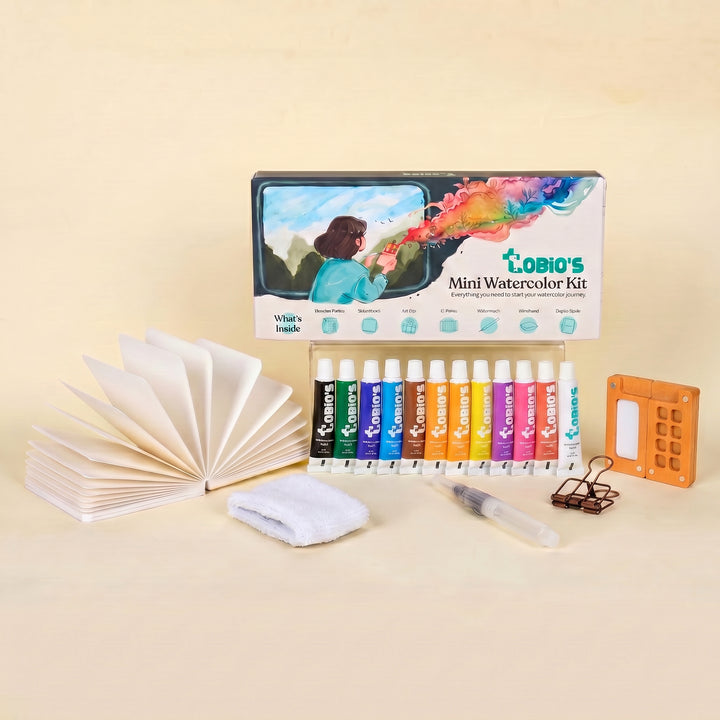
This tutorial was designed for use with our Watercolor Kit.
Shop the Kit


