


Lake Watercolor Painting: Step-by-Step Tutorial


What You'll Need
- Watercolor Paper
- Pencil and eraser
- Two water cups
- Watercolors
- Round brush
Color Palette
Let’s be honest: most tutorials for a lake watercolor painting want you to tape down your paper, pre-mix five shades of blue, and hold your breath while painting a perfect gradient.
That is not what we are doing today.
Look at the image above. That isn’t a studio masterpiece that took three days; it’s a sketchbook study. It’s fresh, it’s messy in the right ways, and it captures the feeling of a lake without obsessing over the physics of light refraction.
If you want more projects like this after you finish, you can browse our full library of step-by-step lessons on Watercolor Tutorials.
The "Pocket" Color Palette
Looking at our study, we are using a limited, earthy palette. You don’t need 50 colors; you just need the right ones. Based on the washes in the image, here are the specific pigments we are using:
- Cobalt Blue: Used for both the breezy sky and the body of the water.
- Sap Green: The primary color for the grassy foreground and foliage.
- Raw Sienna: The warm, earthy tone used for the sandy banks and to muddy up the greens.
- Payne’s Gray: Used for the deepest shadows under the tree line and the dark shoreline accents.
Supplies (Keep It Simple)
- Paper: A watercolor sketchbook (approx. A5 or 5x7). Ideally 140lb (300gsm) paper so your wash stays flat without needing to be taped down.
- Brush: A single Size 6 or 8 Round Brush. You need a sharp point for the little grassy details and enough belly to hold water for the sky.

The "Messy" Sky Wash
Dip your brush in clean water and wet the top half of your page casually. Pick up some watery Cobalt Blue.
Slash it across the top of the page.
- The Trick: Don’t try to make it smooth! Look at the image, see how the sky has white gaps and uneven edges? That’s what we want. It looks like clouds and air movement. Stop touching it while it's wet.

The Horizon Bleed
While the bottom of your sky is still slightly damp (not soaking), load your brush with a mix of Sap Green and a touch of Cobalt Blue to make a distant, cool teal-green.
Paint the bumpy tree line across the horizon.
- Why do this now? If the sky is slightly damp, the tops of the trees will fuzzy out, pushing them into the distance. This creates atmospheric depth without you trying too hard.

The Water (Save the Sparkle!)
This is the most important step for a lively lake watercolor painting.
Reload with Cobalt Blue, slightly more saturated than the sky. Paint the water using horizontal strokes.
- Crucial Move: Do not paint the whole water area solid blue. Leave horizontal strips of dry white paper showing through (see the center of the lake in the photo?). These unpainted spots represent sunlight glinting off the water. If you paint over them, you lose the magic.

The Grassy Banks & Final Accents
Now, let’s bring the viewer onto the shore and add our contrast.
- The Banks: Mix a creamy consistency of Sap Green and Raw Sienna. Paint the foreground land masses on the left and right. Be jagged with your brush strokes to suggest tall grasses.
- The Contrast: While those banks are setting, switch to your darkest color (Payne’s Gray).
- The Details: Add a few dark lines right where the land meets the water to ground the scene. Use the very tip of your brush to flick a few "reeds" upward in the foreground or draw thin, broken ripple lines in the blue water.
The "Walk Away"
This is the hardest part. You will want to smooth out that bloom or fix that messy edge.
Don't.
The charm of an expressive lake watercolor painting lies in the unpredictable drying lines and rough watermarks. The magic happens when you aren't touching it. Drop your brush and let it dry completely.
Style Variations: Deep Water, Glassy Morning, and Storybook Shore
Want to change the vibe of your lake watercolor painting? Try these quick sketchbook adaptations:
The "Deep Water" (Dramatic & Moody)
- Cool the palette: Swap your warm Sap Greens for deep, moody blues like Indigo or Payne’s Gray mixed with your brown.
- Deepen the shadows: Paint the reflection in the water much darker than the trees themselves, leaving only a tiny sliver of light at the shoreline.
- Lost edges: Let the tops of the trees bleed entirely into a dark, stormy sky wash to anchor the scene in "bad" weather.
The "Glassy Morning" (The Soft, Hazy Phase)
- Lighten the palette: Stick to highly watered-down Cobalt Blue and the palest wash of Raw Sienna.
- Change the contrast: Reduce the difference between land and sky. Keep the tree line pale and ghostly to suggest mist.
- The "Fresh" Texture: Skip the dry-brush ripples. Keep the water wash perfectly smooth and wet-in-wet for a still, mirror-like look.
The "Storybook Shore" (Simplified for Cards & Patterns)
- Exaggerate shapes: Push the shape language into distinct layers, a flat blue sky, a jagged tree line, and a solid blue lake.
- Clean up the edges: Lean into the illustrative vibe by waiting for every layer to dry completely. No bleeds, just crisp outlines.
- Flat color: Skip the messy watermarks and sparkles. Use flat, highly-pigmented, graphic washes of solid color.
Inspiration: Why This Style Works
This loose, expressive sketchbook approach to a lake watercolor painting is perfect for:
- Travel Journals and Hiking Logs: Capture the view you spotted on a trail without needing a tripod or a landscape degree. You don’t need to paint every single ripple on the water; you just need that cool, blue horizon line to bring the memory back.
- Cabin Vibes & Home Decor: Because water scenes are naturally calming and organic, a soft, loose study looks timeless in a bathroom or a home office. Frame a trio of these (perhaps adding a river rock or a pine study) for instant, nature-inspired wall art that doesn't feel "store-bought."
Frequently Asked Questions
I accidentally painted over the white sparkles in the water. Is it ruined?
Not at all. In a sketchbook, we cheat. Use a White Gel Pen or a tiny dab of White Gouache to add a few crisp horizontal lines back over the dry blue wash. It adds texture and saves the light.
My sky dried with weird "blooms." Should I fix it?
No! In a loose lake watercolor painting, those cauliflower marks look like clouds or wind currents. They add organic texture that makes the sketch feel alive. Embrace the accident.
Why does my lake look flat compared to the photo?
You need more contrast. If your darkest shadows (like the tree bases) aren't dark enough, the depth disappears. Be brave, add a deep stroke of Payne’s Gray under the tree line to make the distance pop.
Conclusion
Calm water is mostly about restraint: a smooth sky wash, a soft lake wash that matches the sky, and just enough shoreline contrast to create depth. Paint it once to learn the timing, then paint it again to make it yours.
Mel, Founder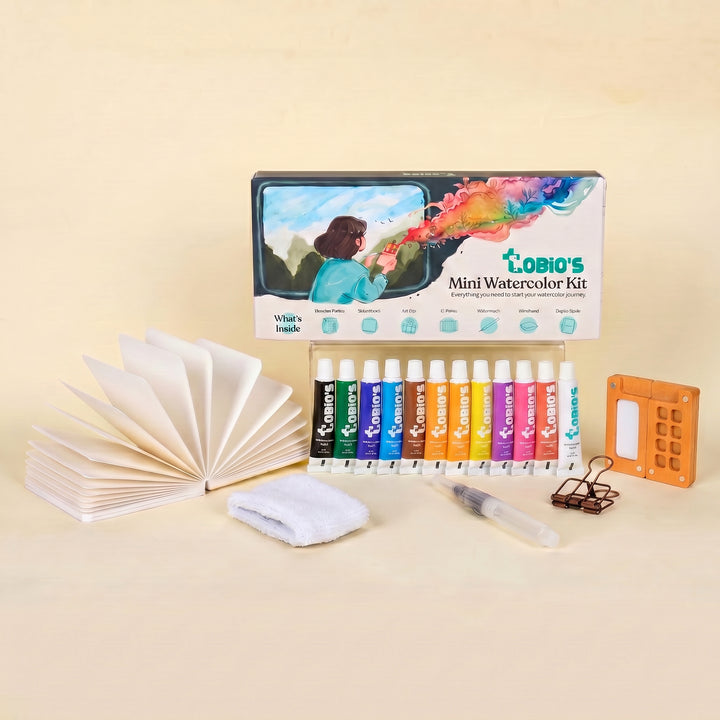
Ready to Paint?
This tutorial was designed for use with our Watercolor Kit.
Link to the link


