


Mountain Watercolor Painting: Step-by-Step Tutorial


What You'll Need
- Watercolor Paper
- Pencil and eraser
- Two water cups
- Watercolors
- Round brush
Color Palette
If you’ve ever tried a mountain watercolor painting and ended up with a sad gray blob, you’re not alone. The problem usually isn't your skill, it's that you're trying too hard to be "perfect."
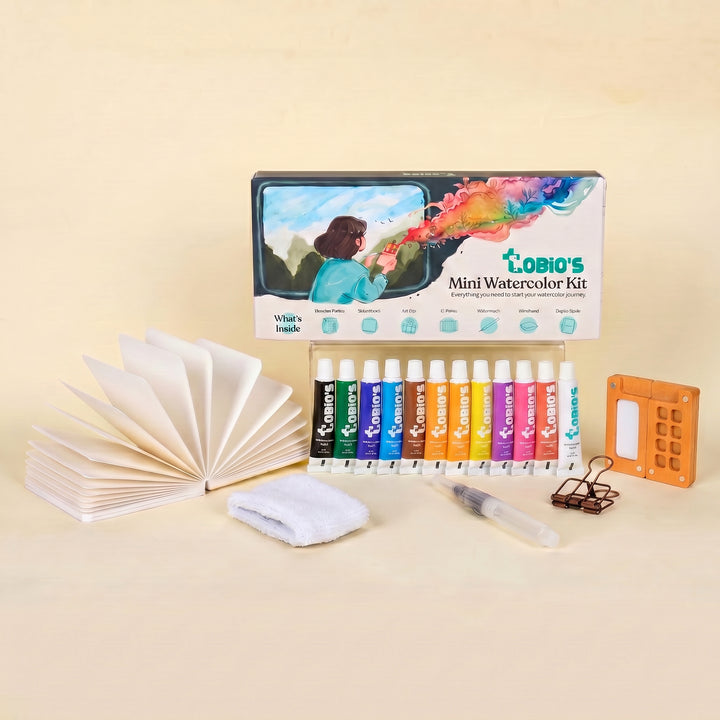
Look at the image above. See that tiny sketchbook? That cool wooden palette clip? There is no masking tape here. There is no complex grid drawing. This is a "Loose Sketchbook Style." It’s about capturing the feeling of a jagged peak in 20 minutes while your coffee is still hot.
If you want more projects like this after you finish, you can browse our full library of step-by-step lessons on Watercolor Tutorials.
The "Rocky Peak" Color Palette
Looking at our reference study, we aren't using a massive rainbow. The painting relies on a moody, high-contrast triad. While your palette box might have bright yellows and reds, for the actual mountains on the paper, we are using these three specific pigments:
- Indigo: For those deep, dramatic shadows and sharp peaks.
- Ultramarine Blue: For the lighter, airy washes in the sky and distant slopes.
- Burnt Umber: To warm up the foreground and give the mountains a rocky, earthy base.
What You Need (Keep it Minimal)
This style is about portability.
- Paper: A small sketchbook (A6 or 5x7). Ensure the paper is at least 140lb / 300gsm cold press so it can handle a bit of water without buckling.
- Brush: You only need one. A Size 6 Round Brush with a good point can do everything from the broad washes to the tiny peak details.
- Water: Just a small cup.

The "barely there" sky
Dip your brush in clean water and pick up a tiny, tiny amount of Ultramarine Blue. You want this to be 90% water. Swipe a quick, uneven wash across the top half of your page. Don't worry about smooth gradients, streakiness looks like wind.

The jagged peaks (Leave the white!)
While the sky is drying (it doesn't have to be bone dry), load your brush with a creamy mix of Indigo.
Here is the secret: Do not paint a triangle. instead, use the side of your brush to make jagged, downward strokes.
- Crucial Tip: Leave gaps of white paper! Look at the image, the white paper is the snow. If you paint the whole mountain blue, the snow melts.

Bleed down the mountain
Rinse your brush slightly so it's damp, not dripping. Touch the bottom edge of your jagged Indigo strokes and drag the color downward. The paint will flow and soften, creating the body of the mountain naturally.
This creates that "misty" look in the middle of the range without you trying.

The earthy foreground
While the bottom of your blue mountains is still damp, pick up some Burnt Umber. Drop this brown into the wet blue at the very bottom of the page.
Let the brown and blue mingle on the paper to create a dark, neutral grey/brown. This grounds your mountain watercolor painting so it doesn't look like it's floating in space.
The "Walk Away" technique
This is the hardest part of the entire tutorial. The second you drop that brown paint into the foreground, put your brush down immediately.
Do not fiddle. Do not add "just one tiny detail." The paint is still alive and moving on the paper. Trust the water to finish the painting for you and literally walk away until it is bone dry.
Style Variations: Stormy, Misty, and Graphic
Want to change the weather in your sketchbook? Try these quick adaptations using the same three colors:
The "Stormy Peak" (Dramatic & Moody)
- Cool the palette: Swap the light Ultramarine sky for a heavy, watery wash of Indigo.
- Blur the lines: While the mountains are still wet, mist the paper with water. Let the peaks bleed upward into the sky to look like passing rain or heavy fog.
- Deepen shadows: Use nearly black pigment in the crevices.
The "Morning Mist" (Soft & Airy)
- Lighten the touch: Use 90% water and just a whisper of Ultramarine Blue.
- Lost edges: Paint the top of the mountain clearly, but use clean water to fade the bottom of the mountain into nothingness (white paper). This creates the illusion of low-hanging cloud cover.
- Skip the earth: Leave out the Burnt Umber entirely for a frozen, high-altitude look.
The "Graphic Badge" (Simplified for Stickers)
- Hard edges: Unlike our loose study, let the sky dry completely (bone dry!) before painting the mountains. This creates a crisp, sharp ridge line.
- Flat washes: Mix a puddle of color and paint the mountain as one solid shape, no shading. It looks modern, like a national park patch.
Inspiration: Why This Style Works
This loose, expressive sketchbook approach to a mountain watercolor painting is perfect for:
- Hiking Journals & Travel Logs: You don't have time to wait for precise layers to dry when you are on a trail. This style captures the scale of the summit in the time it takes to eat a granola bar. It’s about memory, not photorealism.
- Adventure Decor: Because these studies are small and monochromatic, they look sophisticated rather than "crafty." Frame a grid of three small mountain studies (perhaps a morning, noon, and night version) for instant "cabin vibes" that don't feel store-bought.
Frequently Asked Questions
My paper is buckling. Is the sketch ruined?
Nope! Sketchbook studies have texture, it adds character. If the crinkles bother you, just weigh the page down under a heavy book once your mountain watercolor painting is fully dry.
How do I paint the white snow?
You don't. The white paper is the snow. Paint the rocky shadows around the highlights, this is called "negative painting." If you lose a white spot, it’s just a rockier peak now.
Why do my mountains look like stiff triangles?
Are you drawing outlines first? Stop! Instead, have you tried using the side of your brush to make jagged, uneven strokes?
Let the brush create the texture for you rather than filling in a perfect shape.
Conclusion
A strong mountain watercolor painting is basically a value and layering game: soft sky, pale distant peaks, progressively darker ranges, then a confident foreground. Keep it simple, let layers dry, and make the farthest mountains do less. That’s the whole magic trick.
If you want more step-by-step projects to keep the momentum going, head to Tobio’s watercolor tutorials, or explore Tobio’s Kits when you’re ready for curated, project-based painting practice.
Mel, FounderLike these guides? Set Tobio's as a preferred source on Google and our pages will show up first when you search for watercolor questions.
Ready to Paint?
This tutorial was designed for use with our Watercolor Kit.
Link to the link


