


Northern Lights Watercolor Painting: Step-by-Step Tutorial


What You'll Need
- Paper
- Brushes
- Paint colors
- Palette
- Water cup
- Pencil
Color Palette
Many beginners over-complicate a northern lights watercolor painting. They try to paint specific ribbons, they fuss over "perfect" gradients, and they end up with a muddy sky that looks more like a bruise than an aurora.
Today, we are doing a loose sketchbook study. Look at the image above. It isn't a photorealistic photograph; it’s a moody, swirling mixture of wet paint. We are letting the pigments do the dancing for us. This method is all about "wet-on-wet" magic—you set the stage, drop the paint, and let gravity (and chemistry) create the lights.
The Supplies (Keep it Simple)
- Paper: 140lb/300gsm Cold Press paper. (This technique uses a LOT of water, so thin paper will struggle).
- Brush: A Size 8 or 10 Round Brush (something that holds a lot of water).
- Paints: See our "Aurora" palette below.
- Extras: Masking tape (crucial for clean edges) and a paper towel.
The Color Palette
Based on the sketchbook study above, we are using cool, staining colors that flow beautifully in water.
- Phthalo Blue (or Prussian Blue): For the deep, dark night sky.
- Phthalo Green (or Viridian): For the bright, electric aurora light.
- Dioxazine Purple: For the transitions and the deep shadows.
- Indigo (or Payne's Gray): To darken the corners and create contrast.
Step-by-Step: Your Expressive Northern Lights Watercolor Painting
This painting is 90% timing. We are working fast while the paper is wet. Once you lay down that initial water glaze, the clock is ticking. You need to drop your colors in boldly and let them explode across the page rather than trying to paint perfect, stiff lines. If it feels a little chaotic, you are doing it right, the aurora is wild, and your painting should be too. Don't try to force the blends; just place the pigment and let the water do the heavy lifting.

The Soak (Wet-on-Wet)
- Use clean water to wet the entire square of paper. It should be shiny and slick, but not have big puddles.
- Artist Tip: Tilt your head to see the sheen. If there are dry spots, the paint will stop dead and create hard edges. We want everything soft.

The Green Path, The Darkness & The Flow
The Green Path - Mix a watery puddle of Phthalo Green (or a bright yellow-green).
- Paint a loose, swirling "S" shape or a random diagonal streak across the wet paper.
- Watch it spread. This is your light. Don't worry if it looks messy; it's supposed to be gas glowing in the atmosphere.
The Darkness - Now, mix a strong, thick puddle of Phthalo Blue mixed with Purple.
- Paint around the green path. Drop this dark color into the corners and the edges.
- Let the dark blue touch the wet green. They will bleed together to create a teal transition. This is exactly what we want.
The Flow - This is the fun part. Pick up your board and tilt it.
- Let the dark blue run slightly into the green. Let the green run slightly into the blue.
- If you want more "ribbons," use the tip of your brush to drag some dark blue streaks through the green area.
- The Texture: The image above has some "blooms" (cauliflower shapes). You can create these by dropping clean water or watery paint into a drying area. In this style, these "mistakes" look like magical space clouds.

The Stars
- Wait for the painting to be bone dry. If you touch it now, you will make mud.
- Cover the bottom half with a paper towel if you want a clean horizon.
- Mix White Gouache (or thick white acrylic) with a tiny bit of water.
- Tap your brush over the painting to splatter stars.
Common Mistakes (And Quick Fixes)
The "Black Hole" Effect
- The Cause: You painted the dark blue sky over your green light path. Because watercolor is transparent, the blue covers the light, and the glow disappears.
- The Fix: Remember "Negative Painting." You must paint the dark colors around the green path, leaving the bright paper (or the pale green wash) untouched. If you lose the light, you can try lifting it back out with a damp, clean brush while the paint is still wet.
The "Hard Stripe" Aurora
- The Cause: Your paper dried out before you finished. If the paper isn't shiny and slick, the paint won't flow, and you will get stiff, hard edges instead of soft gas clouds.
- The Fix: Speed up! Or, if you see a dry spot, gently mist it with a spray bottle or re-wet the area with clean water before you drop in the dark blue. Softness requires water.
The "Muddy" Transition
- The Cause: You tried to force the blend by scrubbing the blue and green together with your brush.
- The Fix: Let gravity do the work. Instead of using your brush to mix them, tilt the board (Step 4). Let the liquids run into each other naturally. The chaos creates a cleaner gradient than your brush ever will.
Frequently Asked Questions
Why did my paper dry before I could finish the green swirl?
You might be working too slowly, or your room is too warm. In the "Soak" phase, the paper needs to be shiny and slick. If it goes matte or dull, stop immediately! Re-wet it gently with clear water before adding paint. If you paint on damp (sticky) paper, you will get hard, scratchy edges instead of that soft, atmospheric glow.
My sky looks like a dark blob. Where did the light go?
You probably covered too much of the paper in Step 3. The "Light" is actually the white paper showing through the transparent green paint. If you paint dark blue over the green, you lose the glow. You must paint around the green path (Negative Painting) to keep it looking luminous.
How do I stop the paper from buckling?
Since we are using a massive amount of water for the "Soak" step, thin paper will warp instantly. You really need 140lb/300gsm paper for this technique. Taping it down to a hard board on all four sides also helps keep it flat while it dries.
Can I use white paint for the aurora instead of lifting?
You can, but it often looks chalky and blue-ish when mixed with the dark sky. The brightest, most "neon" glow comes from using transparent Phthalo Green on white paper, not from adding thick white paint on top of dark. Save your white paint for the stars!
Conclusion
A great northern lights watercolor painting is really just a smart mix of wet paper, a limited palette (blue, green, optional purple), and the confidence to leave light areas alone. Keep your first layer soft, let it dry, then bring the drama with crisp silhouettes and a few bright stars.
If you’re in the mood to keep painting without reinventing the wheel each time, explore Tobio’s Kits and swing by our watercolor tutorials for more guided projects that are beginner-friendly, relaxing, and genuinely fun.
Mel, FounderLike these guides? Set Tobio's as a preferred source on Google and our pages will show up first when you search for watercolor questions.
Ready to Paint?
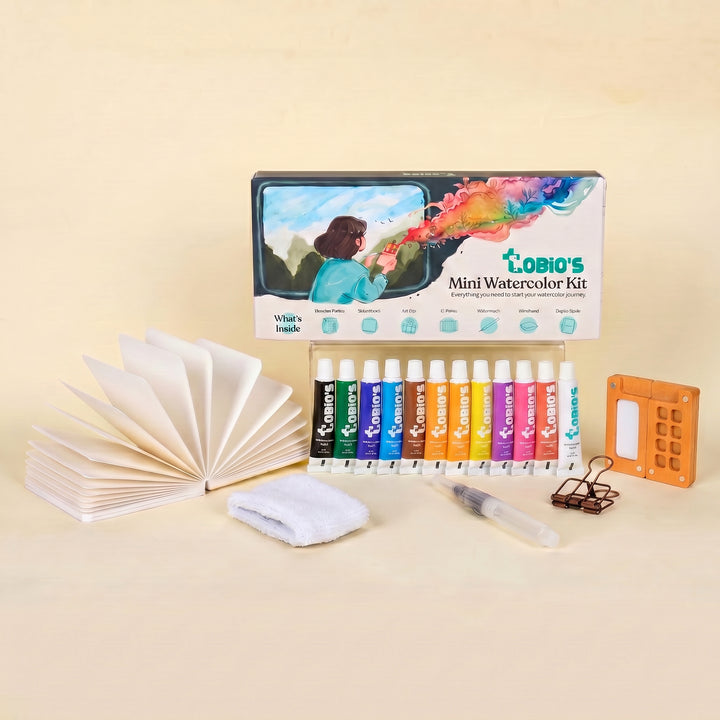
This tutorial was designed for use with our Watercolor Kit.
Shop the Kit


