
How to Paint an Oyster: Watercolor Tutorial


What You'll Need
- Watercolor paper
- Pencil and eraser
- Two water cups
- Paper towel or clean cloth
- Round brush
- Washi tape
Color Palette
You want that salty, coastal vibe, but your previous attempts looked more like a geology diagram than a piece of art. We’ve all been there.
While many tutorials focus on hyper-realism, this guide is about capturing the essence of the shell. We are focusing on a Loose Sketchbook Style. This means we are trading stiff perfection for fluid lines and happy accidents. This is the kind of oyster watercolor painting you can do in 15 minutes while your coffee is still hot.
It’s fast, it’s beginner-friendly, and it uses the water to do the heavy lifting for you.
If you want more projects like this after you finish, you can browse our full library of step-by-step lessons on Watercolor Tutorials.
What You’ll Be Able to Paint (Beginner to Advanced)
Option 1: Beginner (15 to 25 minutes)
Goal: One loose oyster, soft interior, simple rim, no stress.
- Skill focus: wet-on-wet base wash, simple shadow placement
- Best for: first-timers, quick sketchbook studies, relaxing practice
Option 2: Intermediate (30 to 45 minutes)
Goal: One oyster with believable depth, ridges, and a convincing pearl.
- Skill focus: glazing, value planning, controlled texture
- Best for: painters who can wait for layers to dry (a rare superpower)
Option 3: Advanced (60 minutes or more)
Goal: A small cluster with overlaps and optional background wash.
- Skill focus: composition, depth through layering, extra texture and details
- Best for: coastal print sets, statement pieces, “look what I did” energy
The "Coastal Minimalist" Color Palette
Based on the sketchbook study shown above, you don't need a massive kit. This specific look relies on just three pigments.
- Payne’s Gray: This is your workhorse. It handles the steel-blue outer shell and the deep interior shadows.
- Raw Sienna: A warm, sandy yellow for that stained, organic look on the shell’s rim.
- Burnt Umber: A rich brown to mix with the gray for the "dirty" edges of the shell.
Paper Specs: Even for a quick sketch, paper matters.
Use 140lb (300gsm) Cold Press watercolor paper. The texture allows the pigment to settle into the grooves, creating natural shell textures without you having to paint them manually.
If you’re building your watercolor habit and want an easy way to get set up for projects like this, start at Tobio's Kits and pick something that matches your pace.

The Wonky Oval (Pencil Sketch)
Grab a pencil and draw a kidney bean or a wonky oval. Oysters are organic, if you draw a perfect circle, it’s going to look fake.
- Draw the outer uneven edge.
- Draw a smaller inner circle (the "cup" of the shell).
- Artist Tip: Keep your pencil lines light and loose. If your hand shakes, good. That adds texture.

The "Mother of Pearl" Wash
We are going to paint the inside first using a "wet-on-wet" technique, but we’ll keep it controlled.
- Dip your brush in clean water and wet the inside of the shell (the cup).
- Load a watery mix of Raw Sienna and drop it near the center.
- Immediately drop in a watered-down Payne’s Gray on the opposite side.
- The trick: Do not over-blend. Let the yellow and gray touch and swirl on their own. This creates that iridescent, pearly look naturally.

The Crusty Outer Shell
While the inside is settling (it can be damp, but not soaking), let’s tackle the outside.
- Mix a stronger, creamy consistency of Payne’s Gray mixed with a touch of Burnt Umber.
- Using the tip of your round brush, paint the outer rim.
- Be messy here. Vary your pressure. Press down for a thick line, lift up for a thin one. Leave some white gaps between the outer shell and the inner cup to act as a highlight.

The Muscle Mark & Deep Shadows
Look at the reference image. See that dark blob inside the shell? That’s the adductor muscle scar, and it gives the painting depth.
- With the paper slightly damp (not wet), drop a concentrated spot of Payne’s Gray into the middle-left of the interior.
- Let it bleed slightly, soft edges look more natural than hard circles.
- Add a final dark stroke under the "lip" of the shell to make it look cupped and 3D.
The "Walk Away"
This is the hardest step. You will want to fiddle. You will want to fix that one bloom.
Don't.
The charm of an expressive oyster watercolor painting lies in the drying lines and the watermarks. Let it dry completely.
Can You Do an Oyster Watercolor Painting on Canvas?
Yes, but not on raw canvas. Watercolor needs an absorbent surface.
What to use
Coat the canvas with watercolor ground and let it cure according to the manufacturer instructions.
How it paints differently
- Water tends to sit on top longer, so paint can travel more
- You will likely use less water and rely more on glazing
- Lifting is easier, which is helpful until it’s not
Sealing
After the painting is fully dry, use a spray fixative suitable for watercolor on canvas. Varnish is optional if you want extra protection and a different finish.
Troubleshooting (Muddy Color, Blooms, Flat Shells)
“My colors look muddy.”
- Cause: too many pigments mixed together or overworking a damp area
- Fix: limit your mixes to 2 to 3 colors and let layers dry before glazing
- Reset move: let it dry, then glaze a single unifying light wash
“I’m getting blossoms and I hate them.”
- Cause: adding wetter paint into a wash that is starting to dry
- Fix: either soften the bloom edge with a damp brush while still wet, or let it dry and glaze over it
“It looks flat, not 3D.”
- Cause: not enough value contrast
- Fix: deepen only the darkest 5 to 10 percent (under the pearl, hinge area, under the lip)
“I overworked the pearl.”
- Cause: scrubbing and repainting while it is damp
- Fix: let it dry completely, then add one smooth, very light glaze to re-unify
Inspiration: Why This Style Works
This loose approach is perfect for:
- Restaurant Journals: document that seafood platter before you eat it.
- Gallery Walls: Paint 3 or 4 of these on small 5x5 squares for a grid display.
- Warm-ups: Loosening up your wrist before a serious painting session.
Frequently Asked Questions
Do I need to be good at drawing to start this?
Not at all. This specific style relies on "wonky" organic shapes. If you can draw a kidney bean or a wobbly oval, you are qualified. In fact, perfect circles make the shell look fake.
How long does this oyster watercolor painting actually take?
If you stop fiddling? About 15 minutes. This tutorial is designed as a "sketchbook study," meaning we rely on wet-on-wet techniques that happen quickly. If you are glazing for an hour, you are overworking the freshness.
Can I use cheap paper for sketchbook studies?
I wouldn't. Even for a quick oyster watercolor painting, the magic happens in the texture. You need 140lb (300gsm) Cold Press paper so the pigment settles into the grooves. You can use student-grade paint, but don't skimp on the paper.
Conclusion
A charming oyster watercolor painting isn’t about perfection, it’s about letting the water do the heavy lifting: granulating grays, sandy browns, and a shell shape that feels organic, not engineered. Sketch wonky, paint wet, and let the texture happen on its own.
If you want to keep the momentum going with guided projects and less supply guesswork, head over to Tobio’s Kits and pick a kit that makes painting feel like a break, not a battle.
Mel, Founder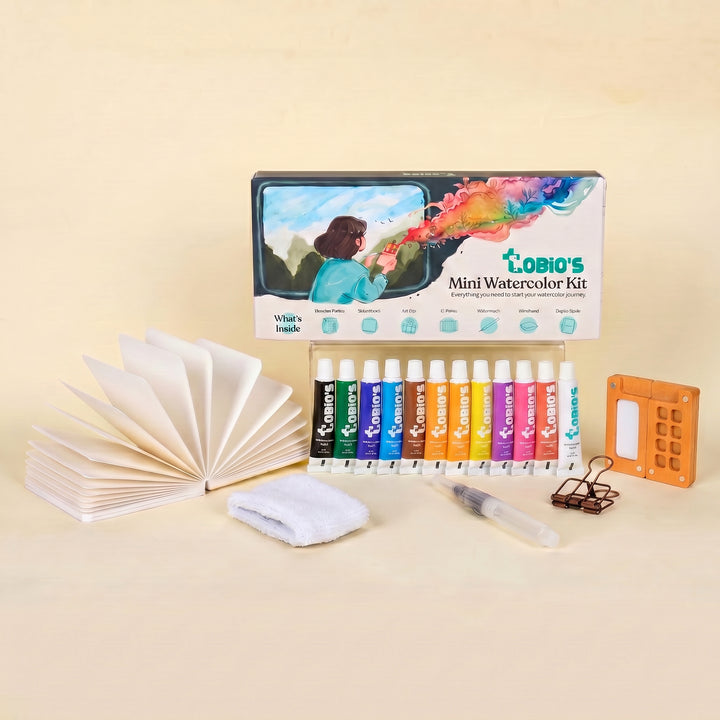
Ready to Paint?
This tutorial was designed for use with our Watercolor Kit.
Link to the link


