Parrot Watercolor Painting: Step-by-Step Tutorial


What You'll Need
- Watercolor Paper
- Pencil and eraser
- Two water cups
- Watercolors
- Round brush
Color Palette
If you’ve ever tried painting a bird and ended up with a stiff, anatomical diagram, you’re trying too hard. The image above isn't about counting feathers; it’s about capturing energy.
While this is technically a tutorial for a parrot watercolor painting, we are ditching the rigid rules. We are focusing on a "Loose Sketchbook Style." This method is fast, messy, and relies on the water doing the work for you. It’s perfect for travel journaling or a quick creative coffee break.
If you want more projects like this after you finish, you can browse our full library of step-by-step lessons on Watercolor Tutorials.
The "Sketchbook" Color Palette
Looking at our reference study, we aren't using a complicated 12-color mixing chart. We are using a simple, vibrant selection to keep the painting bright rather than muddy.
- Parrot Red: The powerhouse color for the head and chest.
- Sunshine Yellow: For the bright shoulder patches and mixing.
- Wing Tip Blue: For the wing tips and tail feathers.
- Background Sap: For the background splashes and wing transitions.
- (Note: You can mix the Blue and Red to create a dark neutral for the beak and eye).
Supplies for a Stress-Free Session
Since we are working loose, your paper matters. You need something that can handle a splash without buckling instantly.
- Paper: 140 lb / 300 gsm Cold Press watercolor paper. (The sketchbook format is perfect for this).
- Brushes: A single Round Brush (Size 6 or 8) can do 90% of the work here.
- Extras: A pencil (HB), a kneaded eraser, and a paper towel.

The "Barely There" Sketch
Don't press hard. You want a ghost of an outline, just enough to guide your brush.
- Draw a curved line for the beak and head.
- Sketch a simple oval for the wing.
- Mark the branch placement lightly.
- Pro Tip: Do not draw feathers. Draw the shape of the bird. If you draw every feather, you will feel obligated to paint every feather, and that kills the sketch vibe.

The "Background Sap" Splash
We are working "outside in" to establish the mood.
- Load your brush with watery Background Sap.
- Paint loose, abstract "cloud" shapes behind where the parrot sits.
- Don't fill the whole page. Leave plenty of white space. Let the edges be rough and organic.

The "Parrot Red" Wash
While the background is settling, let’s tackle the bird.
- Load up Parrot Red. Start at the top of the head.
- Paint down the chest and back, strictly avoiding the beak and the white patch around the eye.
- Crucial: Leave gaps of white paper on the chest! Don't fill it in like a coloring book. Those white gaps look like light hitting the feathers.

The Gradient Wing
This is the fun part. We are using a technique called "charging," where we drop color into a wet shape.
- While the red wash is still damp, rinse your brush and pick up Sunshine Yellow. Touch it to the "shoulder" of the wing so it blends into the red.
- Moving down the wing, drop in Wing Tip Blue at the ends.
- Allow gravity to pull the blue down into the tail feathers. If the colors bleed into each other, let them! That is the "expressive" part of a parrot watercolor painting.
Style Variations: Blue Macaw, Amazon Green, and Storybook Version
The "Blue Macaw" (Cool and Classic)
- Invert the temperatures: Instead of the warm red body, use your Wing Tip Blue as the main body wash.
- Swap the glow: While the blue wash is wet, charge the chest area with Sunshine Yellow. Watch it turn a brilliant green where they meet, don't fight it, that’s the magic.
- Deepen the contrast: Use a mix of Parrot Red and Wing Tip Blue (heavy on the blue) to create deep, indigo shadow shapes under the wing to make the yellow chest pop.
The "Amazon Green" (The Texture Challenge)
- Change the palette: Forget the red. Create a lime green base by mixing Sunshine Yellow with a tiny touch of Background Sap.
- Emphasize texture: While damp, drop in pure, unmixed Background Sap or even Blue in short, jagged strokes to suggest ruffled feathers on the back and neck.
- Camouflage the beak: instead of a dark beak, leave it pale (paper white) with just a light grey shadow underneath to match the lighter beak of green parrots.
The "Storybook Parrot" (Simplified for kids or quick cards)
- Exaggerate shapes: Make the head perfectly round and the beak overly large and curved. Give it a "chunky" look rather than a sleek one.
- Minimize the palette: Use one flat wash of Parrot Red for the body and one solid stripe of Wing Tip Blue for the wing. No fancy blends.
- Skip the mess: Forget the background splashes and the "charging" technique. Go for a smooth, clean silhouette that reads "tropical" instantly.
Inspiration: Why This Style Works
This loose, expressive sketchbook approach to a parrot watercolor painting is perfect for:
- Zoo & Field Sketching: Capture the loud personality of a bird at the zoo or on vacation before it hops away. You don’t need them to pose; you just need to catch the "S" curve of the posture and the splash of color.
- Instant Tropical Decor: Because parrots are naturally vibrant, even a quick study looks high-energy. Frame two or three of these loose paintings in simple white frames for an instant "summer vacation" vibe in your home.
- Conquering "Mud Fear": Painting bold colors is intimidating because beginners fear making brown mud. This style is the perfect, low-stress way to practice letting complementary colors (like Red and Green) sit near each other without scrubbing them into a mess.
Frequently Asked Questions
1. "My red and green mixed and turned brown. What happened?"
Stop scrubbing! Red and Green are opposites (complementary colors). When they mix thoroughly, they cancel each other out and make mud. The trick to a vibrant parrot watercolor painting is to let the colors touch on the paper but not stir them together with your brush. Let the water do the blending for you.
2. "How do I paint feathers if I don't draw them first?"
You paint the suggestion of feathers, not the feathers themselves. By using the "charging" technique (dropping Wing Tip Blue into wet Sunshine Yellow) or leaving rough dry-brush marks on the wing, the viewer's brain fills in the texture automatically. If you paint every single feather, your bird will look more like a pinecone than a parrot.
3. "My background splash bled into the bird! Is it ruined?"
Absolutely not, that is the best part! In a loose sketchbook study, we want the subject to feel connected to the environment. If the Background Sap bleeds slightly into the Parrot Red shoulder, it creates a soft edge that implies movement. It shows the bird is in the atmosphere, not a sticker pasted on top of it.
Conclusion
Parrot watercolor paintings get much easier when you stop trying to paint every feather and instead focus on: a clean base wash, controlled wet-on-dry details, and a few well-placed shadows. Start simple, finish the painting, then level up with glazing and selective texture.
If you want your next painting session to be even smoother, explore more step-by-step lessons in the watercolor tutorials section, or head back to Tobio’s Kits to keep the creative momentum going.
Mel, FounderLike these guides? Set Tobio's as a preferred source on Google and our pages will show up first when you search for watercolor questions.
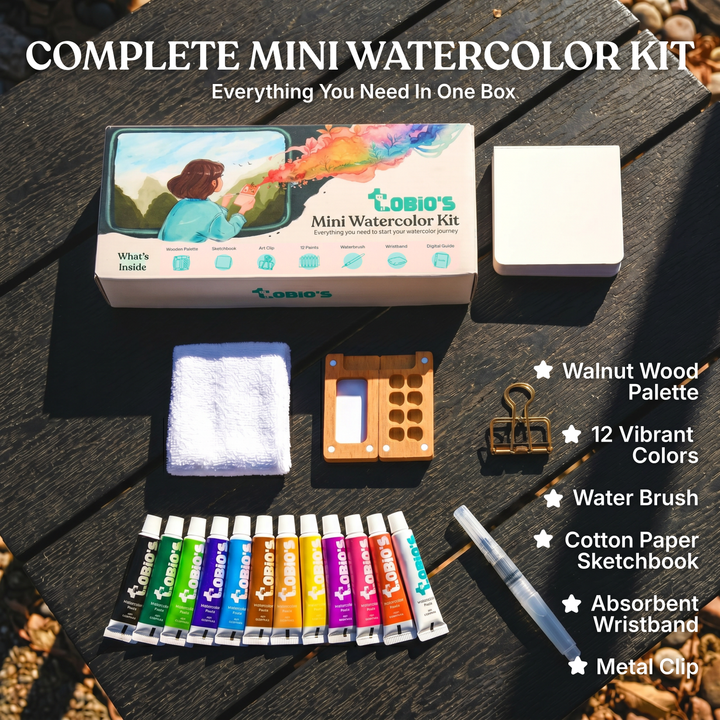
Ready to paint along?
Everything you need to paint anywhere and feel inspired doing it.
- Ultra compact
- Express yourself creatively
- For total beginners