Seahorse Watercolor Painting: Step-by-Step Tutorial


What You'll Need
- Watercolor Paper
- Pencil and eraser
- Two water cups
- Watercolors
- Round brush
Color Palette
Welcome to your new favorite creative break. If you’ve ever tried painting ocean animals and ended up with a sad, overworked blob, you are entirely in the right place.
While this is technically a tutorial for a seahorse watercolor painting, we are completely ditching the hyper-realistic, hours-long perfectionism. Instead, we are focusing on a "Loose Sketchbook Style." This approach is fast, wonderfully expressive, and highly beginner-friendly. We aren't taping down edges, we aren't using masking fluid, and we definitely aren't stressing.
If you want more projects like this after you finish, you can browse our full library of step-by-step lessons on Watercolor Tutorials.
The Minimalist Color Palette
You do not need 48 tubes of paint to make something beautiful. Based on our quick, loose study, here are the exactly four pigments we are using to bring this underwater scene to life:
- Cadmium Yellow Light: For that bright, sunny base of the seahorse's body.
- Burnt Sienna: To drop in warm, natural shadows along the spine and the curl of the tail.
- Cerulean Blue: For the soft, watery splashes in the background.
- Sap Green: For the loose, sweeping underwater foliage.

The Bare-Bones Sketch
Keep your pencil lines whisper-light. Draw a gentle "S" curve for the spine, a small oval for the head, a little triangular snout, and curl the bottom into a spiral. You want a loose guide, not a coloring-book outline.

Splash in the Seahorse Base
Load your brush with Cadmium Yellow Light and water, then loosely fill in the seahorse shape. Don't worry about staying perfectly inside the lines!
While the yellow is still shiny and damp, pick up a tiny bit of Burnt Sienna on the tip of your brush and dab it along the back ridges and inside the tail curve.
Let the colors bleed together naturally, do not over-mix them on the paper.

Expressive Seaweed and Water
You don't even need to wait for the seahorse to dry. Take your Sap Green and make quick, vertical, wavy strokes around the bottom and sides to suggest sea plants. Rinse your brush, grab some watery Cerulean Blue, and dab a few loose water shapes around the background. If a little blue touches the green and bleeds, embrace it! That’s the magic of a loose sketchbook study.

The Final Pop of Detail
Once the paper is completely dry, use the very tip of your brush with a concentrated mix of Burnt Sienna to add a tiny dot for the eye. You can also add a few quick, jagged lines along the back fin or belly for texture.
Step back and admire your work.
Style Variations: Deep Sea, Sunlit Reef, and Storybook Seahorse
Want to change the vibe of your seahorse watercolor painting?
Try these quick sketchbook adaptations:
The "Deep Sea Dweller" (Dramatic & Heavy)
- Cool the palette: Swap your sunny yellows and warm Siennas for deep, moody blues like Indigo, Phthalo Blue, or a dark violet.
- Deepen the shadows: Paint the curves of the belly and under the chin much darker, leaving only a tiny sliver of pale rim light on the very top of the head and spine.
- Lost edges: Let the bottom of the coiled tail bleed entirely into a dark, heavy indigo background wash to anchor it in the mysterious depths of a midnight kelp forest.
The "Sunlit Reef" (The Smooth, Gentle Phase)
- Lighten the palette: Stick to highly watered-down pastel pinks, pale lemons, and the softest wash of Cerulean Blue for the background.
- Change the proportions: Soften the jagged armor ridges so the seahorse sits as a smooth, rounded, delicate little creature (think of a tiny pygmy seahorse).
- The "Fresh" Texture: Skip the heavy, crunchy Burnt Sienna shadows. Keep the washes light, translucent, and smooth for a luminous, sun-dappled look.
The "Storybook Seahorse" (Simplified for Cards & Patterns)
- Exaggerate shapes: Push the shape language into perfectly stylized curves—a perfectly round belly, an exaggerated pointy snout, and a distinct, tightly wound spiral for the tail.
- Bring back the speckles: Lean into the illustrative vibe by flicking a few perfect, deliberate splatters of contrasting paint over the dry seahorse for a fun, stylized texture.
- Flat color: Skip the messy, wet-on-wet watercolor bleeds. Use flat, highly-pigmented, graphic washes of solid color, and consider outlining the final dry piece with a waterproof ink pen.
Inspiration: Why This Style Works
This loose, expressive sketchbook approach to a seahorse watercolor painting is perfect for:
- Beach Vacation Journals and Aquarium Logs:
Capture the magical marine life you spotted on a snorkeling trip or at the local aquarium without needing an underwater camera or a marine biology degree. You don’t need to paint every single armor plate or fin ray; you just need that iconic, curvy silhouette to bring the memory back. - Coastal & Nursery Decor:
Because seahorses are naturally whimsical and delicate, a soft, loose study looks timeless in a bright, beach-themed bathroom or a cozy nursery. Frame a trio of these (perhaps adding a real seashell or a piece of sea glass to the frame) for instant, ocean-inspired wall art that doesn't feel generic or "store-bought."
Frequently Asked Questions
My seahorse turned into a muddy, brown blob. What happened?
Deep breaths! This usually happens from over-mixing or scrubbing the wet paper with your brush. Next time, just drop your yellow and brown next to each other on wet paper and let the water do the blending for you.
Do I really need heavy 140lb watercolor paper for a quick 15-minute sketch?
Honestly, yes. Since we use wet-on-wet techniques, thin paper will warp instantly and create weird puddles. Thick 140lb (300 gsm) paper won't buckle into a taco, letting you focus on fun instead of fighting your sketchbook.
Can I use this exact same method for other ocean animals?
Absolutely! This loose 4-step method works for almost anything. Try it with a sea turtle using Sap Green, or a jellyfish using watery Cerulean Blue.
Just keep the sketch minimal and let the water do the heavy lifting!
Conclusion
A solid seahorse painting is really just a handful of smart watercolor moves stacked in the right order: soft wet-on-wet background, a warm base layer, a couple of glazes for form, then texture and tiny details. That’s it. No magic, no mystery, no “talent required.”
If you want more beginner-friendly projects you can finish in a relaxed sitting, head over to Tobio’s watercolor tutorials, or explore what’s available on Tobio’s Kits and make your next creative break absurdly easy to start.
Mel, FounderLike these guides? Set Tobio's as a preferred source on Google and our pages will show up first when you search for watercolor questions.
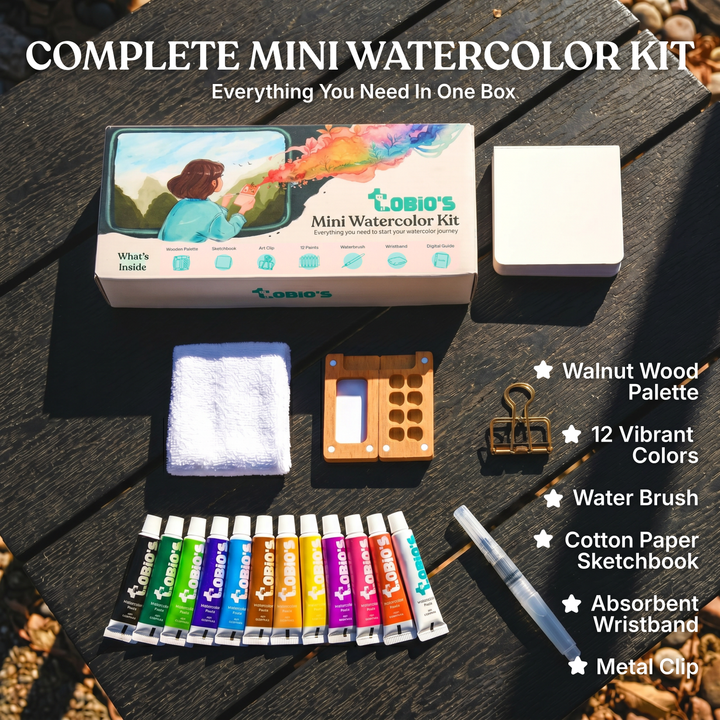
Ready to paint along?
Everything you need to paint anywhere and feel inspired doing it.
- Ultra compact
- Express yourself creatively
- For total beginners