Watercolor Leaf Painting: Step-by-Step Tutorial


What You'll Need
- Watercolor Paper
- Pencil and eraser
- Two water cups
- Watercolors
- Round brush
Color Palette
Let’s be honest: sometimes you just want to paint without overthinking it. While this is a definitive guide to watercolor leaf painting, we are skipping the stiff, overworked botanical illustrations today. Instead, we are focusing on a loose sketchbook style that is fast, expressive, and beautifully beginner-friendly.
If you have ever stared at a blank page and felt intimidated, this 15-minute study is your antidote. We are going to embrace the happy accidents, like those gorgeous natural blooms in the center of our example, let the water do the heavy lifting,
If you want more projects like this after you finish, you can browse our full library of step-by-step lessons on Watercolor Tutorials.
The Monochromatic Palette for Our Watercolor Leaf Painting
If you look closely at the leaf in our sketchbook, you won't see a rainbow of warm yellows or deep blues. It relies on the beauty of a simple, nearly monochromatic green scale! To achieve this translucent, organic look, you only need to use varying concentrations of a basic green pigment.
- Spring Green (or Light Hooker's Green): A pale, fresh green for the light, watery, translucent base of the leaf.
- Muted Olive (or your base green with a tiny bit less water): A slightly darker, more concentrated green to define the edges and sweep in the organic veins.

The Ghost Sketch
Lightly map out a simple teardrop shape with a slight point at the tip. Keep the pencil pressure extremely light so it doesn't overpower the transparent paint.

The Juicy Base Wash
Mix a very watery puddle of your lighter Spring Green.
Load up your brush and fill in the entire leaf shape. Don't scrub the paper; just let the wet paint glide across the surface. Let the water pool naturally to create those slightly uneven, beautiful "blooms" right in the middle.

Defining the Edges
While that base wash is still damp, pick up a little more of your concentrated, slightly darker green (your Muted Olive). Gently run the tip of your brush along the outer edge of the leaf. Let the water naturally pull this darker pigment into the lighter wash for a soft, bleed effect.

Expressive Veins
Wait until the leaf is mostly dry, but perhaps retains the tiniest hint of moisture. Using the very tip of your round brush and your slightly darker green, quickly sweep in the central vein and a few diagonal side veins. Because you aren't overworking it, the lines will look organic and natural, giving you that perfect loose sketchbook vibe.
Add a quick flick for the stem at the bottom, and you're done!
The "Walk Away"
Resist the urge to fiddle or "fix" a messy puddle!
The true magic of expressive watercolor happens in those unpredictable watermarks and natural bleeds.
Drop your brush, step back, and let it dry completely.
Style Variations: The Moody Forest Floor, Sunlit Sprout, and Storybook Foliage
Want to change the vibe of your watercolor leaf painting?
Try these quick sketchbook adaptations using the exact same teardrop shape:
The "Moody Forest Floor" (Dramatic & Heavy)
- Cool the palette: Swap your bright, fresh greens for deep, moody hues.
Drop a tiny bit of Payne’s Gray or a warm brown into your wet green wash. - Deepen the shadows: Paint the base of the leaf and the central vein much darker, leaving only a tiny sliver of pale, watery light at the very tip.
- Lost edges: Let the bottom of the stem bleed entirely into a dark, heavy shadow wash to anchor it, making it look like it's resting on damp forest soil.
The "Sunlit Sprout" (The Smooth, Gentle Phase)
- Lighten the palette: Stick to highly watered-down, translucent washes leaning heavily on pale yellows rather than deep greens.
- Change the proportions: Soften the pointed tip so the leaf sits as a fat, rounded, freshly sprouted bud.
- The "Fresh" Texture: Skip the heavy, crunchy veins. Keep the washes incredibly light and smooth for a delicate, translucent look.
The "Storybook Foliage" (Simplified for Cards & Patterns)
- Exaggerate shapes: Push the shape language into a perfectly symmetrical, almost geometric teardrop silhouette.
- Bring back the speckles: Lean into a fun, illustrative vibe by flicking a few deliberate splatters of dark green paint over the dry leaf for a stylized texture.
- Flat color: Skip the messy watermarks entirely. Use a flat, highly-pigmented, graphic wash of solid color with zero blooms.
Inspiration: Why This Style Works
This loose, expressive sketchbook approach to a watercolor leaf painting is perfect for:
- Nature Journals and Foraging Logs:
Capture the beautiful foliage you spotted on a hike or in your garden without needing a macro lens or a botany degree. You don’t need to paint every single microscopic cellular vein; you just need that organic, earthy silhouette to bring the memory back to life. - Botanical & Earthy Decor:
Because leaves are naturally grounding and organic, a soft, loose study looks timeless in a home office or cozy reading nook. Frame a trio of these quick 15-minute studies (perhaps leaving the torn edges of the watercolor paper exposed) for instant, nature-inspired wall art that doesn't feel rigid or "store-bought."
Frequently Asked Questions
Why does my watercolor leaf painting look flat without those cool watermarks?
You might be overworking the paint! Those beautiful "blooms" happen when a wet wash pools and dries naturally. For a loose style, drop the color in, then step back and let the water do the work.
Do I really need thick paper for a quick sketchbook study?
Yes. Even for a quick watercolor leaf painting, 140 lb / 300 gsm paper is non-negotiable. Thin paper warps instantly and absorbs water too fast to create those gorgeous, transparent bleeds.
How do I paint crisp veins without them turning into a blurry mess?
It's all in the timing! If you paint veins while the base wash is soaking wet, they will feather out entirely. Wait until the leaf is mostly dry with just a tiny hint of dampness for clean, organic lines.
Conclusion
Once you’ve painted a few pages of leaves, you’ll realize the “secret” isn’t secret at all: simple shapes, believable mixes, and letting layers dry before you fuss with them. Practice the drills, rotate through the five leaf types, then build up to clusters and foliage masses.
If you want more guided projects with a calm, beginner-friendly vibe, explore our watercolor tutorials, or learn more about the brand and what we make at Tobio’s Kits.
Mel, FounderLike these guides? Set Tobio's as a preferred source on Google and our pages will show up first when you search for watercolor questions.
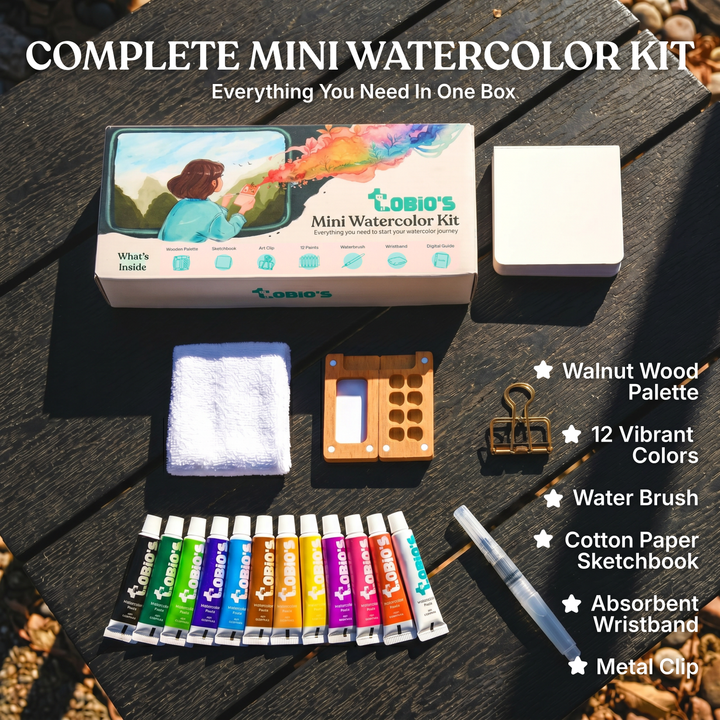
Ready to paint along?
Everything you need to paint anywhere and feel inspired doing it.
- Ultra compact
- Express yourself creatively
- For total beginners