


Watercolor Painting of Rocks: Step-by-Step Tutorial


What You'll Need
- Watercolor Paper
- Pencil and eraser
- Two water cups
- Watercolors
- Round brush
Color Palette
If your painted rocks usually end up looking like overworked, sad potatoes, take a deep breath. You are not alone, and the problem isn't your talent, it's over-complicating the process! While this is a tutorial for a watercolor painting of rocks, we are tossing the rigid rulebook out the window.
Today, we are focusing on a Loose Sketchbook Style that is fast, expressive, and incredibly beginner-friendly. No masking tape, no tedious tracing, and no agonizing over tiny textures. Just clip your mini travel palette to your sketchbook with a bulldog clip, grab a brush, and let’s get a little messy.
If you want more projects like this after you finish, you can browse our full library of step-by-step lessons on Watercolor Tutorials.
The Minimalist Setup & Color Palette
You do not need a studio full of fancy gear for this. A small sketchbook with decent paper, 140lb/300gsm cold press is the sweet spot so your water doesn't warp the page into a taco, is all you really need.
Notice the bright, beautiful paint blobs in the wooden palette at the top of the image? We are actually going to ignore those completely! Based entirely on the painted pile of stones on the page, here are the 4 earthy pigments you need to create this exact look:
- Yellow Ochre: A pale, dusty yellow-tan for the sunlit tops of the stones.
- Raw Sienna: A warm, mid-tone brown for the earthy sides and transitions.
- Payne's Gray: A cool, moody slate gray for the cooler rocks and soft shadows.
- Burnt Umber: A deep, rich brown for the darkest, crunchiest crevices.

The Wonky Outline
Grab your pencil and lightly sketch a messy, uneven pile of rocks. Don't stress about geometry or tiny cracks.
Look for big, chunky shapes stacked on top of each other.
If your sketch looks a bit lumpy and uneven, you are doing it perfectly.

The "Tea-Water" Base Wash
Mix a very pale, watery puddle (think the color of weak tea) of Yellow Ochre and another puddle of diluted Payne's Gray. Slap these colors loosely over the whole rock pile, letting them mingle on the paper.
Crucial: Leave a few random spots completely bare so the crisp white of the paper shines through as highlights. Now, step back and let this layer dry completely.

Carving the Chunks
Once your paper is bone dry, it's time to build form. Mix a slightly thicker, mid-value version of your Raw Sienna and Payne's Gray. Paint the shaded sides of the rocks where the light doesn't hit directly.
Keep your brushstrokes confident, chunky, and angular. Resist the urge to blend everything into a soft blur, hard edges make rocks look like rocks!

The Deep Crevices
Save this for the very end. Load your brush with a thick, concentrated mix of Burnt Umber and Payne's Gray.
Drop these dark accents only into the deepest cracks where the rocks overlap, and right at the bottom where they meet the ground.
This instantly anchors the pile so they don't look like floating space debris.
The "Walk Away"
Now comes the hardest part: resist the urge to fiddle. You'll want to smooth out a bloom or "fix" a messy puddle, but don't.
The true charm of an expressive watercolor painting of rocks lies in those unpredictable watermarks and natural bleeds.
Drop your brush, step back, and let it dry completely.
Style Variations: Moody Riverbed, Sunlit Pebble, and Storybook Cairn
Want to change the vibe of your watercolor painting of rocks? Try these quick sketchbook adaptations:
The "Moody Riverbed" (Dramatic & Heavy)
- Cool the palette: Swap your warm Siennas for deep, moody blues like Indigo or extra Payne’s Gray mixed with your brown.
- Deepen the shadows: Paint the bottom crevices much darker, leaving only a tiny sliver of pale rim light on the very top of the pile.
- Lost edges: Let the bottom of the lowest stones bleed entirely into a dark, heavy ground wash to anchor them in wet mud or river moss.
The "Sunlit Pebble" (The Smooth, Gentle Phase)
- Lighten the palette: Stick to highly watered-down Yellow Ochre and the palest wash of Raw Sienna.
- Change the proportions: Soften the jagged edges so the rocks sit as flat, rounded, water-polished ovals.
- The "Fresh" Texture: Skip the heavy, crunchy shadows. Keep the washes light and smooth for a fresh, un-chipped look.
The "Storybook Cairn" (Simplified for Cards & Patterns)
- Exaggerate shapes: Push the shape language into perfectly stacked, geometric blocks or distinct, stylized triangles.
- Bring back the speckles: Lean into the illustrative vibe by flicking a few perfect, deliberate splatters of paint over the dry stones for a stylized texture.
- Flat color: Skip the messy watermarks. Use flat, highly-pigmented, graphic washes of solid color.
Inspiration: Why This Style Works
This loose, expressive sketchbook approach to a watercolor painting of rocks is perfect for:
- Travel Journals and Hiking Logs:
Capture the cool geological formations you spotted on a mountain trail without needing a macro lens or a geology degree. You don’t need to paint every single mineral fracture; you just need that chunky, earthy silhouette to bring the memory back. - Earthy & Coastal Decor:
Because stones are naturally grounding and organic, a soft, loose study looks timeless in a study or cozy reading nook. Frame a trio of these (perhaps adding a sprig of dried grass or a piece of sea glass) for instant, nature-inspired wall art that doesn't feel "store-bought."
Frequently Asked Questions
Why does my watercolor painting of rocks look like a muddy blob?
You probably didn't let the first layer dry! If you add mid-tones while the base wash is still damp, everything bleeds into a sad, flat potato.
Remember Step 5: walk away. Crisp, hard edges on dry paper are what make rocks look real.
I don't have Payne's Gray or Raw Sienna. Can I still paint this?
Absolutely. A believable watercolor painting of rocks just needs three things: a warm brown, a cool dark tone, and a pale yellow-tan. Swap in Ultramarine Blue mixed with brown for your darks, or Burnt Sienna for warmth.
I accidentally painted over my white highlights. How do I fix it?
It happens! If you got a little brush-happy and lost the bare white paper, don't panic. Just wait for the painting to dry completely, then tap those crisp edges back in using a dab of opaque white gouache or a white gel pen.
Conclusion
Believable rocks come from boring fundamentals done well: clear light direction, a strong value plan, and patience between layers. Once that foundation is there, texture techniques become easy, and your watercolor painting of rocks starts looking like stone instead of guesswork.
If you want more structured guidance that builds these skills project by project, explore Tobio’s Kits and keep learning through the step-by-step lessons in the watercolor tutorials library.
Mel, FounderLike these guides? Set Tobio's as a preferred source on Google and our pages will show up first when you search for watercolor questions.
Ready to Paint?
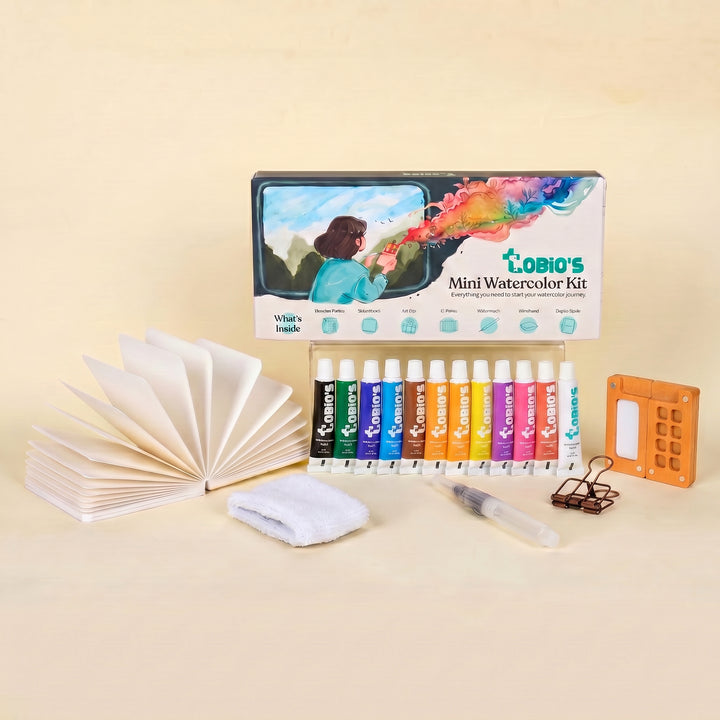
This tutorial was designed for use with our Watercolor Kit.
Link to the link


