Watercolor Painting Winter: Step-by-Step Tutorial


What You'll Need
- Paper
- Brushes
- Paint colors
- Palette
- Water cup
- Pencil
Color Palette
Winter landscapes are deceptively tricky. Beginners often overwork them, trying to paint "white" snow until it turns into gray slush. But the secret to a fresh watercolor painting winter scene isn't about what you paint, it's about what you don't paint.
In this loose sketchbook study, we are capturing a snowy cabin scene using negative space and soft, cool washes. We aren't painting every pine needle; we are using quick, triangular gestures to suggest trees and letting the white paper do the heavy lifting for the snow.
The Supplies
- Paper: 140lb/300gsm Cold Press paper. (Essential for wet-on-wet skies).
- Brush: A Size 8 Round Brush (for the sky/snow) and a Size 4 Round Brush (for the cabin/trees).
- Paints: See our "Frosty Morning" palette below.
The Color Palette
Based on the sketchbook study above, we are using a cool, limited palette to create that chilly atmosphere.
- Ultramarine Blue: The hero color for the sky and snow shadows.
- Burnt Umber: For the cabin walls and chimney.
- Payne's Gray (or Indigo): Mixed with green for the deep pine trees.
- Sap Green: Muted with a little red or brown for the winter foliage.
Step-by-Step: Your Expressive Watercolor Painting Winter Scene
The trick here is to work from "Background to Foreground" and to leave the snow bright white. In watercolor, you can't easily add white back in once it's gone, so we have to paint around the snow, not on it. Think of the sky as a curtain that hangs behind everything; we need to get that cold blue wash down first before we layer the crisp trees and cabin on top. By reserving the dry white paper for the roof and the ground, the snow looks bright and untouched, rather than muddy.

The Invisible Sketch
- Keep your pencil lines extremely light.
- Draw a simple horizon line (not straight! Make it a rolling hill).
- Sketch a tiny house shape: a box with a triangle roof.
- Important: Draw and paint the smoke on the roof

The Chilly Sky & The Snowy Ground
- Wet the entire sky area with clean water, stopping around the roof of the house and the tops of where the trees will be.
- Drop in a watery mix of Ultramarine Blue.
- The Texture: Let the blue bloom and settle. Don't smooth it out perfectly. A little blotchiness looks like winter storm clouds.
- While the sky dries, mix a very pale, watery Ultramarine Blue.
- Paint "shadow paths" across the white ground.
- Don't paint the whole ground blue! Just paint broad, sweeping stripes where the shadows of trees would fall. This defines the white paper as "snow" by contrast.

The Pine Trees (The Gesture)
- Mix Sap Green + Payne's Gray for a dark, cold green.
- Use the tip of your brush to paint loose, jagged triangles for the trees.
- The Trick: Leave gaps in the green! Don't paint solid triangles. Leave little white holes in the foliage to look like snow resting on the branches.
- Vary the heights. Make some tall and some short.

The Cabin Focus & The Shadows
- Use thick Burnt Umber to paint the front wall of the cabin.
- Paint a tiny dark square for the door/window.
- The Smoke: If your sky is still slightly damp, lift out a squiggle of paint with a clean, dry brush, or paint a faint gray swirl rising from the chimney. This adds instant coziness.
- Once the trees are dry, mix a dilute Payne's Gray.
- Paint a shadow on the snow underneath the cabin and the trees. This anchors them to the ground so they don't look like they are floating in mid-air.
Fix-It Guide: Common Winter Watercolor Problems
My snow looks flat
- Add a second, slightly darker shadow glaze in a few places.
- Increase contrast near the focal area (trees or cabin) and keep distance softer.
Everything turned gray and muddy
- Let layers dry fully before glazing.
- Use fewer pigments in mixes. Two colors is usually enough.
- Rinse your brush more often than you think you need to.
My sky has hard streaks
- Your paper was drying mid-wash. Work faster, or pre-wet evenly.
- Tilt your board slightly so the wash moves consistently.
Trees look like blobs
- Vary edge quality: soften one side, keep one side crisper.
- Add a few trunk hints and negative snow pockets to break up the mass.
Want more guided practice beyond winter? Browse these watercolor tutorials and reuse the same process for different landscapes and seasons.
Frequently Asked Questions
How do I keep my snow from looking gray?
Stop painting it! The brightest white in watercolor is the paper itself. Only paint the shadows (the blue stripes). If you paint the whole ground, you lose the light.
My trees bled into the sky.
You didn't wait long enough. The sky wash must be matte-dry (no shine) before you paint the green trees on top of it. If the paper is cool to the touch, it's still too wet.
Can I add falling snow?
Yes! Once the painting is 100% dry, cover the cabin area with your hand and flick white gouache (or white acrylic) off a toothbrush for a splatter effect.
Why does my cabin look flat?
You probably painted the whole house one color. Leave the roof white (snow-covered). Only paint the vertical walls brown. The contrast between the brown wall and white roof is what makes it pop.
Conclusion
Great watercolor winter paintings aren’t about painting every snowflake. They’re about clean whites, controlled washes, and confident value shifts. Start with the minimal snowfield, level up to pine silhouettes, then try the cabin glow when you want a story-focused scene.
If you want your learning to feel less like guesswork and more like “follow the steps, finish the painting,” head to Tobio’s Kits and keep practicing with guided projects you can actually complete.
Mel, FounderLike these guides? Set Tobio's as a preferred source on Google and our pages will show up first when you search for watercolor questions.
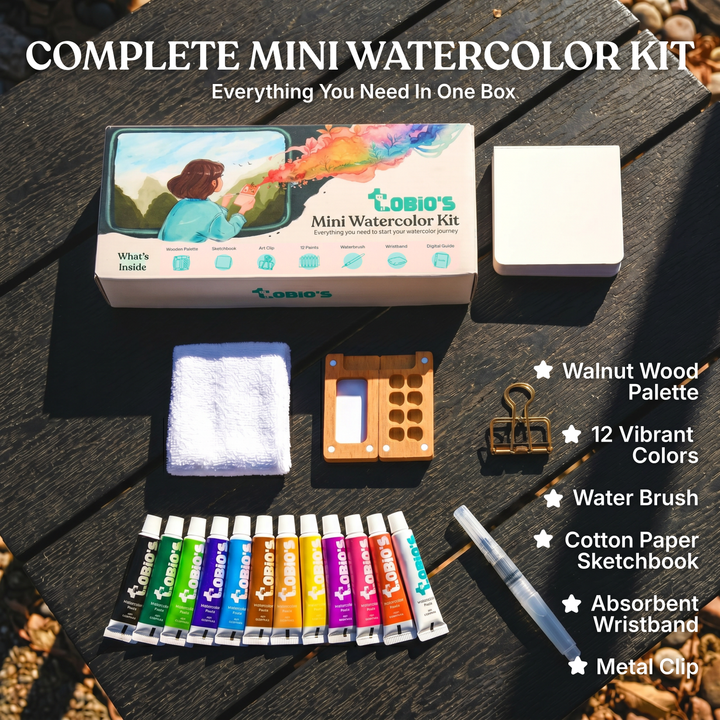
Ready to paint along?
Everything you need to paint anywhere and feel inspired doing it.
- Ultra compact
- Express yourself creatively
- For total beginners