


Indigo
Indigo color is the deep blue between blue and violet in the rainbow, named after the plant dye that put the blue in blue jeans. On the web it is #4B0082; in a paint box it is a dark, dusty navy.
What color is indigo?
| Hex | #4B0082 |
| RGB | 75, 0, 130 |
| CMYK | 42, 100, 0, 49 |
| Warm or cool | Cool, but the warmest of the dark blues, because it carries a little red. That is why it sits so comfortably next to browns. |
| On the wheel | Between blue and violet. The screen version leans purple; the dye and the paint lean toward blue-black. |
The story of indigo
Cloth dyed with indigo comes out of the vat yellow, and turns blue in the air while you watch.
The dye comes from the leaves of Indigofera tinctoria, a shrub domesticated in India, and the leaves are not blue. They hold a colorless compound, indican. Soak them, let the mash ferment for twelve to fifteen hours, and you get a yellow liquid; leave it open to the air and it oxidizes into a blue powder that will not dissolve in water. The oldest indigo-dyed cloth is 6,000 years old, from Peru, but India ran the trade: the Greeks called the stuff indikon, Indian, and English had indigo as a color name by 1289.

Europe had woad, a plant with the same molecule in smaller amounts. Then Vasco da Gama reached India by sea in 1498 and cheap indigo arrived by the shipload. The woad towns fought back with law: France and Germany banned imported indigo in the 1500s, officials announced that it rotted yarn, and in 1609 Henry IV of France made using "the false and pernicious Indian drug" a capital offense. None of it worked. The trade was never clean, either. In South Carolina it was grown by enslaved West Africans, and in Bengal the indigo farmers rose against the planters in 1859.
Isaac Newton put it in the rainbow. In the mid-1660s he bought a pair of prisms at a fair near Cambridge, just as indigo was arriving in England, and split a beam of sunlight on his wall. He named five colors, then added orange and indigo to make seven, so the spectrum would match the seven notes of a musical scale. He admitted his eyes were not much good at colors and had a friend mark the boundaries in pencil. Some later scientists think the band he called indigo is just blue.

Then a German laboratory ended the plantations. Adolf von Baeyer bought a lump of indigo for two thalers on his thirteenth birthday and published syntheses of it in 1878 and 1880; it took BASF until 1897 to make the process pay. That year about 7,000 square kilometers were planted with indigo, mostly in India, more than twice the area of Luxembourg. By 1914 plant indigo had fallen from 19,000 tons a year to 1,000, and Baeyer had a 1905 Nobel Prize. Levi Strauss and Jacob Davis patented riveted work pants in 1873, a pair of jeans takes 3 to 12 grams of indigo, and the world now makes about 80,000 metric tons of synthetic indigo a year, mostly for denim.
Which brings me to the tube in your hand. Real indigo fades, natural or synthetic, which is why your jeans fade, so almost nobody puts it in watercolor anymore. What sells as indigo today is a costume: a lightfast dark blue, usually indanthrone or a phthalo, mixed with black to hit the color of new denim. Indanthrone came out of BASF in 1901 as Indanthren, short for indigo from anthracene, which tells you what it was built to replace. Your screen shows indigo as a purple because in the 1980s a few programmers gave #4B0082 the name. I do not mind. The costume is better behaved than the original, and the name carries the whole story.
Pigment facts
| Colour Index | Not one pigment. Natural indigo is NB1 and synthetic indigo is PB66, but both fade, so most watercolor tubes labeled indigo are mixtures: a lightfast dark blue such as indanthrone (PB60), phthalo blue (PB15) or Prussian blue (PB27) with a black (PBk6, PBk7 or PBk9). |
| Transparency | Semi-transparent. The black in the mix takes the glow down a notch, but thin washes still let the paper through. |
| Lightfastness | Depends on the tube. Genuine indigo, NB1 or PB66, fades in strong light. Modern mixtures built on indanthrone or phthalo blue are excellent. |
| Granulation | Usually none. Phthalo and indanthrone mixtures dry smooth; a version built on ultramarine granulates gently. |
| Staining | Moderate to high. Phthalo-based indigos bite into the paper and will not lift once dry, so plan your highlights first. |
| Toxicity | Non-toxic. The dye has low toxicity, and the modern mixtures are organic pigments plus carbon black. |
These describe the pigment in general. Every brand's tube behaves a little differently, so test yours on scrap paper.
How to mix indigo
You can mix a convincing indigo from any dark blue and a little black; that is what the tube is anyway. Ultramarine with a touch of black gives a soft, granulating version; phthalo blue with black gives a smooth, staining one closer to new denim. Keep the black under a quarter of the mix or the blue dies.
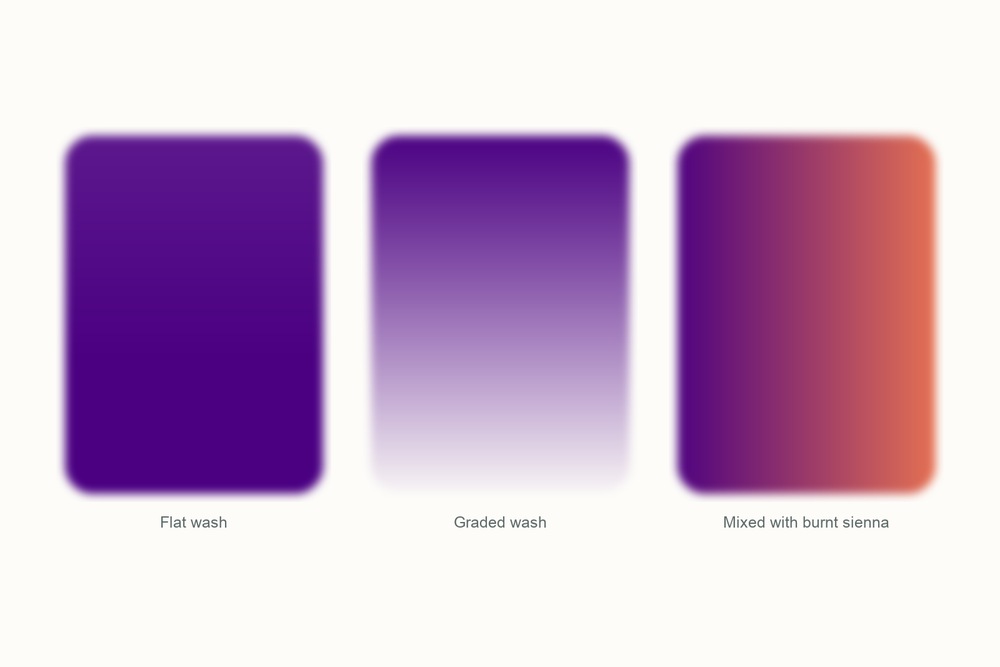
Indigo and burnt sienna is the pairing that matters. Equal parts make a warm near-black that stays a color; tip it toward the sienna for tree bark, toward the indigo for a night sky with a horizon still in it. If you own Payne's gray, indigo is its bluer, moodier cousin.
| Mix | Recipe | Best for |
|---|---|---|
| Indigo from scratch | Ultramarine with a touch of black, about four to one | When the palette has no indigo |
| Denim indigo | Phthalo blue with a little black, about three to one | New jeans, deep water, night windows |
| Warm near-black | Indigo and burnt sienna, half and half | Darks that still read as color |
| Faded denim | Indigo very dilute, a second glaze over the folds once dry | Fabric, worn jeans, distant hills |
| Storm gray | Indigo with a speck of Venetian Red and plenty of water | Rain clouds, wet slate |
| Bottle green | Indigo with yellow ochre, roughly equal | Dark foliage, the old way to make green |
Closest mix from the Tobio's kit
Twilight Indigo with Ivory Black, about three to one, then a speck of Forest Green to pull it away from violet and toward the blue-black of dyed cloth. Twilight Indigo on its own is brighter and more purple than any painter's indigo, so the black does most of the work. Add water until it looks like new denim rather than a bruise. Test on scrap first.
The 12-color kit does not include a tube of indigo, so this is how I get there with what is in the palette. Running low on a color? The 12 paint refills drop straight into the wells.
Using indigo in watercolor
Use indigo where you want dark without dead: night skies, deep water, the folds of a pair of jeans. It is my color for the sea in the last hour of light, when the water is nearly black but you can still tell it is blue.
Wet-on-wet, it makes a night sky in one move. Wet the paper, drop indigo along the top, tilt the board and let it fade toward the horizon. Leave a warm strip of bare paper at the bottom and the sky reads as dusk instead of a blackout.
It pairs best with browns: burnt sienna or raw umber next to it looks warmer, and the indigo beside them looks deeper.
One thing I learned the hard way: a painting done mostly in indigo dries flat, like a poster. It needs a warm color somewhere on the page to push against. I once painted a harbor at night in three strengths of indigo and it looked like a photocopy. A little burnt sienna in the boats fixed it.
Everything I use on this page is the Tobio's Watercolor Kit: twelve colors chosen to mix, a walnut palette, cotton paper, and a water brush. Want to see how any two of the colors blend before you commit? Try the interactive color mixing chart.
Get the kitIndigo vs Prussian blue (and Payne's gray)
Prussian blue is the one people confuse with indigo, and they really are close: a Nature article in the late 1800s compared the pigments and found indigo almost identical to Prussian blue. The difference is temperature. Prussian blue is colder and greener; indigo carries a little red and settles into a softer, dustier dark.
Payne's gray is the other neighbor, and in many ranges it is nearly the same recipe, a blue and a black, tipped further toward black. Indigo keeps more of the blue. If you own both, indigo goes into skies and water and Payne's gray into shadows and stone.
If indigo is the sea at nine in the evening, Prussian blue is the same sea in January at noon, and Payne's gray is the rain coming in over both.
Questions people ask
What color is indigo?
Is indigo warm or cool?
What colors make indigo?
Is indigo toxic?
Is indigo blue or purple?
Why is indigo in the rainbow?
Sources
- Indigo, Wikipedia (the color name, Newton, the web color)
- Indigo dye, Wikipedia (plant, chemistry, bans, synthesis, denim)
- Isatis tinctoria (woad), Wikipedia (the laws against indigo)
- An Indigo Factory, Allahabad, Louis Rousselet, The Cleveland Museum of Art
- Loom width with Stylized Leaf Design, Alsace, 1790, The Cleveland Museum of Art
More color stories
