


Watercolor Tubes vs Pans for Beginners: Which Should You Start With?


What You'll Need
- Decide where you will paint: at a table at home, or in a bag on the move
- Decide how big your paintings will be: postcard size, or a full sheet with big skies
- Pick a small set of 12 colors, not 48, in whichever format you choose
Watercolor tubes vs pans is a choice about format, not quality, because both hold the same kind of pigment. Watercolor tubes are squeeze tubes of moist paste that give strong color the moment they hit a palette. Watercolor pans are dried cakes of the same paint, usually in half-pan wells, that wake up when a wet brush touches them. Tube paint squeezed into an empty well and left to dry for a day or two becomes a pan, so the two formats are one paint in two states. Tubes suit large washes and strong color, pans suit travel and small pieces, and a beginner who wants both can start with tubes. Watercolor tubes are the more flexible first purchase for most beginners, and pans are the tidier one.
Full disclosure: I make Tobio's Watercolor Kit, and it uses tubes squeezed into pan wells, so I have a view. I held that view long before I sold anything, after a year of scrubbing at stiff little cakes and wondering why my skies looked streaky.
Key takeaways
- Tubes give strong color fast and make big washes easy. Pans are compact, tidy and low waste.
- You can squeeze tubes into an empty well, let them dry, and use them exactly like pans.
- The usual tube problems are wasted paint and dried-up blobs. The usual pan problems are weak color and slow loading.
- If you are unsure, start with tubes. They can do both jobs.
What is the difference between watercolor tubes and pans?
The difference between watercolor tubes and pans is that tubes hold wet paste and pans hold dried paint. The pigment and the binder are the same. What changes is how you reach the color.
- Tubes: you squeeze a pea-sized amount onto a palette, add water with a brush and mix.
- Pans: you wet the brush, touch the cake and lift the color straight onto paper.
- Color strength: tubes read stronger straight away. Pans often look a little paler until you load more paint and use less water.
- Portability: pans live in one sealed tin. Tubes need a palette and a spot to squeeze onto.
The part that surprises beginners is that you do not have to pick one. Tube paint left to dry in a well behaves exactly like a store-bought pan, so you are never locked in.

What watercolor tubes are like for a beginner
Watercolor tubes are small toothpaste-style tubes of moist paint, and they are the format most studio painters reach for. You squeeze, add water and the color is rich and ready. A wide sky wash across a full sheet needs a lot of evenly mixed paint, and tubes give you that in seconds where a dry pan takes minutes of scrubbing.
Pros
- Strong, saturated color from the first squeeze.
- Less scrubbing, more painting.
- Easy to judge how much water each color needs.
- Easy to mix big batches for washes and backgrounds.
Cons
- It is easy to squeeze out more than you need.
- Leftover paint dries and cracks on an open palette.
- One careless squeeze and the paint is on your hands and sleeves.

What watercolor pans are like for a beginner
Watercolor pans are small cakes of dried pigment that sit in plastic wells, the classic row of color blocks in a hinged tin. You open the tin, wet the brush and start. That lack of setup is the whole appeal, and it is why most beginners reach for pans first.
Pros
- Very portable, one sealed package with nothing to leak in your bag.
- Almost no waste, because the brush only picks up what it needs.
- Nothing left to dry out on a palette between sessions.
Cons
- Loading enough paint for a large wash takes a while.
- Colors often look a little weaker than the same pigment from a tube.
- Neighboring colors contaminate each other if you rinse carelessly.
Can you put watercolor tubes into pans?
Yes, you can put watercolor tubes into pans, and it is one of the most useful tricks a beginner can learn. Squeeze a small amount of tube paint into an empty well. Leave it uncovered until it is completely dry, which usually takes a day or two depending on the room. After that, a wet brush wakes it up like any pan.
You get a custom palette that you fill with the colors you actually use, and fresh paint is always one squeeze away. Tobio's kit works this way: twelve 8 ml tubes go into a walnut palette with 12 wells, and the two halves close with magnets. If you want to go deeper on this, the guide to using watercolor paint covers water ratios for both formats.
Which format does the Tobio's Watercolor Kit use?
Tobio's Watercolor Kit uses tubes, squeezed into the palette wells once and then rewetted like pans. The box also holds a refillable water brush and a 60-page sketchbook of 300 gsm (140 lb) cotton paper, roughly postcard size. It costs $36 with a 60-day money-back guarantee.
It is not for you if you want large paintings or the deepest artist-grade color. The kit is small, and the paint is student grade. Reviews say the same. One customer wrote, "I love the portability of it, the paints are just a bit more sheer than I like." If you outgrow the set, the 50 Watercolor Paint Set has 50 artist-grade colors, and the 12 refill tubes restock the same colors as the kit.
Which should you choose, tubes or pans?
Choose tubes if you want to learn fast and paint big, and choose pans if you want to paint small and travel light. Here is the short version.
- You paint at a table and like big skies and backgrounds: tubes.
- You paint on trains, in cafes or on a lap: pans, or tubes already squeezed into a travel palette.
- You want strong color on day one: tubes.
- You hate waste and mess: pans.
- You are not sure: tubes, because they can be dried into pans later.
Whichever you pick, the paper matters more than the format. See the paper guide before you spend money on more paint.
Questions people ask about tubes and pans
Can you put watercolor tubes into pans?
Yes. Squeeze tube paint into an empty well and let it dry fully, usually a day or two. Once dry, wake it with a wet brush like any pan.
Do you mix watercolor tubes with water?
Yes. Tube paint is too concentrated to use straight. Squeeze a small amount onto the palette and add water with the brush. Use more water for light washes and less for rich color or fine detail.
How do you mix watercolor paint from pans?
Wet the brush, lift color from the first pan and move it to an empty part of the palette. Rinse, lift the second color and mix there. Never mix inside the wells, or the colors get muddy fast. The guide to mixing watercolors has more.
Are tubes better than pans for beginners?
For most beginners, yes, because tubes give stronger color and more control, and they can be dried into pans. Pans win on tidiness and travel. Neither is wrong.
You are not locked into either one
Squeeze a little tube paint into an empty well, leave it for a day or two, and you have a pan. Squeeze a little onto a palette and add water, and you have a wash. The format is a habit, not a rule.
If you cannot decide, buy a small set of tubes. Tubes can pretend to be pans. Pans cannot pretend to be tubes.
Mel, FounderLike these guides? Set Tobio's as a preferred source on Google and our pages will show up first when you search for watercolor questions.
Keep reading

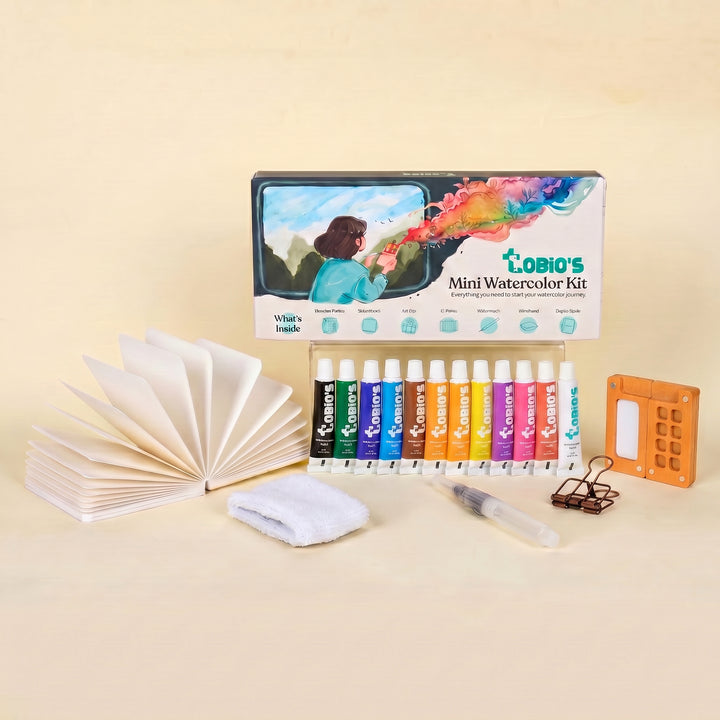
Tubes in a pocket-sized box
Twelve 8 ml tubes squeezed into a walnut palette, a refillable water brush and a 60-page cotton sketchbook, with a video guide. $36.
- 12 tubes, 8 ml each, in a 12-well walnut palette
- 60-page 300 gsm cotton sketchbook
- Refillable water brush, no cup needed
- Video guide included

4.75/5 from 7,300+ reviews


