


Watercolor Supplies for Beginners: Everything You Actually Need


What You'll Need
- Watercolor paint — a small student-grade set
- Watercolor paper — around 140 lb / 300 gsm
- One round brush — size 6 or 8 is plenty
- A palette — or even a ceramic plate
- Water — two jars, one to rinse and one clean
- Paper towel or wristband — for blotting
If you’ve ever Googled “watercolor supplies” you might have gotten a little surprise in terms of a 30-item shopping list. Masking fluids, sea sponges, 100-color palettes, and a gazillion brushes. Does it feel like you just received a massive load of homework? I thought so.
Here’s the truth from someone who knows a thing or two about watercolors and once spent all her savings on buying all of the stuff from this list (you should see my supplies closet): You need five or six things. Tops. The rest is stuff you can get later on. So no need to go crazy and buy everything you think you might need just because a list says so.
So who am I? I’m Mel and I’ve spent the past few years obsessing over painting with watercolors. I’ve also spent more time than I care to admit researching materials, read every blog post and watched every YouTube video I could find and visited craft stores… And by the time I had everything I thought I needed, I had no clue where to even start and it all felt a bit overwhelming.
Let’s keep things simple and manageable. Here’s what you need to get started without all of the extras, so you can start happy and not overwhelmed before you’ve even touched a brush.
The sections below explain each essential so you can buy with confidence, and at the end I’ll show you how to skip the shopping trip altogether with our all-in-one watercolor kit.
Paint: Pans vs Tubes, Student vs Artist Grade
Watercolor paint usually comes either in pans or in tubes. Pans are little dry blocks that you have to unwrap the first time you get them. They are already dry so you need to wet them with your brush.
Tubes are a moist paste, kind of like toothpaste. You squeeze it out and rewet with your brush. The paint may dry if you put it in a palette with little paint holes, and that’s the point. They dry much like the pans, and you just use a little water to use them.
Both are great for beginners, and the choice is more about how you like to work. Personally, I prefer tubes because you get a lot more paint so the value is great, and you really get more bang for your buck. Pans can run out much faster and it’s annoying having to reorder your favorite colors again. With the tubes, you just refill the little paint holes if they run out. Plus I love that the color is so easy to mix if you like to do washes of color.
Pans are a bit tidier though, before the tube paint has dried.
Another thing to keep in mind is student-grade pigments vs. artist-grade pigments. Artist-grade paint has more pigment and better lightfastness. That’s why it resists fading over years and might be better for pros. Student-grade is the best place to start, though. You get more paint for less money, so you can learn without spending a fortune. Most likely, you will not even notice the difference in the beginning.
Once you are ready to level up, you can always invest in an artist-grade set. But in the beginning, there is no rush, and quite frankly, it can be a bit of a waste of money.
Spend your energy painting, not agonizing over pigments. When you want to top up or level up, our 12 paint refills keep you going. The 50-color watercolor paint set gives you room to grow once you feel 100% ready.
Worth knowing if you’re painting with kids around: make sure the paints are safe and tested and suitable for ages 6+. They are certified by the ACMI (the Art & Creative Materials Institute). If you get your kit through Tobio’s, you can be sure the kit is fully certified.
Paper: The One Thing Worth the Money
Now paper is important. If you cheap out on this, the paper might be thin and flimsy and if you use any water on it, it will buckle. You’ll also get frustrated over how fast the paper gets fussy and pills. You don’t want to look at your painting and feel like you’ve just painted on a wet tissue.
Investing in high-quality paper will make it less frustrating and more enjoyable.
So what spec do you need to look for?
Here are three quick things I always look for in great paper. Cold-pressed paper has a light texture that is more forgiving and feels fantastic to work on. This is great for beginners. Hot-press paper is smooth and might be better if you want to create finer details at a later stage. For the weight, you want thick paper that holds the water. 140 lb (300 gsm) is the beginner default and it’s sturdy and durable. Finally, look for cotton paper since it handles water a lot better than wood-pulp cellulose.
At Tobio’s, you get the cotton paper workbook inside the all-in-one watercolor kit. This is exactly the kind of paper that holds up and has everything you should be looking for. When you want more pages you can add an extra sketchbook.
Brushes: You Only Need One to Start
Don’t get me started on the brush selections. I have a drawer full of brushes I never touch, all because it was on some list I found ages ago. What you need is one or maybe two brushes. A round and a flat brush. That’s it.
A round brush holds the water really well, and the point is perfect for when you want crisp details. It also spreads quite flat when you push it against the paper, so it’s also great for washes. Essentially, you get three brushes in one. Choose a medium size for the biggest versatility.
If you want a more portable solution, our kit comes with something called a water brush. You might have seen them before. You get one brush, and inside of the handle is a little water reservoir. You squeeze the handle gently, and the water comes out through the bristles. This is great for beginners, and you don’t need a water cup or a bottle of water. Apart from being very practical, it also makes it more portable. You don’t need to worry about spilling your water or having any leaks in your bag.
Our kit comes with this water brush, so it’s not something you need to purchase separately. You can also pick up spare brushes with the water brush set. When you want finer control later or if you want a more at-home setup and not as much paint-on-the-go, the artist brush set (12 pcs) gives you a great range of shapes and sizes.
The Extras: Palette, Water, and a Paper Towel
These are the easiest ones, and you can use things you have at home for this, if you don’t want to spend money. A palette is a surface to mix on. It doesn’t need to be anything fancy. You can use a little ceramic plate or similar.
For water, it’s nice to have two jars. One to rinse your brush in first to get rid of the paint, and then a second to get the brush even cleaner.
The last thing is something to wipe the brush on after dipping it in the water. You can use a paper towel, cloth or old rag.
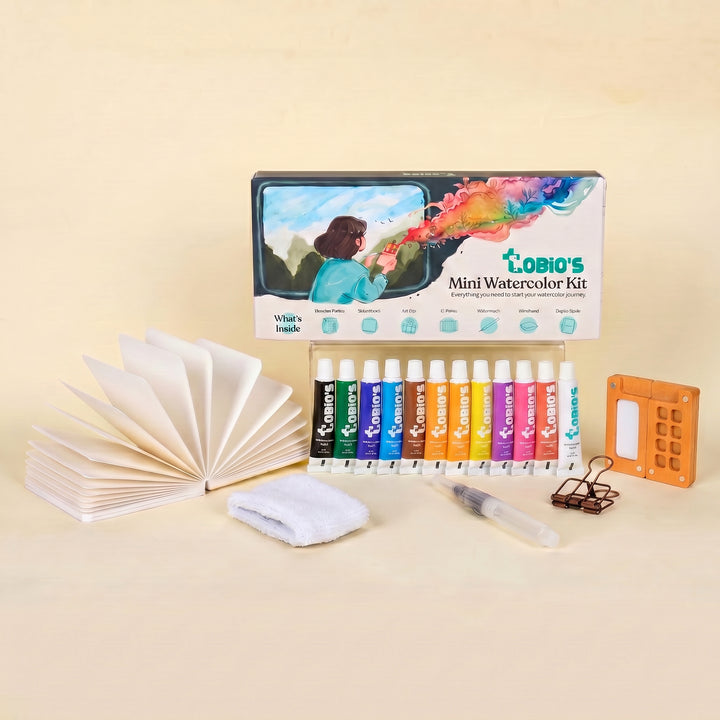
If you get our mini watercolor kit, all of these things are included. The palette is magnetic and has two halves. One side is for adding the paint colors, and the other has a little mixing area. The two halves come together with the magnets, so it stays shut during transportation. The material is walnut wood, so it will last, and it feels more luxurious and high quality.
Instead of the water cup, you get a water brush, which is so much easier for beginners.
As for the “something to wipe your brush on”, you get a wristband made from a towel-like fabric. This is perfect for when you paint on the go. You can hold the workbook in one hand, the brush in the other, and just wipe it on your wristband as you paint, without having to let go of anything.
But whether you invest in a kit like ours, or choose to DIY, these are simpler things to get.
Buy Separately vs One Kit: An Honest Comparison
Whether you prefer to research and source your own supplies, or you want to get everything in one single kit, it’s a personal choice. No answer is wrong here. Some people love the research part, and I get it. It can be part of the fun. But if you love the convenience and want to make sure you can just start painting from the moment you get the box, a kit is probably better for you.
Buying separately gives you total control, but buying a kit gives you full convenience. What I have noticed is that most of our customers that write to us are really happy that everything is already included, so that the process becomes much easier. You don’t need to think about which paint goes well on which paper, or which brushes are meant for watercolor and not oil or something else.
Here is the honest side-by-side:
- Paint — Separately: a student-grade pan or tube set, chosen from dozens of brands. One kit: 12 colors in tubes, already in the box.
- Paper — Separately: a cold-press pad, ideally cotton, 140 lb. One kit: a cotton notebook, 140 lb (300 GSM).
- Brush — Separately: at least one round brush, plus a water jar or two to rinse it. One kit: a refillable water brush (no cup or big brush set needed).
- Palette — Separately: a separate mixing palette or a spare ceramic plate. One kit: mixing wells built into the walnut wood palette.
- Time to decide — Separately: hours of comparing brands, specs, and reviews. One kit: none — it’s chosen for a beginner already.
- Cost — Separately: roughly $40–$100 once each item is added up. One kit: $34 for the all-in-one.
This is the gap our all-in-one watercolor kit was built to fill. You get all of the items listed. The walnut wood magnetic palette, the thick, high-quality cotton paper in 300 GSM, 12 vibrant paint colors that are easy to mix and beautifully pigmented and rich, a wristband to wipe excess water on, and even a manual and ebook with step-by-step instructions on how to get started.
Our paint is student-grade and beginner-focused on purpose. If you want maximum lightfastness or fine-detail control you’ll eventually want artist-grade tubes and traditional brushes.
For starting, and for spending time painting instead of googling, this is an epic choice. You can also browse watercolor kits to compare options.
A Note on Cost
Buying every little material separately almost always costs more than a starter kit. You’ll be paying for six things chosen individually instead of one set. We use high quality across all the supplies, but since it’s bundled into one amazing watercolor kit, it’s more affordable.
The all-in-one kit is currently $34, the 50-color paint set is $34, and the artist brush set is $21.99.
Start Painting, Not Shopping
I hope you feel by now that it’s not a matter of quantity but of quality. Rather spend a bit more on great paper than a set of 15 brushes, for example. One brush is plenty. Two is a luxury.
Give it a try first and see how you’ll fall in love with it. Learn and grow with it, and wait to upgrade the materials until you feel like it’s a must.
Whether you choose to DIY your supplies or get a ready kit is up to your preferences. Do whatever feels best to you. Just keep in mind that the price will be higher and you’ll spend significantly more time if you choose to pick and choose your own things.
If you would rather skip the shopping list, the all-in-one watercolor kit ($34) is the six-item list in one box. When you want to grow, the 50-color paint set ($34) and the artist brush set ($21.99) are waiting. You can also read the Tobio’s story if you want to know why a kit like this exists in the first place.
Frequently Asked Questions
What supplies do you need to start watercolor painting?
Only six little things are needed. You’ll need great paper, a set of paint, some brushes (at least one or two), a palette to mix on, some paper or a rag to blot on, and water. Student-grade paint and one brush are completely okay to start with. Everything else on the long shopping lists is optional and can wait until you’ve mastered the basics.
What is the best watercolor paper for beginners?
Cold-press paper around 140 lb (300 gsm) is the beginner default. The light texture is forgiving, and the weight is enough that it will not buckle when it gets wet. Cotton paper handles water better than cheaper cellulose, so choose cotton if you can.
Is student-grade or artist-grade watercolor better for beginners?
Student-grade is better for beginners, in my honest opinion. It costs less, so you can paint freely while you learn. Artist-grade has more pigment and better lightfastness. This makes it much more expensive. For a beginner that’s honestly an unnecessary cost, and the student-grade ones will give you better value for your money.
How much does it cost to start watercolor painting?
A beginner kit usually costs less than buying each piece on its own. Our all-in-one kit is $34. If you get your own supplies, the cost can easily be $40–$100 depending on what you choose.
Like these guides? Set Tobio's as a preferred source on Google and our pages will show up first when you search for watercolor questions.
More watercolor reads


Ready to start painting?
Everything on the six-item list in one beginner-friendly box: 12 student-grade paints, a water brush, a walnut palette, a wristband, and a 300gsm cotton workbook.
Get the Tobio’s Watercolor Kit


