


Emerald Green
Emerald green is a bright, clean, slightly blue-leaning green named after the gemstone. The original pigment was made with arsenic; the tube you buy today is not.
What color is emerald green?
| Hex | #50C878 |
| RGB | 80, 200, 120 |
| CMYK | 60, 0, 40, 22 |
| Warm or cool | Cool. It has more blue in it than yellow, which is why it reads as gemstone rather than grass. |
| On the wheel | A true green that tips toward blue rather than yellow. It sits between viridian and phthalo green on the cool side, a long way from olive and sap green. |
The story of emerald green
Most color names are dull. Emerald green has a body count.
The original pigment was invented in 1814 in Schweinfurt, Germany, by two chemists, Wilhelm Sattler and Friedrich Russ. They were trying to improve on Scheele's green, a copper arsenic pigment from 1775 that went dark whenever it met anything containing sulfur. Their version was brighter, more stable, and made from copper, vinegar and white arsenic. It went by half a dozen names: Schweinfurt green, Paris green, Veronese green, and emerald green, after the gem it resembled.
The Victorians loved it. It went into wallpaper, dress fabric, artificial flowers, even sweets. It was also, in the same decades, the most popular rat poison in Europe, which tells you everything. Factory workers who ground the powder got sick. People living in green-papered rooms got sick more slowly. There is a long-running theory that the arsenic wallpaper in Napoleon's bedroom on St Helena helped finish him off. It is unproven, and it is exactly the kind of story this pigment collects.

Painters used it anyway, because nothing else was that bright. Cezanne leaned on it. So did Van Gogh and Monet. Then the safer greens arrived, viridian first and phthalo green a century later, and emerald green was quietly pulled from artists' ranges in the early 1900s. It hung on as an insecticide until the 1960s.

What you buy today under the name is a recreation. Manufacturers mix a phthalo green with a little yellow, sometimes a touch of white, to hit the same hue without the poison. It is a better paint in every practical way. I still think it is worth knowing what the name used to mean, if only because it explains why every old painting manual tells you not to lick your brush.
Pigment facts
| Colour Index | Modern emerald greens are mixtures, usually PG7 (phthalo green, blue shade) or PG36 with a yellow such as PY3 or PY97, sometimes with a little white. The historical pigment was copper acetoarsenite and is no longer made. |
| Transparency | Transparent to semi-transparent in phthalo-based versions. The historical pigment was opaque. |
| Lightfastness | Excellent in modern versions. The historical arsenic pigment darkened whenever it met sulfur and was never reliable. |
| Granulation | Non-granulating. Phthalo greens dry smooth and even. |
| Staining | High. Phthalo-based greens stain paper fast, so lift while damp or not at all. |
| Toxicity | Non-toxic today. The original was a notorious poison, sold as rat killer and insecticide under the name Paris green. |
These describe the pigment in general. Every brand's tube behaves a little differently, so test yours on scrap paper.
How to mix emerald green
You cannot mix a phthalo green from scratch, but you can get to emerald from any decent blue-green plus a little yellow. Start with your greenest blue and add lemon yellow a fingernail at a time until it stops looking like the sea and starts looking like the stone. Go past that and you have spring green, which is a different thing.
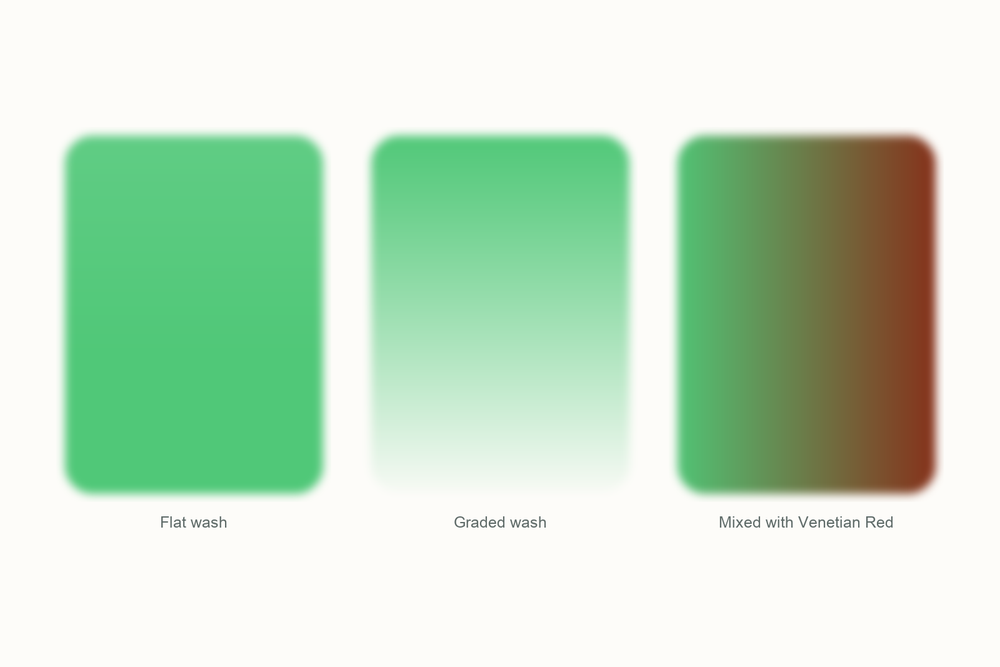
The real skill with emerald is taming it. Straight from the tube it is louder than anything in nature. A speck of its complement, a red or a red-brown, knocks it down to a leaf color you would actually see outside.
| Mix | Recipe | Best for |
|---|---|---|
| Emerald from a blue-green | Phthalo or Glacier Blue with lemon yellow, roughly 3 to 1, adjusted by eye | Gemstone accents, tropical water, holly, jewelry |
| Natural leaf green | Emerald with a speck of Venetian Red or burnt sienna | Foliage that looks real instead of neon |
| Deep forest | Emerald with a touch of Twilight Indigo | Pine shadows, deep water, dark hedges |
| Sea glass | Emerald with lots of water, or a touch of Titanium White for body | Backgrounds, pale pattern work, soft accents |
Closest mix from the Tobio's kit
Forest Green with Lemon Yellow, about two to one, then a touch of Glacier Blue to pull it back toward the gemstone side. Forest Green alone is too dark and too warm; the yellow lifts it and the blue cools it. Stop as soon as it looks like the stone rather than the lawn.
The 12-color kit does not include a tube of emerald green, so this is how I get there with what is in the palette. Running low on a color? The 12 paint refills drop straight into the wells.
Using emerald green in watercolor
Use emerald sparingly and it does a lot of work. A small emerald accent in a painting full of muted greens reads as jewelry: a beetle, a hummingbird's throat, sea glass, the highlight on a bottle. Fill a whole hillside with it and the painting looks like a sports drink.
Because the modern pigment is phthalo-based, a very little goes a long way. Mix it wetter than you think and add color slowly. It also stains, so decide where it goes before it goes there. Lifting it out afterward mostly does not work.
It pairs beautifully with its opposites. Emerald next to Venetian Red or Electric Rose vibrates in a way that makes both colors look more expensive. That is the trick behind every Christmas card ever printed, and it works in watercolor too.
One thing I learned the hard way: emerald dries slightly lighter and cooler than it looks wet. If a green needs to hold its punch, go one notch stronger than feels right.
Everything I use on this page is the Tobio's Watercolor Kit: twelve colors chosen to mix, a walnut palette, cotton paper, and a water brush. Want to see how any two of the colors blend before you commit? Try the interactive color mixing chart.
Get the kitEmerald green vs viridian (and phthalo green)
Viridian is the color that replaced emerald green in the 1800s, once people stopped wanting arsenic in their paint. It is a transparent, granulating, slightly bluer green, quieter and more sophisticated, and it is a genuine single pigment (PG18). Emerald is louder and flatter. If viridian is a forest at dusk, emerald is the same forest with the lights on.
Phthalo green (PG7) is what most modern emerald greens are actually built from. Straight phthalo is darker and bluer with enormous tinting strength; emerald is phthalo with the yellow and the lightness already added. If you own phthalo green and lemon yellow you can make your own emerald in about four seconds, which is why I would buy those two before I bought a tube of emerald.
Questions people ask
What color is emerald green?
What two colors make emerald green?
Is emerald green warm or cool?
Is emerald green paint toxic?
What is the difference between emerald green and viridian?
How do you tone down emerald green?
Sources
More color stories
