


Phthalo Green
Phthalo green is a deep, cool, blue-leaning green made from a chlorinated copper compound (PG7), with a yellower sibling (PG36). It is the strongest green in the paint box and the hardest to keep under control.
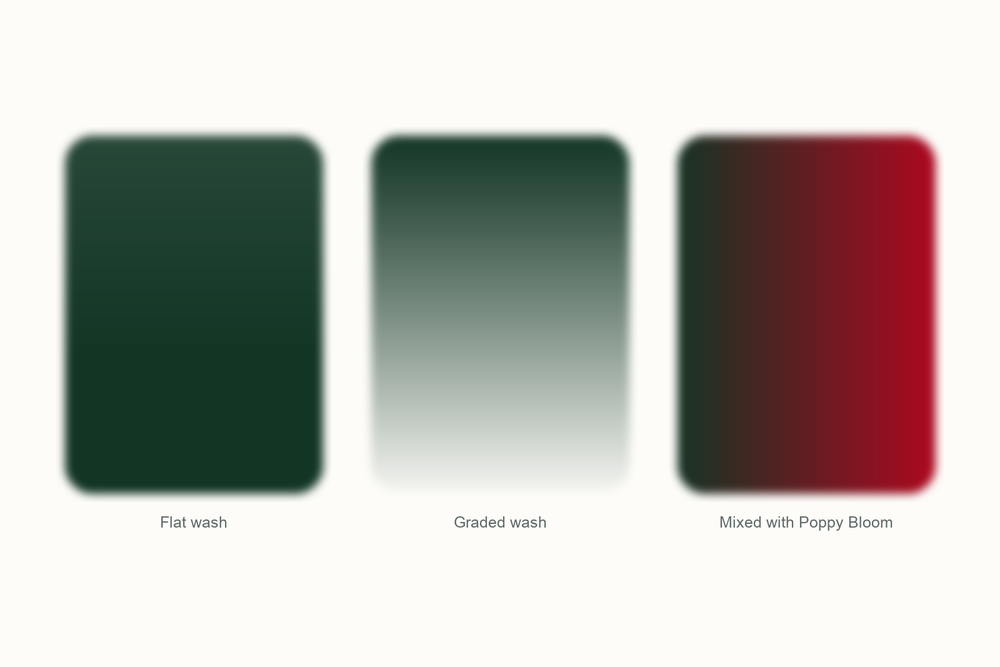
What color is phthalo green?
| Hex | #123524 |
| RGB | 18, 53, 36 |
| CMYK | 66, 0, 32, 79 |
| Warm or cool | Cool. PG7, the blue shade, is one of the coldest greens made. PG36 is warmer, but still cooler than any leaf you will meet outdoors. |
| On the wheel | A green pushed hard toward blue. It sits between viridian and teal on the cool side of the wheel, about as far from grass green as a green can get. |
The story of phthalo green
Every tube of phthalo green starts life as a tube of blue.
The blue was an accident, twice over. In 1927 two Swiss chemists, Henri de Diesbach and Edmond von der Weid, were trying to turn one compound into another and got an intensely blue by-product instead. Around the same time, workers at Scottish Dyes in Grangemouth kept finding traces of a blue dye when they made phthalimide in the presence of iron. It took until 1934 for Patrick Linstead to work out what the molecule was, and in 1935 ICI put the copper version on sale as Monastral blue. DuPont followed in the United States in 1937. It is still the highest-volume pigment made anywhere.
Chlorine turns the blue into the green. Copper phthalocyanine has sixteen hydrogen atoms around its rim. Treat it with chlorine, with aluminum chloride as a helper, and those hydrogens are swapped for chlorine one after another. Thirteen to fifteen of them in practice; the last one or two are stubborn. The color slides from blue to a deep blue-green, and that is PG7. Use bromine for part of the job instead and you get PG36, which comes out of the drum a yellower green. Commercial production of the green started in 1938.

Think about what a green was before that. For most of history a serious green meant copper. Malachite, a copper mineral dug from the ground and crushed to powder, went into paint from antiquity until about 1800; it was only moderately lightfast and it hated acids. Verdigris, the crust on old copper, was the other option. The 1800s added emerald green, a copper and arsenic compound that poisoned the people who made it, and viridian, which was safe but expensive. Phthalo green is a copper compound too. It is just the first one that did everything right.

What you buy today is PG7 or PG36, and it is sold under a ridiculous number of names. Some labels say phthalo green. Some use a house name the company invented. Some borrow an older name: viridian hue is phthalo, and most tubes labeled emerald green are phthalo with a yellow stirred in, because the real thing was arsenic (I told that story on the emerald green page). Read the small print for the pigment code.
Here is my problem with it. Phthalo green is so strong that a pinhead colors a whole wash, and it is a green that does not exist outdoors. Nothing that grows is that blue or that clean. Beginners love it for about a week, paint a lawn with it, and wonder why the lawn looks like a sports drink. Then they learn the trick, which is the rest of this page.
Pigment facts
| Colour Index | PG7 (Colour Index 74260): copper phthalocyanine with most of its hydrogen atoms swapped for chlorine. PG36 is the same molecule with some of the chlorine replaced by bromine, which nudges it toward yellow. Both are single synthetic pigments, not mixtures. |
| Transparency | Transparent. In a thin wash the paper glows through it. At full strength it is dark enough to pass for black. |
| Lightfastness | Excellent. It shrugs off light, heat, acids and alkalis, which is why the same pigment goes into printing ink and plastics. |
| Granulation | None. It dries flat and even with no texture at all. A blessing or a bore, depending on the painting. |
| Staining | Very high. It sinks into the paper fibers almost at once, and lifting a dried phthalo wash back to white does not happen. |
| Toxicity | Non-toxic in normal use. The pigment is permitted in cosmetics, though not around the eyes, and turns up in tattoo ink. Do not eat it anyway. |
These describe the pigment in general. Every brand's tube behaves a little differently, so test yours on scrap paper.
How to mix phthalo green
You cannot mix phthalo green from other colors, because nothing else on the palette is that clean. The pairing that matters is phthalo green with a red. A cool red like quinacridone rose (PV19), about half and half, gives a neutral gray that goes to a deep black with less water, and it is the best black I know. An earth red does something gentler: a speck of burnt sienna turns the neon into a believable leaf.
Rule of thumb: put the other color on the palette first and add phthalo to it, never the other way round. A brush that has touched phthalo will color the next three things you rinse it in.
| Mix | Recipe | Best for |
|---|---|---|
| Chromatic black | Phthalo green and quinacridone rose, about half and half, mixed thick | Deep shadows, night skies, the darkest dark |
| Believable leaf | Phthalo green with a speck of burnt sienna, then lemon yellow to taste | Foliage that looks like it grew outdoors |
| Deep water | Phthalo green with a little ultramarine and plenty of water | Lake depths, sea shadows, glass bottles |
| Pine at dusk | Phthalo green and Twilight Indigo, two to one | Conifers, hedges in shadow, distant woods |
| Cool gray | Phthalo green with Poppy Bloom, thinned right down | Shadows on snow, storm light, wet pavement |
Closest mix from the Tobio's kit
Forest Green with Glacier Blue, about two to one, is the closest thing to phthalo green in the kit. Forest Green brings the depth and Glacier Blue pushes it toward the cold, clean side where phthalo lives. If you need it darker, add a speck of Ivory Black rather than more paint. The mix will never have phthalo's staining strength, which is honestly the point. Test on scrap first and add water until it looks like a wet rock rather than a swimming pool.
The 12-color kit does not include a tube of phthalo green, so this is how I get there with what is in the palette. Running low on a color? The 12 paint refills drop straight into the wells.
Using phthalo green in watercolor
Use it where nature actually goes that dark and that cool: the depths of a lake, the shadow side of a pine, the glass of a bottle, a tropical sea in the last light. A tiny amount in a shadow mix cools it without turning it gray.
Glazing is where it earns its keep. Because it is transparent and does not granulate, a thin phthalo wash over a dried yellow gives a glowing green you cannot get by mixing the two on the palette. Let the yellow dry completely and do not go back in.
It pairs with its opposites. Poppy Bloom or Venetian Red next to phthalo green makes both look more expensive, and a touch of either mixed in makes the green believable.
One thing I learned the hard way: phthalo travels. A pan of it colors the water jar, the brush, the rag and the pans next to it. Keep it at the far end of the palette, rinse twice before you touch another color, and never let your favorite brush for pale washes anywhere near it.
Everything I use on this page is the Tobio's Watercolor Kit: twelve colors chosen to mix, a walnut palette, cotton paper, and a water brush. Want to see how any two of the colors blend before you commit? Try the interactive color mixing chart.
Get the kitPhthalo green vs viridian (and emerald green)
Viridian (PG18) is the green phthalo is most often mistaken for, and the hue is close. Everything else is different. Viridian is hydrated chromium oxide; it granulates gently, lifts off the paper, and has modest tinting strength. Phthalo is a copper compound that dries flat, stains, and takes over any mix it is invited into. A tube labeled viridian hue is phthalo in a costume.
Emerald green is the other confusion. The historical pigment was a copper arsenic compound and is no longer made; the modern tube is a mixture built on phthalo, with yellow and sometimes white added. So emerald is phthalo with the brightness already stirred in.
If viridian is a cello, phthalo green is the same note through a stadium speaker, and emerald green is the pop remix.
Questions people ask
What color is phthalo green?
Is phthalo green warm or cool?
What colors make phthalo green?
Is phthalo green toxic?
Phthalo green vs viridian, what is the difference?
Why does phthalo green look fake in a landscape, and how do I fix it?
Sources
More color stories
