


Peinture à l'aquarelle au sel : tutoriel étape par étape


What You'll Need
- Papier
- Pinceaux
- couleurs de peinture
- Palette
- verre d'eau
- crayon
Color Palette
Lorsque la plupart des gens recherchent une aquarelle au sel, ils recherchent cette astuce classique qui consiste à saupoudrer du sel de table sur de la peinture humide pour créer des textures de galaxie. Mais aujourd'hui ? Nous le prenons au pied de la lettre.
Nous effectuons une étude libre sur un carnet de croquis d'un véritable tas de sel. Il s'agit d'un exercice rapide et adapté aux débutants pour peindre des objets blancs et maîtriser l'espace négatif. Oubliez le ruban de masquage, les sèche-cheveux et les superpositions complexes. Nous allons capturer la géométrie glacée et cristalline du gros sel en moins de 15 minutes.
Les Fournitures (Restons Simples)
You do not need a massive studio setup for this. You just need tools that let the water do its job.
- Papier : 140 lb / 300 g/m² papier grain fin. The natural bumps in the cold press paper will actually help mimic the rough texture of the salt crystals!
- Pinceau : A single Size 6 or 8 Pinceau Rond.
- Peintures : See our specific minimalist palette below.
- Extras : A water cup, a paper towel, and a pencil.
La Palette de Couleurs
How do you paint a white object on white paper? You paint the shadows. Based on the carnet de croquis study above, we are using a cool, frosty palette of just three pigments:
- Gris de Payne: The absolute MVP for painting moody, realistic shadows on white objects.
- Bleu Céruléen: A tiny touch of this gives the salt a translucent, icy gleam instead of looking like dull gray rocks.
- Terre d'Ombre Brûlée: Mixed very lightly with Gris de Payne to create a warmer, grounding shadow at the very base of the pile.
Étape par étape : votre peinture à l'aquarelle au sel expressive
Le secret pour peindre des cristaux convaincants réside dans les bords durs et la préservation de votre espace blanc. Le papier intact est votre point fort ! Une fois que vous avez recouvert ces espaces blancs immaculés avec de la peinture, vous perdez à jamais cet éclat glacé et translucide. Résistez à l’envie de tout mélanger dans un dégradé doux et fluide. Pour une aquarelle réaliste au sel, un contraste net et des ombres confiantes et non mélangées sont vos meilleurs amis.

Le croquis déchiqueté

La sous-couche gelée

Tailler les cristaux

L'ombre de base
L'expression (définir le visage)
Foire Aux Questions
How do you paint a white salt peinture aquarelle?
The trick is that you aren't painting the white salt; you are painting the shadows on and around the salt. The bright white of your aquarelle paper acts as the actual salt crystals. By painting a cool gray (like Gris de Payne) in the crevices and adding a darker shadow underneath the pile, the unpainted paper suddenly looks like a 3D mound of salt.
Why did you use blue to paint salt?
Pure black or flat gray can look dead and heavy. Adding a tiny touch of Bleu Céruléen to your shadow mix gives the salt crystals an icy, translucent quality. It makes the pile look reflective and "crisp" rather than looking like a pile of dull gravel.
My salt pile looks like a soft gray blob. What went wrong?
You probably used too much water and blended your shadows too much. Salt crystals have hard, angular facets. You need to use less water on your brush and leave crisp, hard edges to your shadow shapes. If you over-blend, you lose the crystalline texture.
Do I need to draw every single grain of salt?
No! If you try to sketch every tiny grain, you'll go crazy, and the final painting will look overworked. Sketch the overall shape of the mound, and then just suggest a few larger, distinct square or jagged shapes near the edges. The brain will fill in the rest of the details.
Conclusion
La peinture à l'aquarelle au sel repose sur un timing contrôlé : peignez un lavis juteux, attendez le stade satiné, saupoudrez légèrement et laissez sécher complètement avant de brosser. Une fois que vous avez trouvé ce rythme, vous pouvez utiliser des textures salées pour les galaxies, la neige, l'écume de plage et les couches abstraites qui semblent bien plus compliquées qu'elles ne le sont.
Vous voulez plus de techniques étape par étape que vous pouvez réellement concrétiser dans de vrais projets ? Dirigez-vous vers les didacticiels d’aquarelle de Tobio, puis passez aux kits de Tobio's lorsque vous êtes prêt à vous approvisionner et à continuer à peindre.
Mel, Founder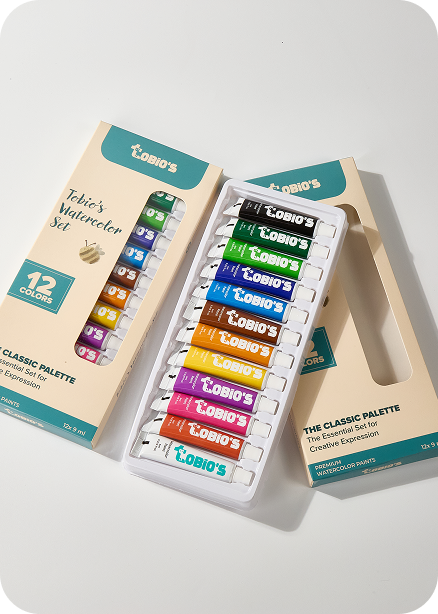
Prêt à peindre ?
Ce tutoriel a été conçu pour être utilisé avec notre kit aquarelle.
Acheter le kit


