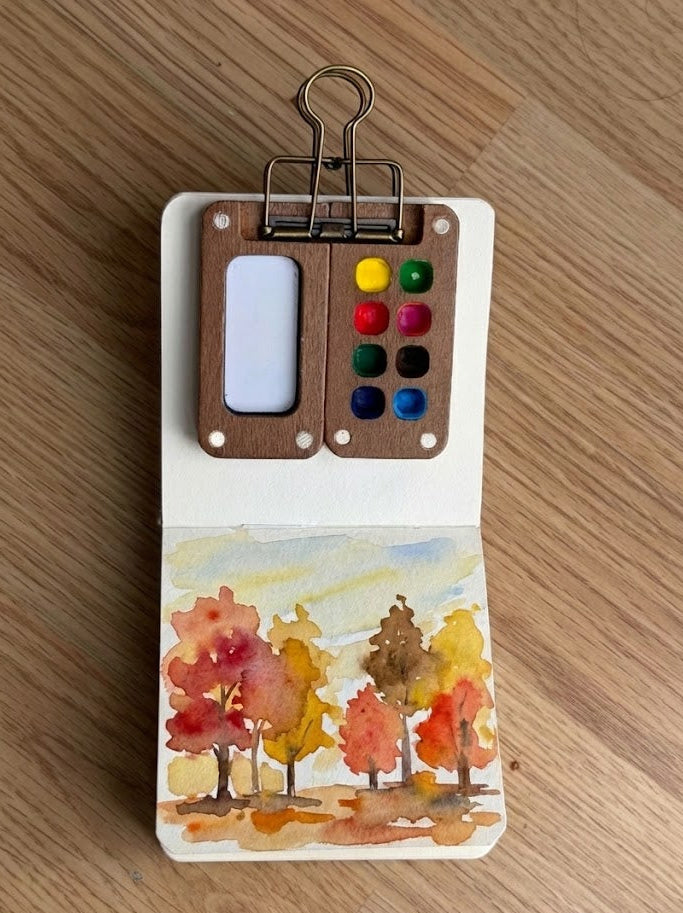
Look at the image above. Notice how the sky bleeds into the trees?
Notice how the edges aren't perfect? That is the goal.
While many tutorials for a fall watercolor painting focus on botanical precision, this guide is about capturing the mood of autumn. We are working in a "Loose Sketchbook Style." This means no masking tape, no complex tracing, and definitely no stressing over "blooms" or back-runs. In fact, we are going to do them on purpose.
If you want more projects like this after you finish, you can browse our full library of step-by-step lessons on Watercolor Tutorials.
The "Earthy" Color Palette
To get the look in the photo, you need to abandon bright, synthetic colors. We aren't using Lemon Yellow or Phthalo Blue here. We want earth tones that mix together to create that vintage, cozy vibe.
Based on our reference study, you only need 4 specific pigments:
- Yellow Ochre: This is that muted, mustard yellow seen in the sky and the foreground grass. It serves as the "light" in the painting.
- Burnt Sienna: The MVP of autumn. This is the rusty reddish-orange used for the main foliage and warmth.
- Sap Green: Used sparingly for the left tree and distant bushes. Tip: Mix a little Burnt Sienna into this to "muddy" it up so it looks like nature, not candy.
- Burnt Umber: For the dark tree trunks, deep shadows, and ground contrast.
The "Messy" Sky Wash
We are going to work Wet-on-Wet. Wet the top half of your paper with clean water, don't be afraid to be sloppy with the edges.
While the paper is wet, load your brush with watery Yellow Ochre and drop it in randomly. Immediately follow up with touches of diluted Burnt Sienna. Let the colors bleed and mix on the page. Tilt your sketchbook slightly to let gravity do the work.
The Soft Horizon
While the sky is still damp (not soaking, but cool to the touch), mix a creamy consistency of Sap Green and a touch of Burnt Sienna.
Paint the distant bushes across the middle of the page. Because the paper is still slightly damp, the tops of the bushes will blur softly into the sky, creating that foggy, distant autumn look.
The Foreground & Path
Rinse your brush. Load it with Yellow Ochre (cleaner this time). Paint the bottom half of the page using horizontal strokes. Leave some white gaps of paper showing through, this adds sparkle and suggests fallen leaves or light hitting the ground.
While this yellow wash is wet, drop in thick spots of Burnt Sienna and Burnt Umber in the bottom corners to create a sense of shadow and earth.
The Trees (Wet-on-Dry)
Mix Burnt Umber to get a dark, rich contrast. Holding your brush vertically, paint the tree trunks. Start from the bottom and flick upward to get thin branches.
Add the foliage on the main trees using a "scumbling" motion (pressing the side of the brush down) with thick Burnt Sienna (right tree) and Sap Green mixed with brown (left tree). Since the paper is dry now, these shapes will have harder edges, making them pop against the soft sky.
The "Sparkle" Details
Take your Burnt Umber and add quick, horizontal dashes across the foreground to suggest shadows on the path. Finally, dot your brush around the ground with Burnt Sienna to create the illusion of fallen leaves.
Done. Put the brush down. Overworking is the enemy of the loose style!
Style Variations: The "Late November," "Golden Hour," and "Folk Art Forest"
Want to change the vibe of your fall watercolor painting?
Try these quick sketchbook adaptations:
The "Late November" (Moody & Dramatic)
- Cool the palette: Swap your sunny Yellow Ochre for a heavier use of Sap Green mixed with Burnt Umber. Create a sky that feels heavy and overcast by using dirty water or a touch of grey in your wash.
- Deepen the woods: Paint the tree trunks much thicker and darker. Instead of a light wash, let the distant trees be a dark, solid mass of Burnt Umber to suggest a dense, wet forest.
- Lost edges: Let the bottom of the tree trunks bleed entirely into the foreground earth. We want it to look wet, muddy, and atmospheric, anchoring the scene in the heavy dampness of late autumn.
The "Golden Hour" (Soft & Glowing)
- Lighten the palette: Stick to highly watered-down Yellow Ochre and the palest wash of Burnt Sienna. Avoid the dark Umber almost entirely.
- Soften the landscape: Round out the jagged tree branches. Let the foliage be soft, blooming clouds of gold rather than distinct leafy shapes.
- The "Hazy" Texture: Skip the dry-brush texture on the ground. Keep the washes soaking wet and smooth to create that blinding, hazy light of an October sunset where everything blurs together.
The "Folk Art Forest" (Simplified for Cards & Patterns)
- Exaggerate shapes: Push the shape language into stylized, geometric blocks. Make the trees perfect circles or triangles, and the path a distinct winding ribbon.
- Bring back the ink: Lean into the illustrative vibe by using a waterproof pen to outline your trees after the paint dries. Add little "V" shapes for flying birds or distinct lines for grass.
- Flat color: Skip the beautiful, messy watercolor bleeds. Use flat, highly-pigmented washes of solid Burnt Sienna and Sap Green for a modern, graphic design feel perfect for Thanksgiving cards.
Inspiration: Why This Style Works
Nature Journals and Park Sketchbooks:
Capture the fleeting colors of the changing season while sitting on a park bench, without needing a focused studio setup or hours of time. You don’t need to paint every single leaf on the oak tree; you just need that warm, iconic Ochre-and-Sienna contrast and a loose hand to bring the crisp autumn air to life on the page.
Seasonal & Cozy Wall Decor:
Because autumn landscapes are naturally warm and inviting, a soft, loose study looks incredibly sophisticated in a hallway or above a mantle. Frame a lively, 15-minute piece like this for instant, seasonal wall art that feels organic and full of rustling movement, rather than stiff and "store-bought."
Frequently Asked Questions
My sky bled into the trees, did I ruin the painting?
No. We want that. In a loose fall watercolor painting, connected shapes create atmosphere. If every edge is perfect, it looks like a sticker book. Embrace the bleed; it looks like mist.
How do I stop my colors from turning into brown mud?
Stop mixing on your palette. Since we are using earth tones (Yellow Ochre and Burnt Sienna), they get dull if over-blended. Drop them wet-into-wet directly on the paper and let them mix there to keep the glow.
Why does my painting look flat halfway through?
You are missing the darks. A watercolor often looks messy until the final step. The "glow" only pops once you add the deep Burnt Umber tree trunks (Step 4) to create contrast against the light sky. Trust the process.
Artist Pro-Tip
"A fall watercolor painting doesn't require a botany degree or hours of waiting for layers to dry, just a willingness to let the water take control. By limiting your palette to earthy Ochres and Siennas, you capture the feeling of autumn without getting stuck in the details. Remember, in this loose style, the "mistakes" are what make it look real. So ditch the masking tape, trust your messy edges, and spend the next 15 minutes filling your sketchbook with the colors of the season."