


Panda Watercolor Painting: Step-by-Step Tutorial


What You'll Need
- Watercolor paper
- Pencil and eraser
- Two water cups
- Paper towel or clean cloth
- Round brush
- Washi tape
Color Palette
Let’s be honest: trying to paint a photorealistic panda usually results in a stressed-out artist and a painting that looks like a stuffed animal. Today, we are ditching the perfectionism.
We are focusing on a loose, expressive sketchbook study. If you look at the example image, you’ll see rough edges, water blooms, and quick gestures. This isn't about counting fur hairs; it’s about capturing the vibe of a panda in about 20 minutes.
In this tutorial, we will tackle this panda watercolor painting using a "wet-and-wild" approach that embraces accidents rather than fearing them.
If you want more projects like this after you finish, you can browse our full library of step-by-step lessons on Watercolor Tutorials.
The "Sketchbook" Color Palette
Based on our study image, we are keeping the colors minimal. You don't need a massive studio setup, just a small travel pan set will do.
- Lamp Black: For the deep, punchy darks of the ears and legs.
- Ultramarine Blue: To mix into the black for cool, shadowy greys and the background wash.
- Sap Green: For the loose bamboo shoots.
- Burnt Sienna: A tiny touch to warm up the black if it looks too "dead."
Materials Needed
- Paper: 140lb / 300gsm Cold Press. (The image shows a small sketchbook, which is perfect for this).
- Brushes: A Size 6 or 8 Round Brush. (We want a brush that holds water, no tiny detail brushes allowed until the very end!).
- The Basics: Water, paper towel, and a mechanical pencil.
- Clip: To hold your sketchbook open (as seen in the photo). No masking tape required. We want those raw, organic edges.

The "Bean" Sketch
Don't trace. It kills the energy. Look at the panda in the image, it's essentially a stack of marshmallows.
- Draw a loose circle for the head.
- Draw a larger, wider "bean" shape underneath for the body.
- Mark two tilted ovals for the eye patches and round triangles for the ears.
- Tip: Keep your pencil loose. If the lines show through later, it just adds to the artistic character.

The Fur (Let it Bleed!)
We are going to paint the dark limbs first. Load your brush with Lamp Black (mix in a touch of Blue if you want that cool grey look).
- Paint the ears and the legs/arms.
- The trick: Do not make the edges perfect. While the paint is wet, touch the edge of the black shape with a clean, slightly damp brush to pull the color out.
- Let the black bleed slightly into the white belly area. This creates that fluffy, soft texture without drawing individual hairs.

The Face & "The Bloom"
This is the most crucial part of your panda watercolor painting.
- Paint the eye patches with a medium-strength grey (water down your black).
- While the patches are still wet, drop a tiny dot of pure, thick Black into the center. Watch it explode outward. This creates depth naturally.
- Leave a tiny white speck of paper dry for the sparkle in the eye.
- Paint the nose with a quick triangular dab.

The "Salt & Pepper" Texture
In the reference image, the panda’s belly isn't pure white, it has texture.
- Take your dirty rinse water (yes, really) and glaze a very faint shadow under the chin.
- If you want that "cauliflower" texture seen on the panda's right shoulder, drop a bead of clean water into the drying black paint and let it push the pigment away.

The Face and The Bamboo
Finish with the character details.
Drop in your darkest black mix for the nose and the deep centers of the eyes, that contrast is crucial.
Swipe a watery green for the bamboo, letting it touch the fur so the panda feels in the scene, not just pasted on top.
Stop.
Put the brush down.
Overworking turns a fluffy panda into a muddy rock.
Style Variations: Red, Sleeping, and Kids’ Version
Red Panda (The Colorful Cousin)
- Swap your Lamp Black for Burnt Sienna mixed with a touch of Orange.
- Emphasize the fluffy, ringed tail (this is the fun part).
- Add white face markings by leaving the paper dry, don't paint white over the red.
Sleeping Giant (The "Bean" Pose)
- Let the head and body merge into one big, comfortable shape.
- Use curved lines for closed eyes instead of detailed pupils.
- Paint the black limbs loosely, letting them bleed into the shadow underneath so the panda looks heavy and relaxed.
Kids’ Quick Version (10 to 20 minutes)
- Make the head and eye patches bigger and rounder.
- Use one flat black (no fancy mixing) and one bright color for a background bamboo stalk.
- Skip the fur texture and go straight to "cute."
Inspiration: Why This Style Works
This loose, sketchbook approach is perfect for:
Zoo Field Trips
Capture the vibe of a day out without needing the animals to wake up. Pandas spend 90% of their time sleeping, making them the perfect model for a quick, 15-minute study while you eat your lunch.
Minimalist Nursery Decor
Frame two or three of these simple black-and-white studies in light wood. The high contrast is great for babies, and the loose style feels handmade and cozy rather than mass-produced.
The Ultimate Contrast Practice
A panda watercolor painting is the best way to practice value without getting overwhelmed by color theory. Because it is strictly black and white, you can focus entirely on water control and "saving your whites" without worrying about muddy colors.
Frequently Asked Questions
How do I start a panda watercolor painting without it looking like a blob?
Think "marshmallows," not anatomy. Start with a loose circle for the head and a larger "bean" shape for the body. The trick is to leave the white paper dry for the face and belly, if you paint over the white, you lose the panda.
My black paint looks flat and boring. How do I fix it?
Tube black can look dead on the page. To make your darks vibrate, mix a tiny touch of Ultramarine Blue (for cool shadows) or Burnt Sienna (for warm fur) into your black paint. This creates a "chromatic black" that has depth and life.
How do I get that fluffy fur texture without drawing every hair?
Let the water do the work. While your black paint is still wet on the ears or legs, touch the very edge with a clean, slightly damp brush. The water will bleed outward, creating a soft, fuzzy edge naturally, no tiny brushstrokes required.
Conclusion
The secret to expressive panda watercolor paintings isn’t precision, it’s knowing when to stop. A loose sketch breathes because of the imperfections, not in spite of them.
Embrace the blooms, leave your wonky pencil lines visible, and trust that a dynamic bleed of Lamp Black looks more alive than a perfectly painted hair.
If you want to keep the momentum going with guided projects and less supply guesswork, head over to Tobio’s Kits and pick a kit that makes painting feel like a break, not a battle.
Mel, Founder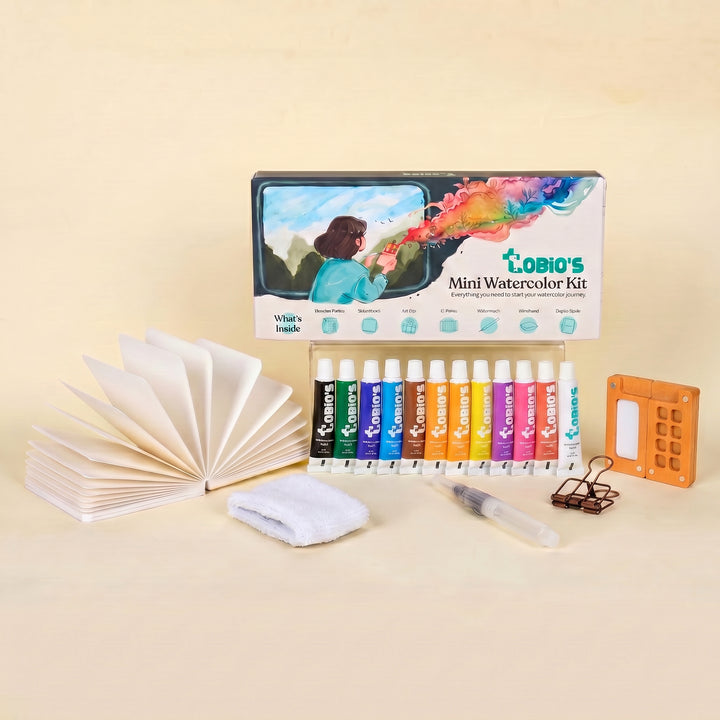
Ready to Paint?
This tutorial was designed for use with our Watercolor Kit.
Link to the link


